3 months ago
109
3 months ago
109
Miuccia Prada and Raf Simons, the co-designers of Prada, said backstage at Milan fashion week that fashion’s greatest challenges were inequality and artificial intelligence.
An interesting perspective, since Mark Zuckerberg, the billionaire owner of Meta, and his wife, Priscilla Chan, sat next to Lorenzo Bertelli, Prada’s husband, in the front row.
There are reports that Meta is collaborating with Prada on “smart glasses” with integrated camera, processing and voice assistant functions.
Prada said of the diplomatic demands of her job: “We are a company that makes expensive clothes for rich people. So I try to be political, but I can’t be obvious.”
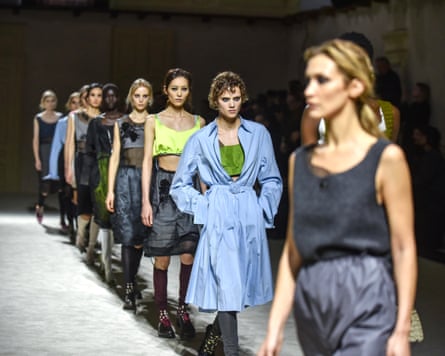
Simons, meanwhile, said the colourful scarf worn by the first model was a reference to the Pride flag, under attack as conservatism returns to politics, but mostly the design duo confined themselves after the show to expansive but inoffensive remarks about democratic dressing, and clothes without hierarchy.
Instead of 60 outfits on 60 models, 15 women each walked four times in a slightly different version of the same outfit – changing a jacket, stripping off a layer, re-wrapping a scarf.
The vibe was Prada boiled down to concentrate – boxy jackets, knee-length skirts, socks with kitten heels, grey with jewel colours – but relatable.
“It’s about life, and how you dress each day with the clothes you have,” said Simons. “About real, human people.”
Milan is currently in the unusual position of being a beacon of female leadership in fashion. Miuccia Prada’s taste has set the style weather for decades, and she looms larger than ever.
Prada recently bought the house of Versace for $1.4bn (£1bn), and Miuccia Prada is known to be taking a keen interest in its future.
She is close to Donatella Versace, who has departed the design studio to become chief brand ambassador, and is said to have personally phoned Versace’s incoming designer, Pieter Mulier, to offer him the role.
Along with debuts by Maria Grazia Chiuri at Fendi and Meryll Rogge at Marni, the Emporio Armani show saw a catwalk bow by a female Armani - Silvana, niece of the late designer Giorgio.
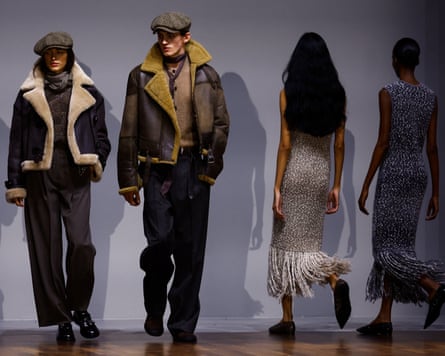
First clues as to what Armani looks like without Giorgio Armani were revealed as the two appointed heirs to the late designer showed their first joint collection.
Under the late designer’s succession plan, womenswear is now overseen by his niece Silvana, while menswear has passed to Leo Dell’Orco, his life partner and right-hand man.
This is a very Armani changing of the guard: subtle and understated. Both the new designers have been at the heart of the Armani studio for four decades. Their appointments made it clear that the founder, who had no children of his own, nonetheless saw his empire as a dynasty.
Dell’Orco’s closest collaborator is his nephew, Gianluca, who is now head of Armani’s menswear style office.
Change is coming for Armani down the line. The designer’s will stipulated a sale of 15% of the company to occur within 18 months of his death, and any new partner will expect creative input. But until then, Silvana Armani and Leo Dell’Orco are putting continuity first.
This collection was based on the tailoring that Armani invented, with draping and wrap silhouettes borrowed from Japanese construction to soften traditional Italian lines.
Silvana Armani said she wanted to keep “deeply rooted values” but to bring a female perspective. “My uncle tended to add embellishments, perhaps to make an outfit feel more ‘feminine’”, she said. So this season, fewer jangly earrings and dinky hats.
At Max Mara, designer Ian Griffiths was inspired by Sutton Hoo – although not a mainstay of fashion moodboards, a visit to the Anglo-Saxon burial site, close to the designer’s Suffolk home, started him thinking about “objects which get more beautiful with time”.
Max Mara coats, for instance. “They are lifelong companions, and they grow old gracefully, as all of us hope to.”
Those plush, generous coats that are the brand’s hardy perennial were the storyline of the collection, with over-the-knee boots, falconer gloves, a lot of suede and minimal modern hardware adding medieval plot points along the way.