3 months ago
160
3 months ago
160
The excitement around Christopher Nolan’s forthcoming film of the Odyssey has been taken up a notch this week with the launch of a new trailer and the director appearing on Stephen Colbert’s US chatshow to give a rare interview.
With fresh information emerging about the film, which is scheduled to be released on 17 July, it’s worth taking stock of what we know about Nolan’s adaptation of Homer’s ancient Greek epic, starring Matt Damon as Odysseus. And how faithful to the original poem is it likely to be?
Details of the film have been emerging slowly over the past 10 months since a teaser was shown in cinemas before screenings of Jurassic World Rebirth in July. A six-minute “prologue” had a similar cinematic release in December and was closely followed by a trailer launched online just before Christmas. More footage was shown by Nolan at the CinemaCon trade show last month before the new trailer went up online this week.
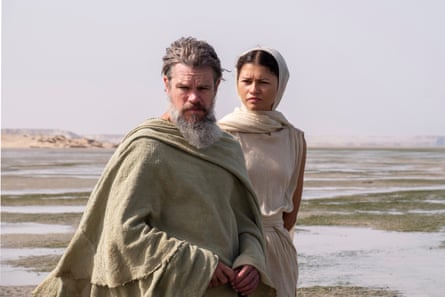
So we know that many of the Odyssey’s most celebrated characters and scenes are going to feature in the film: the trailers show us glimpses of the Cyclops, the whirlpool Charybdis and Odysseus summoning the spirits of the dead. The crisis on Odysseus’ home island of Ithaca is depicted in the latest trailer, with Robert Pattinson in arch-villainous form as Antinous, the most odious of the suitors who are laying claim to Odysseus’ wife, Penelope (Anne Hathaway), and tormenting his son, Telemachus (Tom Holland).
Nolan has been unable to resist including the famous wooden horse, the ruse devised by Odysseus to enable the Greeks to break into Troy, which features in the first trailer as well as being the subject of December’s prologue.
Homer does not in fact tell the story of the horse in the Odyssey, but it is alluded to: Odysseus asks a bard to recount the tale and the Spartan king Menelaus mentions it when Telemachus visits him to ask for news of his father.
We have yet to see how Nolan depicts the sorceress Circe turning men into pigs and back again, or hear how composer Ludwig Göransson will make the Sirens sound. But it looks as if most if not all of the Odyssey’s greatest hits will be brought to life on screen, with even Odysseus’ dog, Argos, making it into the new trailer.
Nolan – who has become Hollywood’s leading maker of cerebral spectaculars since helming the Dark Knight trilogy – is a natural fit for the Odyssey, with its vast canvas and timeless themes of family ties, homecoming and revenge.
“You’re always looking for something that hasn’t been done before,” Nolan told Colbert on Monday night, explaining what drew him to the project. “And Greek mythology … hadn’t really been done on a kind of A-budget, big studio, throw everything at the screen and see what sticks kind of way … It’s just one of the great adventure stories and I really wanted to see it done justice.”
It is perhaps surprising that the Odyssey has not been given a definitive cinematic treatment before. The epic boom of the 1950s and 1960s took inspiration from the Bible and ancient Rome rather than Greek myth, although there is a rather lightweight Italian “peplum” film of the Odyssey from that time: Ulysses (1954) starring Kirk Douglas. Last year’s The Return, with Ralph Fiennes and Juliette Binoche, concentrated on the latter part of the Odyssey, in which Odysseus plots his revenge on the suitors, and omitted the most colourful material. The richest screen versions of the story have been for TV: an eight-part Italian TV series from 1968 and a 1997 mini-series starring Armand Assante and Greta Scacchi.
Nolan’s interest in the Odyssey can in fact be traced back to the last major film that adapted Homer: Wolfgang Petersen’s Troy (2004), which dramatised – and took major liberties with – Homer’s earlier epic, the Iliad.
Nolan was lined up to replace Petersen when the German director turned his attention to developing a Batman v Superman film; when that project fell through, Petersen returned to Troy. Nolan’s consolation prize for being stood down was to work on Batman Begins, the stunningly successful superhero reboot that would propel him into the major league of Hollywood directors and cement his reputation as a blockbuster auteur.
But Nolan never lost his desire to make a Greek epic. “It was a world I was very interested to explore,” he told Empire last year. “So it’s been at the back of my mind for a very long time. Certain images, particularly. How I wanted to handle the Trojan horse, things like that.”
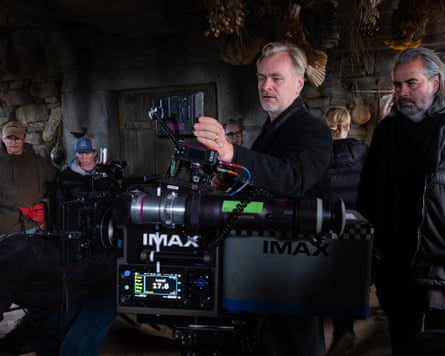
One aspect of the Odyssey that must have appealed to Nolan is its narrative complexity, remarkable in such an early piece of literature. “It’s the original non-linear narrative,” as Nolan observed to Colbert. The director has relished this approach to storytelling right from his accomplished low-budget debut Following, making striking use of it in his breakthrough film Memento (2000). A fascination with the science of time underpins the head-spinning plot manoeuvres of Inception, Interstellar and Tenet.
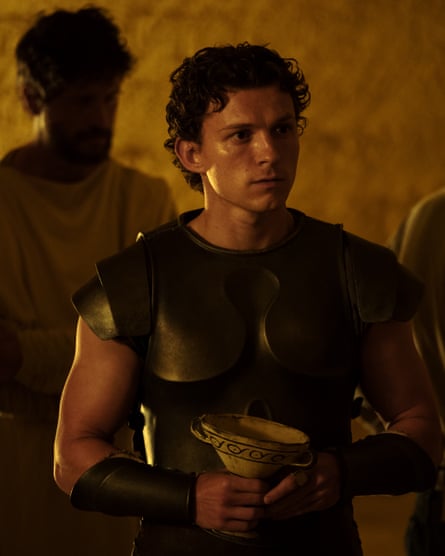
The poem doesn’t do wormholes or inverted chronology, but it does have multiple narrative strands, and at one point alternates between the stories of Odysseus and Telemachus in a technique that anticipates cross-cutting. Many of the most famous episodes – Odysseus’ encounters with the Cyclops and Circe, his meetings with the spirits of his old comrades and his brushes with the Sirens, Scylla and Charybdis – are told in flashback, by Odysseus himself, when he is a guest of the Phaeacians. Other stories are told as anecdotes or digressions.
Nolan has confirmed that the film’s action will start in Ithaca, without Odysseus, as it does in the poem. In another sign that he has striven to be faithful to the original text, he seems to have retained the involvement of the gods, with Zendaya reported to be playing Athena, who has a crucial role in the poem as Odysseus and Telemachus’ patron and helper.
When asked by Colbert whether his film contained any gods, Nolan would not answer directly but hinted that it would reflect the Odyssey’s divine dimension: “This is a world where people saw gods in everything, everywhere – so the thunder, the tides coming in, the wind blowing. That’s all evidence of divinity that they’re surrounded by, so what we’re trying to do is take the audience and put them in that world and put them in that mindset.”
Modern adaptations of the Homeric poems have struggled with the idea that the gods intervene directly in human affairs, appearing as themselves or in disguise. Petersen’s Troy dispensed with them, as did The Return, but they are an essential element of the original works.
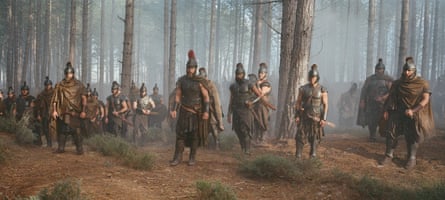
Whether Nolan will include some of the more troubling aspects of the Odyssey may depend on how far his own taste for complexity goes and what distributor Universal is prepared to tolerate in a mainstream release. Will we see Odysseus having sex with Circe and Calypso, as he does in the poem? Will the topic of slavery be addressed? Many of the poem’s servant characters – the nurse Eurycleia and the swineherd Eumaeus, for instance – are enslaved workers. The palace civilisation depicted in the Odyssey relied on human trafficking and forced labour.
Will all the suitors be butchered? Will there be sympathy shown for any of them? Homer’s portrait has some nuance, but it does not save any of them from a violent death.
And most contentiously of all, will Nolan show the 12 enslaved women who had sexual liaisons with the suitors, possibly against their will (the text is vague on this), being put to death by Telemachus? The presence in the reported cast list of one such disloyal character, Melantho – played by Mia Goth – suggests this is possible, if unlikely (previous adaptations have not gone there).
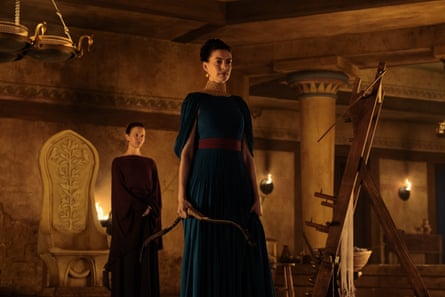
That deeply unsettling episode provides one of the Odyssey’s unforgettable images, when Homer mentions how the hanged women “struggled with their feet for a little while, but not for long”.
This kind of attention to visual detail demonstrates how Homer’s work could translate so well into film. Another wonderfully vivid moment is when six of Odysseus’ colleagues are snatched from their ship by the monstrous Scylla. “I saw above me their hands and feet as they were lifted up,” Odysseus recalls, a word-picture that automatically suggests a point-of-view shot for a future film director. As Scylla eats the men, Odysseus hears them shrieking and sees them stretching their hands out to him. It will be fascinating to see what Nolan makes of this and many other extraordinary moments.