3 months ago
213
3 months ago
213
Wrapped in a vast white sheet, Rosalía is telling the audience a story about her youthful dreams of performing in London, undaunted by the fact that her English is, as she puts it “a little bit rat-a-tah”. It turns out her real ambition was to sing at the Royal Albert Hall – “which I’ve never done” – but no matter: “I have sold out two nights at the O2!” she cries triumphantly. “Crazy, crazy,” she adds, shaking her head.
You can understand the Catalan singer’s surprise. We are supposed to live in a hopelessly risk-averse era for pop, where what audiences are deemed to want is more of the same. While you might have expected her fourth album, Lux, to be greeted with critical hosannahs, the fact that she’s managed to fill one of the UK’s biggest venues twice off the back of a song cycle based on the lives of various female saints, sung in 13 different languages, and set to music that conjoined lavish orchestration with leftfield electronica – and provoked a debate about whether the results should be filed under classical rather than pop – seems pretty improbable.
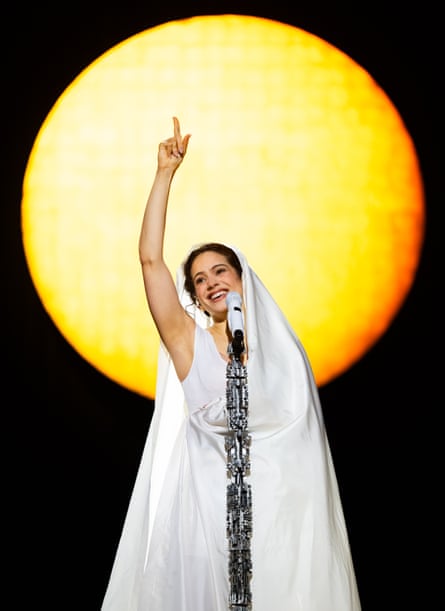
And yet the place is packed, with an audience noticeably older – and, it has to be said, more audibly Spanish – than you’d get at your average arena-sized pop extravaganza, although just as prone to pop fan behaviour: there are a lot of people who’ve referenced both Rosalía’s nationality and Lux’s religious theme by accessorising their outfits with mantillas, just as Gracie Abrams stans show their devotion by arriving at her gigs wearing the singer’s trademark bow in their hair.
If it all feels a little unexpected given Lux’s challenging contents, their devotion starts making sense the minute Rosalía appears, from within a giant wooden box, dressed as a ballerina, with the lyrics to her songs surtitled in English above the stage. It turns out she can sing while en pointe, which is no mean feat, but more striking still is how extraordinary she sounds. What’s happening is beautifully staged and frequently seems to have been choreographed down to the last muscle twitch: her performance of La Perla, on a blacked-out stage, with her dancers’ white-gloved hands alternately covering her bottom half like a dress or forming a frame around her, is both visually stunning, and weirdly simple, devoid of the kind of hi-tech effects on which pop shows rely.
It’s remarkably visceral experience, partly down to the fact that the disruptive electronic elements of the songs’ arrangements bombard the audience at astonishing volume – you can literally feel them in your ribcage – but mostly down to Rosalía’s voice. It’s not so much her way with an operatic flourish or ability to hit a high B flat, impressive though that is, but how emotionally powerful her vocals are: all the virtuosity in the world can’t account for her ability to break your heart with the fragility of Divinize or to send it soaring with the climax of Mio Cristo Piange Diamanti.
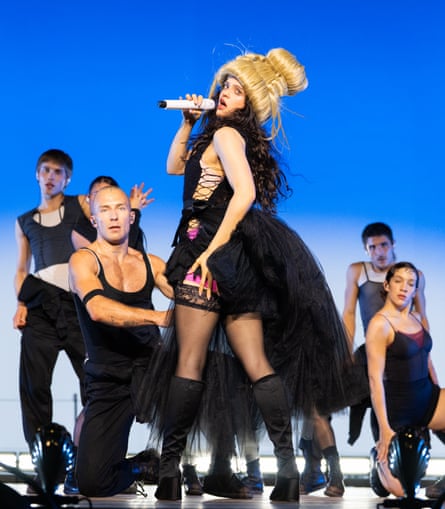
With its references to 10th-century saints and 20th century philosopher Simone Weil, Lux was an album that invited people to take it very seriously indeed – critics were only too happy to oblige – but the show itself is far wittier and more entertaining than you might expect, given the furrowed-brow reception it provoked. Between songs, Rosalía cuts a noticeably funnier and more raucous figure than the woman earnestly quoting Roland Barthes to interviewers: she demands the crowd stop being so reverential, guzzles a glass of wine before Sauvignon Blanc, attempts a British accent, and dances when she shifts into songs from 2022’s reggaeton-fuelled Motomami.. Lola Young makes a guest appearance, not to sing, but to appear in a mock-confessional, telling Rosalía an extended story about sleeping with a man she subsequently discovered was married with a child (“what a piece of shit,” nods Rosalía sympathetically); there’s a section where cameras alight on audience members, who are then encouraged to pose in the style of a succession of celebrated paintings (you’ll have to take my word for it that seeing someone attempt to imitate the posture of the model in Rossetti’s Beata Beatrix is a lot funnier in real life than it looks on paper).
Funny, intelligent, musically adventurous, visually stunning, emotionally impactful: Rosalia’s live show is a triomf, as they say back in Barcelona. It’s also incredibly heartening that it’s playing the world’s arenas: evidence both that pop fans are nowhere near as dumb as they’re frequently taken for, and that the woman at its centre is a pop star entirely unlike anyone else.