4 hours ago
10
4 hours ago
10
‘We are living through a moment of hellish, mindless destruction,” Caragh Thuring tells me, shortly after offering me a cup of tea and a chocolate chip biscuit. We are sitting in the artist’s east London studio, surrounded by paintings, magazine cuttings and cryptic handwritten notes (“AWARENESS, TESTING”). There are metal racks littered with crumpled tubes of paint and bookshelves lined with artists’ monographs. “Making paintings at this moment is, on the one hand, total folly,” she admits. “On the other hand, it is utterly rebellious.”
Before us is a painting, around seven feet high and five wide, in which the shadowy silhouettes of US military airplanes are flanked by densely packed clusters of bombs. The tapering body of one plane transfigures into the effigy of a knight laid out on a table tomb, one hand clasped to the hilt of a sword, jointed greaves poking out from beneath the wing of a B-52. The confusion of medieval and contemporary imagery, religious art and martial technology, eternal peace and endless war, is bewildering.
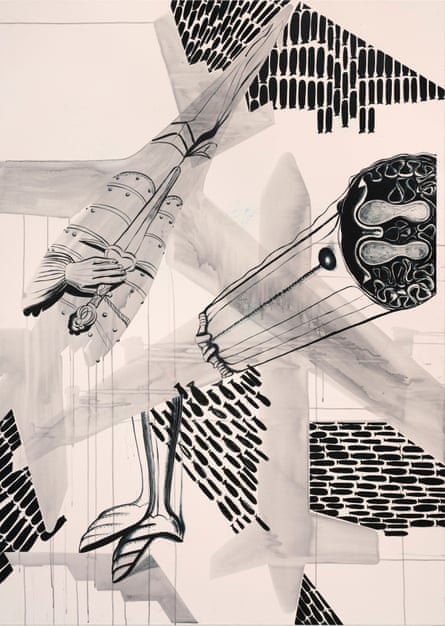
For the past 25 years, Thuring has been making paintings in which submarines glide, volcanoes brood, windows proliferate, tartans pattern and brick walls run through dreamlike spaces. She moves fluidly between styles but returns to the same motifs, creating images that are complexly layered and dizzyingly miscellaneous. That these pictures are so lively and open-ended might in part be due to the fact that she does not make preparatory drawings. Rather than executing a pre-existing plan, they document the movement of her imagination: “There’s the idea,” she says, “and then there is what actually happens when you are painting.”
We look together at The Annunciation. This hot pink mess of a picture breaks every rule in the long tradition of painting the Virgin’s conception: rather than receive the angel Gabriel at a seemly distance, one of two Marys kneels perilously (blasphemously?) close to the spray of lilies that he carries at his crotch; leaves or notes fall through the room like the golden rain into which Zeus transformed in order to impregnate Danaë (another of Thuring’s motifs); phallic pink cacti thrust in from the edges of the scene. Its mishmash of styles and registers is at once irreverent, witty and subversive. You suspect that Thuring likes to stir things up.
The artist is herself a patchwork of interlinking stories. Born in Brussels, to parents of Scottish, Dutch and French descent, she moved to west Scotland as a child. Living on the shores of Holy Loch, she watched nuclear submarines glide through the Firth of Clyde and newly constructed oil rigs being towed across it to the North Sea. She talks fondly of the industrial architectures of Glasgow, has visited volcanoes (another recurring image) from Þríhnúkagígur to Vesuvius, but it is London that best suits her. “My parents met here, despite being from different countries, so it feels like home.” Her description of the city might easily be applied to her paintings. “London is so chaotic, it’s like there’s no system to it. It’s the most radical city. It has this ability to reconstruct itself.” A living thing held together by its own restless energies, rather than dictated by central planning.
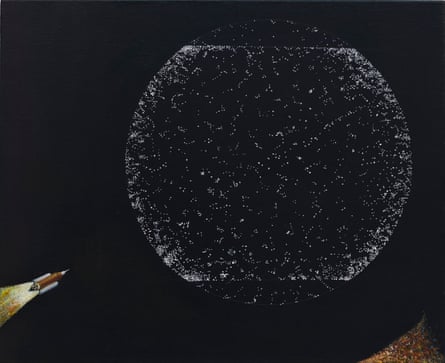
We turn to a smaller, atypically sci-fi painting set in outer space. A constellation of pointed lights is revealed by the title, Starlink, to be a map of the thousands of Elon Musk’s satellites now encircling the globe, swaddling us in broadband and occluding the night skies. After the Annunciation, the rocket streaking towards that glowing sphere suggests a spermatozoon rushing to fertilise an egg (these are the strange connections that jump across Thuring’s paintings, once you spend any time with them). Certainly, the intervention in human affairs of some transcendent power is a theme of her work: a nuclear submarine surfacing, a god breaking into a woman’s bedroom, a volcano erupting. A world about to change.
In their destabilising effects, Thuring’s paintings are more like poetry than prose. Rather than tell a story or illustrate a theory, they create a space in which different images meet. The viewer must bring their own imagination to the task of joining the dots between them, because Thuring will not do it for you. “People want a clear explanation,” she laments. “These paintings do not do that. And I do not want them to do that.” If her unwillingness to deliver a simple message is something like an ethical principle, it also leaves open the possibility that her intentions will be misunderstood. “People will read it their own way. They might think it’s superficial, or that I’m being flippant. That’s the risk you take.” She shrugs when I ask whether she finds that frustrating. “That’s not my problem.”
Thuring’s paintings flit between the mundane and the cosmic. World Trade is based on a photograph sent to her by a friend because, she tells me with a laugh, it reminded them of her work. It shows a corner of a nondescript office, distinguished only by a threadbare check carpet and two twists of electric cable. We could be anywhere in the world, if the title didn’t tell us that we are looking at history. The effect is to remind us that before the twin towers were symbols of civilisational conflict and ideological terror, they were places in which people went about their ordinary lives in unlovely offices, just like the rest of us. There is a sharp and tender shock in this, made more effective by its reluctance to sensationalise the loss that it memorialises.
No part of the world, after all, is more significant than any other. “I’m trying to be curious,” says Thuring, “like a kid mucking around on the pavement, poking around in the dirt. I might see a weed, pull it up, and suddenly everything opens up. You can look at a centimetre of ground and see the whole planet.” And so this new body of work links (in my mind at least) a shabby office space to the wars in the Middle East, the medieval crusades, the colonisation of other planets, the threat of nuclear war, the powerlessness of humans in the face of nature. If you look hard enough at the world around you, or look long enough at Thuring’s paintings, you cannot help but see the threads that connect each thing to every other.
If Thuring is in rebellion against anything, it might be that particular (and presently popular) mixture of stupidity and hubris that allows one to believe that one’s own perspective on the world is the only correct one. No one of that persuasion can gain anything from these paintings (or, while we’re here, from any art that doesn’t reinforce their existing prejudices). They require you to think in unfamiliar ways, to be open to new ideas, and to give up the expectation that art should deliver a comforting message or solicit your approval. If you are willing to do that, you might find something that nags at you, that sets in train a thought or a feeling that will stay with you, that changes the way you see the world. “It’s like little triggers or sparks or ignitions,” says Thuring when I ask her what her paintings might achieve. “That’s all you can ask for: just to ignite something.” And as we all know, small sparks can start a fire.