2 months ago
84
2 months ago
84
Germany's foreign minister says French defence spending is insufficient
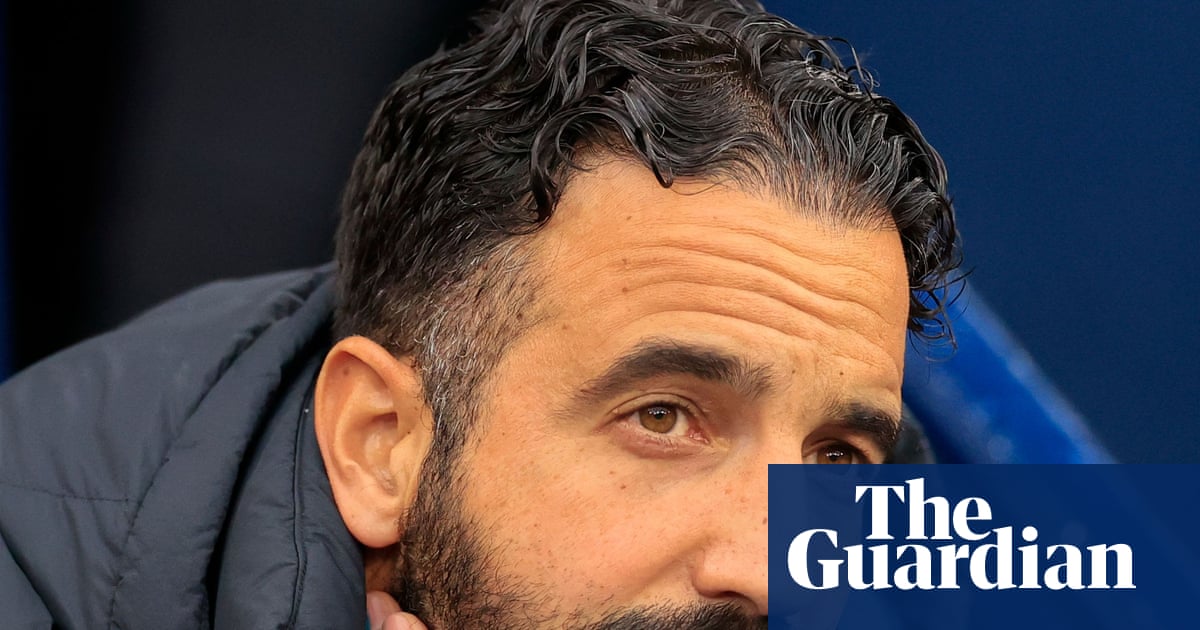
In a radio interview with broadcaster Deutschlandfunk this morning, Germany’s foreign minister Johann Wadephul suggested that France needs to boost its defence spending.
“He repeatedly and correctly refers to our pursuit of European sovereignty,” Wadephul said of French President Emmanuel Macron. “Anyone who talks about it needs to act accordingly in their own country.”
Despite Nato member states last year committing to spend 5% of GDP on defence and security by 2035, Wadephul said progress has been too slow.
“Unfortunately, efforts in the French Republic have also been insufficient to achieve this so far,” Wadephul said. “France, too, needs to do what we are doing here with difficult discussions.”
After years of missing its Nato spending targets, Germany has unleashed hundreds of billions of euros on rearmament in the wake of Moscow’s full-scale invasion of Ukraine in February 2022.
Germany last year exempted most defence spending from constitutionally enshrined debt limits and current budgets foresee Berlin spending more than €50bn on defence between 2025 and 2029.
Under financial pressure, France has less room for manoeuvre with a huge debt burden as a proportion of GDP.
Key events Show key events only Please turn on JavaScript to use this feature
You can see how much individual Nato countries spent on defence last year in this document. Every country in the alliance met the target of spending at least 2% of their GDP on defence.
Members are now committed to spending 3.5% on core defence and 1.5% of GDP to wider resilience and security measures, such as critical infrastructure, civil preparedness and the defence industrial base, by 2035.
Germany's foreign minister says French defence spending is insufficient
In a radio interview with broadcaster Deutschlandfunk this morning, Germany’s foreign minister Johann Wadephul suggested that France needs to boost its defence spending.
“He repeatedly and correctly refers to our pursuit of European sovereignty,” Wadephul said of French President Emmanuel Macron. “Anyone who talks about it needs to act accordingly in their own country.”
Despite Nato member states last year committing to spend 5% of GDP on defence and security by 2035, Wadephul said progress has been too slow.
“Unfortunately, efforts in the French Republic have also been insufficient to achieve this so far,” Wadephul said. “France, too, needs to do what we are doing here with difficult discussions.”
After years of missing its Nato spending targets, Germany has unleashed hundreds of billions of euros on rearmament in the wake of Moscow’s full-scale invasion of Ukraine in February 2022.
Germany last year exempted most defence spending from constitutionally enshrined debt limits and current budgets foresee Berlin spending more than €50bn on defence between 2025 and 2029.
Under financial pressure, France has less room for manoeuvre with a huge debt burden as a proportion of GDP.
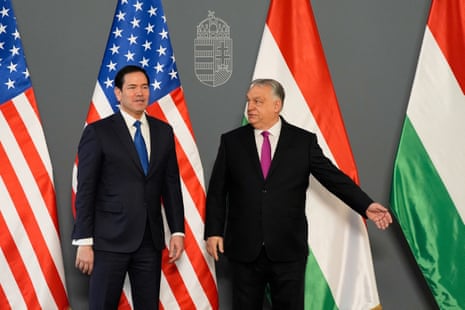
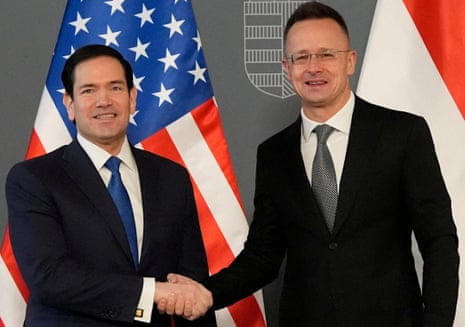
Marco Rubio arrives in Budapest to meet Viktor Orbán and Hungarian foreign minister
We have some images come through from the newswires of Marco Rubio in Budapest:
Hungary’s 12 April election is set to be one of the year’s most consequential in the EU. Voters will choose a new 199-seat national assembly under the country’s mixed electoral system, with Viktor Orbán facing his biggest electoral challenge after 16 years of uninterrupted power.
Under Orbán, Hungary has repeatedly sought to block EU sanctions against Russia, has vetoed the release of billions of euros in funds to reimburse other EU countries providing military aid to Ukraine and has used Budapest’s veto ability in Brussels as a way to prolong urgent EU decisions.
The far-right Hungarian leader has long been at odds with the EU, which has frozen billions in funding to Budapest over concerns he has dismantled democratic institutions, eroded judicial independence and overseen widespread alleged corruption.
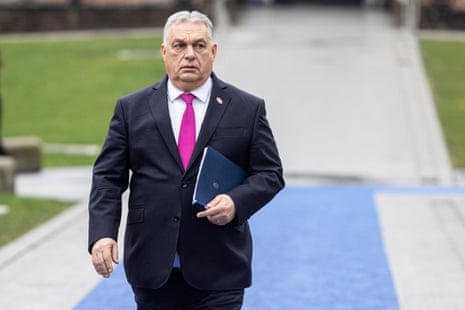
In a speech on Saturday, Orbán compared the EU to the repressive Soviet regime that dominated Hungary for over 40 years last century. His message doesn’t seem to be cutting through to voters in the way he may hope though. Polls have suggested Orbán and his Fidesz party are trailing behind Péter Magyar’s opposition Tisza party.
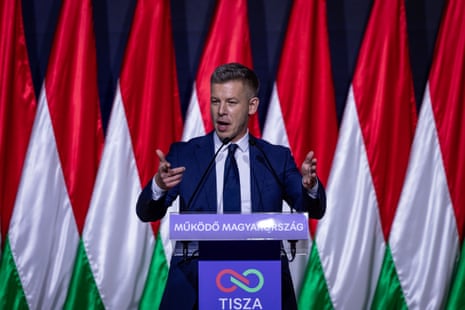
Magyar, a former member of Fidesz, has vowed to root out corruption and bring in term limits for future leaders. He has focused on issues such as low wages and rapidly rising living costs that have made Hungary one of the poorest countries in the EU.
On Sunday, Magyar pointed to meetings he held with numerous European leaders at the Munich Security Conference over the weekend, and said he would put an end to Hungary “drifting out of the European Union” as was the case under Orbán.
EU foreign policy chief criticises ‘fashionable euro-bashing’ by US
Patrick Wintour
The EU’s foreign policy chief has denied claims levelled by the US that Europe is facing civilisational erasure, rejecting what she condemned as “fashionable euro-bashing” by Washington.
Kaja Kallas also said the US was discovering that it could not settle the war in Ukraine without Europe’s involvement and consent.
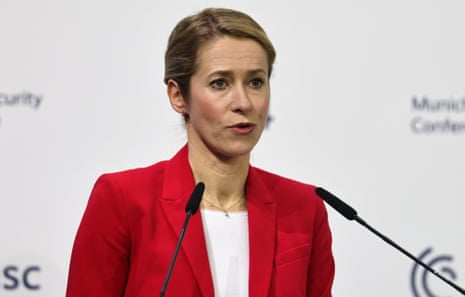
Her remarks capped a difficult three-day Munich Security Conference attended by world leaders and security officials in which the health of the transatlantic alliance, a stronger European pillar inside Nato, and the Ukraine peace talks dominated discussions.
In his speech on Saturday, the US secretary of state, Marco Rubio, laced a more diplomatic tone with a firm message that Washington would only work alongside Europe if it changed to accommodate US leadership on mass migration, free trade and greater European defence spending.
Kallas, speaking on the last day of the conference, suggested some of Rubio’s remarks were directed at a domestic audience.
“Euro-bashing” was now “very fashionable” despite all “the good things that Europe actually has to offer,” Kallas said. “When I travel around the world, I see countries that look up to us because we represent values that are still highly regarded.
“Contrary to what some may say, woke, decadent Europe is not facing civilisational erasure. In fact, people still want to join our club, and not just fellow Europeans. In Canada, I was told over 40% of Canadians have an interest in joining the EU.”
You can read the full story here:
Marco Rubio to meet Viktor Orbán in Budapest ahead of Hungary elections
Good morning and welcome to our Europe live blog. The US secretary of state, Marco Rubio, is in Hungary today as he continues his tour of key American allies in central Europe after attending the Munich Security Conference.
Rubio is expected to have morning talks with Hungary’s foreign minister, Péter Szijjártó, in Budapest, before meeting the country’s embattled prime minister, Viktor Orbán, who has been lagging in polls ahead of crucial elections on 12 April. There is expected to be a press conference at around 11am local time.
Rubio, who visited Slovakia on a diplomatic visit yesterday, is expected to discuss bilateral relations with Orbán as he tries to bolster ties with US allies in the region.
The secretary of state is also reportedly pushing to shore up energy agreements with both Slovakia and Hungary, with Orbán being a particularly vocal critic of the EU’s green policies. Rubio and Orbán plan to sign a civilian-nuclear cooperation agreement later, according to the Associated Press.
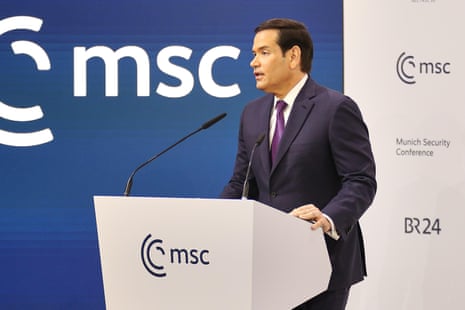
The US president, Donald Trump, threw his support behind Orbán, the EU’s longest-serving leader, earlier this month, saying he had his “complete and total endorsement for re-election”. Orbán has cultivated a strong personal rapport with Trump over the years, including on their shared hard-line immigration policies.
Rubio’s charm offensive follows on from him striking a lighter tone at this year’s MSC in comparison to JD Vance’s aggressive speech last time round, in which the vice-president castigated Europe for its policies on migration and free speech. Instead, Rubio talked of an “intertwined destiny” for the US and Europe, describing America as “a child of Europe, before making a highly conditional offer of a new partnership.
Stick with us as we bring you the latest news from around Europe.