2 months ago
128
2 months ago
128
The bellicose patriotism in this, the last instalment of Shakespeare’s Henriad, makes it a perfect drama for today – showing us the repeated history of war, invasion and acquisition in the name of nationalism.
Those parallels are unspoken in this production, traditionally rendered in period dress. Director Tamara Harvey begins with a flashback – from Henry IV, Part 2 – to an ailing Henry IV and a son keen to don his crown, to denote the ambition that now lies within the younger Henry. Alfred Enoch makes a genial young king, with a limber playfulness at the outset that carries the last embers of “wildness” from his dissolute days with Falstaff. Enoch harnesses his likability to spur on the fight in his “once more unto the breach” speech and Saint Crispin’s Day rallying call.
Lucy Osborne’s set design has a striking scaffold structure, and the scenes on the battlefield are brilliantly evoked through Annie-Lunnette Deakin-Foster’s movement direction and Jamie Salisbury’s pumping compositions. It is a well acted and solid production, evoking the rhetoric of war with all its justifications, but you do not feel the play’s most visceral moments strongly enough.
Is this an endorsement of Henry’s war or a critique of it? You are never sure. There is a subtle interrogation of the invasion in Harvey’s interpretation: the ensemble representing the army plays both sides, English and French, to show death as an equally devastating leveller, perhaps; and obliquely suggest that there is no victory – they all fall around Henry even as he is revelling.
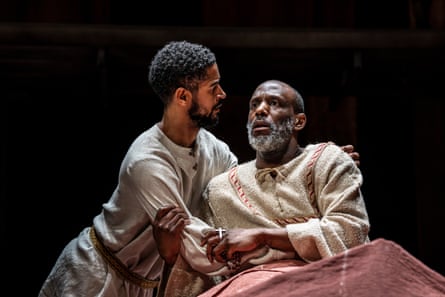
His transformation into a warrior king happens gradually; by the time he orders his army to slit the throats of their French prisoners, his ruthlessness is confirmed. Yet Enoch never seems anything less than affable. He is good-natured when tennis balls are sent by the Dauphin (Michael Elcock), who sneers at his callowness at the start, and all sweetness even as he urges the defeated French king’s daughter, Katharine (Natalie Kimmerling), to kiss him at the end. This production adds awkward comedy to his coercive “wooing” but it remains a distasteful moment.
There is a soft power to his language of warfare, and the ambition that leads him to invade his neighbour really does seem like a morally justified and upstanding endeavour – with Enoch, fresh-faced and earnest, convincingly drawing himself as a “Christian king” rather than tyrant.
The moments in the play when Henry’s nationalism is undermined, mainly through the comedic characters of the Hostess (Catrin Aaron) and her gang of reprobates, do not carry enough satirical sting for it to be a full-on critique, although the physical clowning and comic timing of Pistol (Paul Hunter) is a highlight. He is an amusing picture of nonheroic masculinity in vest and tights.
The victory at Agincourt, followed by unity struck between England and France, rings with a final note of unease that foreshadows the continuing conflict of the hundred years war. All that death and destruction, and for what? This question is raised too cautiously across the production. The drama very much stands as a history play rather than reaching across time to speak of wars waged since in the name of moral righteousness, from Putin’s campaign in Ukraine to Trump’s in the Middle East. It seems, ultimately, like a faithful celebration of Henry’s nationalism, with a few off-notes. Is that a missed opportunity?
-
At Royal Shakespeare theatre, Stratford-Upon-Avon, until 25 April