2 months ago
68
2 months ago
68
When Toronto’s streetcars hit a rare open stretch of road, the metallic grind gives way to an airy electric hum, and for a fleeting moment, there is a feeling that one is hurtling along the knife’s edge of the future.
Seconds later, the illusion shatters: the car grinds to a halt, at a stop – or more often, in traffic. As the city slips past the stalled riders, some notice a runner zipping by.
Allow Instagram content?
This article includes content provided by Instagram. We ask for your permission before anything is loaded, as they may be using cookies and other technologies. To view this content, click 'Allow and continue'.
Mac Bauer is fast, but the city’s trams, weighing more than 100,000lbs and travelling at a maximum speed of nearly 45mph, should be far faster than him.
And yet as of late December, in head-to-head races against streetcars, the 32-year-old remains undefeated in his quest to highlight how sluggish the trams, used by 230,000 people daily, truly are.
Some races have pushed him closer to his limits as a runner. On other occasions, the car has been so slow he’s had time to nip into a McDonald’s before it reaches the last station.
“I don’t like winning. I really don’t. I really, really wish these streetcars were faster than me,” he said. “But they’re not. And this is the problem.”
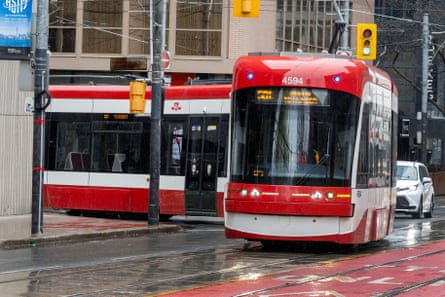
Bauer’s rise as a running celebrity and transit critic embodies the mounting frustration of a city beset by chronic delays, congested streets and decades of under-built transit.
On a recent chilly morning, Bauer’s competition, with its distinctive red and white livery and five articulated cars, was the 511 streetcar, which traces a southward line toward Lake Ontario. Typically, the route is one of the slowest in the city, with turning cars halting the streetcar’s progress and forcing passengers to sit idly in traffic, he said.
But before Toronto’s role as a host to the 2026 Fifa World Cup, workers have painted swaths of the road red to give the streetcar priority. In racing terms, this gives the tram an edge. “Our job,” Bauer said, “is to see if this matters.”
As the doors close and the singsong hum and scrape of the city’s streetcars begins, the race is on. And within moments, any advantage the tram had on paper disappears in the real world. First, it loses ground to a string of stops that Bauer says are far too close together. Then it gets stuck behind cars as it enters the downtown core.
“Streetcars just shouldn’t be stuck in traffic,” he said, adding the system also needed more “signal priority” which gives the streetcars lengthened green lights and shortened red lights.
Bauer started racing transit vehicles roughly a year ago after he and his wife realised how long it took them to traverse the city. He posted videos of those races to Instagram and quickly transformed into a minor celebrity.
Bauer describes his runs as a form of social activism, and his ability to lay bare the absurdities of Toronto’s beleaguered public transit system – a person can outrun a streetcar! – has struck a nerve with the tens of thousands of commuters who share his Instagram posts.
“When I first started, it felt like no one was really talking about signal priority or designated lanes. Now – and maybe I’m in this world too much – but I hear so much more.”
He acknowledges that his speed – the result of a disciplined regimen geared towards road races – isn’t a pace the average runner can sustain. “But even if I slowed down dramatically, I’d still be ahead of a lot of these streetcars.”
Earlier in December, he made headlines for taking on a newly opened light rail transit system – the first new line in the city since 2002. Measuring more than 6 miles in length, planners say Line 6 will carry more than 14 million people along its 18 stops. The project cost more than $C3.5bn (£1.9bn) and yet within days of opening, the line was riddled with service disruptions and delays.
When Bauer raced the train, dodging slicks of ice on the sidewalks, he beat it by 18 minutes – a win that cemented his role as one of the city’s sharpest transit critics. Bauer’s feat was brought up by city councillors who passed a motion to implement “more aggressive” signal priority.
“We can’t allow that to ever happen again,” the councillor Josh Matlow said of Bauer’s win. “The LRT [light rail transit] is meant to be rapid transit.”
Near the end of his most recent race against the 511 streetcar, a bitter wind cut against his face and hands as he ran near the edge of Lake Ontario. But an anxiety hovered as he entered the final sprint: the streetcar was closer than expected. Victory was assured, but the margin was far narrower.
With the final transit station in sight and his legacy intact, Bauer eased up ever-so-slightly, heartened to see how much the gap had closed, largely the result of new dedicated lanes for the streetcar.
“This used to be the slowest route. Now it’s the closest race I’ve done,” he said. “I never thought I’d say this. But I’m really surprised. There’s hope: for the streetcars and for the city.”