3 months ago
139
3 months ago
139
For the third time in three T20 World Cups, England will meet India in the semi-finals, after the co‑hosts beat West Indies in what was in effect a quarter-final on Sunday night to seal their place in the final four and eliminate their opponents.
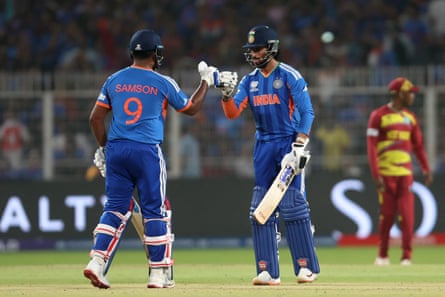
Sanju Samson, who lost his place in the side on the eve of the tournament but who was recalled after India’s humbling Super 8s defeat by South Africa, dramatically rediscovered his touch, batting through the innings to finish unbeaten on 97. Chasing 196, the co-hosts looked in control with the 31-year-old at the crease and fittingly it was Samson who struck the winning runs, lifting his 50th delivery over mid-on to seal victory by five wickets, with four balls remaining.
After West Indies were put in to bat Roston Chase, opening for the first time in Twenty20 internationals, powered the start of their innings in partnerships of 68 off 53 with Shai Hope, and 34 off 16 with Shimron Hetmyer – the latter pairing ended when Jasprit Bumrah dismissed both in a single over – while Jason Holder and Rovman Powell added 76 off the last 35 balls. But they were undermined by Hope’s pedestrian innings of 32 off 33 and by a series of fielding errors, including three dropped catches.
India and England will meet in Mumbai on Thursday knowing that in the past two tournaments the team that came out on top in their encounters have gone on to win the title, with the English prevailing in Adelaide in 2022 and losing in Guyana two years ago.
The other semi-final, to be played on Wednesday, will be between New Zealand, runners-up in England’s Super 8s group, and South Africa, who sealed top spot in theirs by defeating Zimbabwe by five wickets in Delhi. The teams also met in the first group stage, with South Africa prevailing on that occasion by seven wickets to continue their 100% record against the Black Caps in five encounters at the T20 World Cup, though before this tournament they had not met in 12 years.
So the weekend finishes with us finally knowing not only who will face each other in the semi-finals, but where those games will be played. The possibility of a semi‑final, and potentially also the final, being relocated to Colombo was extinguished when Pakistan, who needed to beat Sri Lanka emphatically on Saturday, won by only five runs, but uncertainty about the fixtures was such that tickets went on sale only last Tuesday. At the same time, and at less than two weeks’ notice, sales were also launched for two finals in two countries.
England completed their last Super 8s fixture on Friday and then, despite results in the first two rounds of games in the other group coming as close as possible to a definitive answer, were forced to spend two days hanging around in Colombo waiting for confirmation on where their semi-final would be played.
This uncertainty was extended by the International Cricket Council’s decision not to schedule the final round of fixtures in each group simultaneously, which would not only have had greater sporting integrity but could have allowed all four to be played on the same day. Instead each had its own primetime broadcast slot, stretching them over three days.
It may irritate some that India had the advantage of knowing that only a reunion with Pakistan could have diverted their semi-final from Mumbai, but not every aspect of co‑hosting has been to their benefit. To satisfy their fans they have played their first seven games in six cities, whereas of the other semi-finalists England have played in four, New Zealand three and South Africa two. Should they reach the final, the Proteas will have played six of nine games in the venue that will host the final, the Narendra Modi Stadium in Ahmedabad, and if India really wanted to skew things in their favour those are the fixtures they would have wanted.
For those watching the tournament on television, the complexity of these arrangements has made little difference, but for those on the ground, required to make arrangements to be in two or even three cities simultaneously before cancelling all but one, the organisation of the tournament must seem absurd and inexplicable, and its implications costly. Likewise for the hoteliers in the host cities who will be dealing with thousands of last-minute cancellations and for those required to arrange staffing, policing and catering of games that will never go ahead. In five years, India will co-host a 50‑over World Cup with Bangladesh and they can all do it again.