3 months ago
137
3 months ago
137
The first time I heard Hussein’s mother’s voice, it wasn’t anger that came through the phone, it was exhaustion.
“There are rumours that he burned to death,” she said to me. “How do you think that makes me feel as a mother? Where are you, Hussein? I’m looking for you. Please my daughter, help me.”
Her 28-year-old son had left Yemen, chasing the promise of a salary that could give him a better future. Within weeks, he had vanished into a war he did not understand, in a country whose language he didn’t speak, to one of the world’s most brutal frontlines. For months she scrolled the internet, searching for his face in the videos coming out of foreign fighters on Russia’s frontline, or his name in any of the chat groups discussing them, but had no success. Then a document arrived from Russia: Hussein’s death certificate.
And yet, when I finally found Hussein, he was alive.
I’m Yemeni myself. I have reported on war for the BBC for years, including on my own country’s long collapse. But nothing prepared me for what I would learn while investigating Russia’s recruitment of foreign fighters: the precision with which vulnerability is targeted; how promises are tailored to poverty; how citizenship becomes bait; how families are left to grieve in the dark.
Russia’s full-scale invasion of Ukraine has dragged on into a fourth year, and its appetite for manpower is relentless. An estimated 20,000 foreign fighters have been pulled in from across the world, from countries including Nepal, Cuba, South Africa and North Korea, in what is being advertised as ideological “volunteering” but is, in reality, recruitment by exploitation.
Back in March 2022, President Vladimir Putin publicly backed the idea of bringing men from the Middle East to fight, insisting they wanted to come “not for money”, and that Russia should help them reach the combat zone. What I have seen since is a pipeline: informal brokers and online channels connecting desperate men to contracts with Russia’s military. These contracts often promise a year, a salary, a passport, and safety, but the fine print can trap them indefinitely.
I began following the stories of Yemeni recruits after videos started circulating online: young men filming themselves from Russia, pleading for help. One of them, his voice cracking, says: “We die a thousand times a day from the terror we endure at the hands of the Russians … save your Yemeni brothers … we are being forced to fight … our friends are dead … we are trapped between life and death.”
The videos were raw, immediate, and hard to watch.
In Amsterdam, I met Ali Alsabahi, founder of the International Federation of Yemeni Migrants (based in the Netherlands), who has spent months tracking the journeys of (he estimates) 400 Yemenis who travelled to Russia. He told me he had been receiving pleas daily, calls and videos asking for rescue, and that he had forwarded them to officials, to the foreign ministry, to the Yemeni ambassador in Moscow. “The situation in Yemen is catastrophic,” he said. “It’s normal for young men who are unemployed to be told: ‘Come, we will give you thousands of dollars.’ So they went.”
Yemen’s war has hollowed out the economy and the state. The internationally recognised government and its Saudi-led allies are fighting the Iran-backed Houthi movement, as well as being locked in a power struggle with the UAE-backed Southern Transitional Council in the south of the country. In cities such as Taiz, in the south-west, people survive on fragmented wages, charity, or remittances. For young men, the future can feel like a door that has slammed shut. In that landscape, a contract offering thousands of dollars, plus fast-tracked citizenship, isn’t just tempting; it’s life-changing.
Alsabahi told me that more than 24 Yemenis are known to have been killed in Russia, and others remain missing. Parents call him, desperate to track down sons who have stopped answering. Some, he said, were told their sons burned in vehicles hit on the frontline. Others received death certificates from Russia with no explanations of what happened to their sons or how they could repatriate their bodies. He told me that he had heard rumours of imprisonment in Ukraine. Two names came up again and again: Hussein and Khalil.
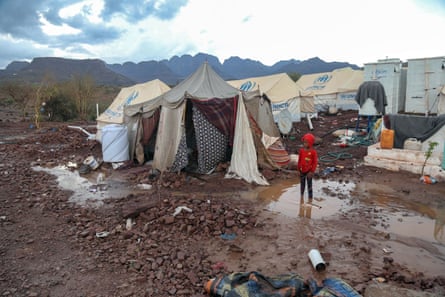
Khalil is from Taiz. His mother, Shafia, lives in the rural village of Badan, in Yemen. She sent me a school photo: Khalil in ninth grade, a boy with his life before him. He was the eldest child and the family’s sole breadwinner. He worked in a market hauling vegetables for a small daily wage she told me he earned about $70 (£52) a month. He then travelled to Oman and worked in a restaurant washing dishes. Even then he would send the $100 (£74) he made back home every month. When he told his mother he had a chance to go to Russia, he told her he would find a job in a restaurant or a farm, the kind of jobs Yemenis had gone abroad to do before, Shafia says. “He told me: ‘Thank God, mother, I feel good things are going to happen. I’ll finally make some proper money.’ Even though we are desperate, I had a bad feeling, I told him, I don’t want you to go. This is a far away country.”
After he reached Russia, contact became sporadic. Then it stopped. “He told me it wasn’t what he expected, but he didn’t tell me they had been sent to the frontline. Khalil has never picked up a weapon in his life.” Shafia searched online and found Yemenis mentioning his name in videos. Then she heard he had been caught up in the battle for Kursk, and that the platoon of 20 Yemenis he was a part of were all killed.
In Yemen, death is familiar. But this was different: not dying in Taiz, not dying under the bombs that have haunted their own skies, but disappearing into a European war, a war he barely understood.
When Ukraine launched its surprise incursion into Russia’s Kursk region in August 2024, reports said that around 600 Russian servicemen were captured. Some of them were foreign fighters with Russian citizenship. When a fighter disappears on the frontline, there are only a few possibilities: killed, buried anonymously, or captured.
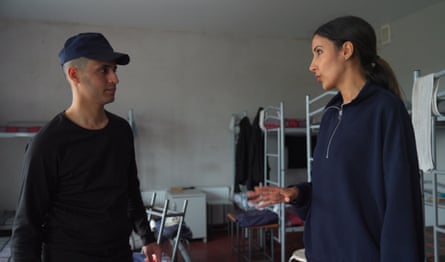
I travelled to western Ukraine, to one of the country’s largest prisoners of war facilities, to meet foreign fighters captured while fighting for Russia. Walking through the prison, the scale of Russia’s recruitment is clear: there are men there from all over the world. I met people from Egypt, Senegal and Sri Lanka. In the canteen, I asked if anyone spoke Arabic to see if any of the men whose families I’d been speaking to were there.
Then, when I said I am Yemeni, prison officials told me they were holding two Yemenis in another part of the prison. I asked if I could meet them.
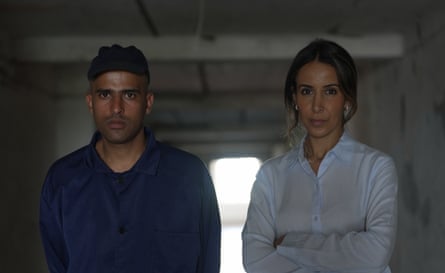
“Hello,” I said, stepping in. “Hussein and Khalil?”
“Yes,” one of them replied.
“I’m Nawal Al Maghafi,” I told them. “I’m also Yemeni. I’ve been talking with your families for a while now.”
Khalil stared at me as if the walls had shifted. “I can’t believe it,” he said. “Is this a dream or real?”
Hussein and Khalil told me they had been in Russia for only six weeks before they were captured. Within days of being sent to the frontline, they were attacked. Many of the men with them were killed. Hussein and Khalil were taken prisoner. I was allowed to interview them alone in a room. Before I could start my interview I asked them about the other men whose families had contacted me; they confirmed to me that they were the only survivors.
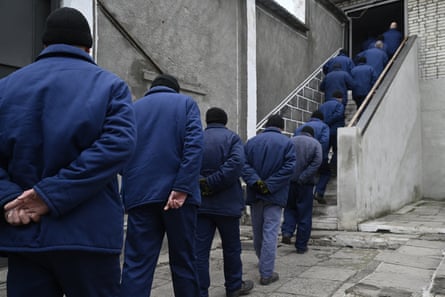
The details they shared were both mundane and devastating: the bureaucracy of a foreign army, the confusion of orders shouted in Russian, the suddenness of violence. “I regret that I went to another country … to fight for what?” Hussein told me. “There’s a war in Yemen, whoever wants war should stay in Yemen.”
He described being woken early one morning, loaded into a tank, and driven to the frontline. “You can’t be on the frontline and not speak Russian,” he said. “That doesn’t make sense.” A drone buzzed overhead, dropping bombs. He was hurt. When he woke, he saw Ukrainian soldiers with a gun to his head.
“At that moment, how did you feel?” I asked.
“It was … a bad situation,” he said quietly.
Khalil told me he had understood that going to Russia might involve army service, but that it was worth it for the money they had promised him. “I’ve never dreamt of having $2,400 (£1,781) a month,” he said. “If I worked for 10 years, I wouldn’t get the same amount as I got in Russia in one year.”
When I asked if he had thought about the people on the other side – innocent Ukrainians who would be their victims – he didn’t hesitate. “If I had known that,” he said, “I wouldn’t have joined this war.”
Khalil asked me one thing: could he call his mother to tell her he was alive? I watched his hands shake as the call connected.
“Hello,” he said.
“Hello Khalil, how are you?” Shafia’s voice came back breaking, overwhelmed to hear her son’s voice.
“Mum, don’t cry,” he pleaded. “God bless you.”
“I swear I can’t believe I’m talking to you right now,” she said. “I dream every day of being able to get in touch with you.”
“It’s the first time I’ve talked to you in eight months,” she repeated.
Then Khalil’s voice dropped.
“I made the biggest mistake,” he said. “Forgive me, forgive me. And tell my dad to forgive me.”
Shafia tried to sound steady. “Look after yourself so that you don’t despair.”
When he hung up, he exhaled. “Thank God,” he said. “My mum is relieved.”
Months after my first visit, I returned to the prisoner of war camp. Prisoners told me that more than 2,000 soldiers had been exchanged between Russia and Ukraine over that period – but none of Russia’s foreign fighters were included. Every week, they said, they watched Russians go home while they stayed behind.
“They don’t care about us,” one prisoner told me. “They’re like: ‘Let’s keep the foreign fighters in prison until the war is over.’”
Khalil had been in prison for almost a year. When I asked him what he wished for, he said: “I dream of a life. Of my future that is lost.” When I asked if he wanted to go back to Yemen, he paused. “Where?” he said. “Yemen did nothing for me.” It wasn’t a rejection of his mother. It was an indictment of what Yemen’s collapse has stolen from its young people. And yet, when he spoke to Shafia, the child in him surfaced immediately.
“Mum, I’m tired,” he said. “I want to get out.”
She replied with the kind of devotion only a parent can offer: “I’d give you my eyes. I’d give you everything I have.”
Khalil said something that shocked me. “I need to go back to Russia,” he told me.
For a moment I thought I had misunderstood. The last time he was there his entire platoon was wiped out, bodies destroyed, men disappearing. Why would he want to return?
Khalil had not withdrawn a single penny of the money he had been promised, he explained. Whatever had been paid was still sitting in a bank account in Russia, an account he could not access from a Ukrainian prison. And he was ashamed, he said, to go back to Yemen empty-handed after everything he had put his family through.
He had left as the family’s provider, the eldest son meant to carry the household. Now he was a prisoner. His mother and four younger brothers were struggling back home. The family had rented out their entire house, and were all living together in one room, relying on charity from people in their neighbourhood to survive. His desire to return to Russia was neither loyalty nor ideology; it was poverty and pride braided together. A man trying to salvage dignity from a catastrophe.
Khalil and Hussein had signed contracts issued by Russia’s military. Recruiters often advertise them as one-year deals, long enough to earn serious money, short enough to feel survivable. But there is a trapdoor. Russia issued a decree in September 2022 binding soldiers to serve until the end of the war effort, which in practice has meant many contracts roll on automatically. For foreigners with limited Russian, little legal support and no political leverage, the effect can be total captivity. These young men told me plainly: they wanted to leave, but they could not. Their Russian citizenship, fast-tracked as part of recruitment, did not protect them. Their own state did not appear to be fighting for their return either.
When I think about Khalil and Hussein now, I understand the terrible simplicity of their choices. What they were promised delivered them to just two fates: to die on the frontline, or to live on and vanish into a prison system that may never let them out. For their families back home, both futures feel like the same kind of loss.
Journalist Nawal Maghafi’s Into the Void: Putin’s Foreign Fighters is now available to stream on BBC iPlayer and on the BBC World Service’s YouTube channel.