4 hours ago
10
4 hours ago
10
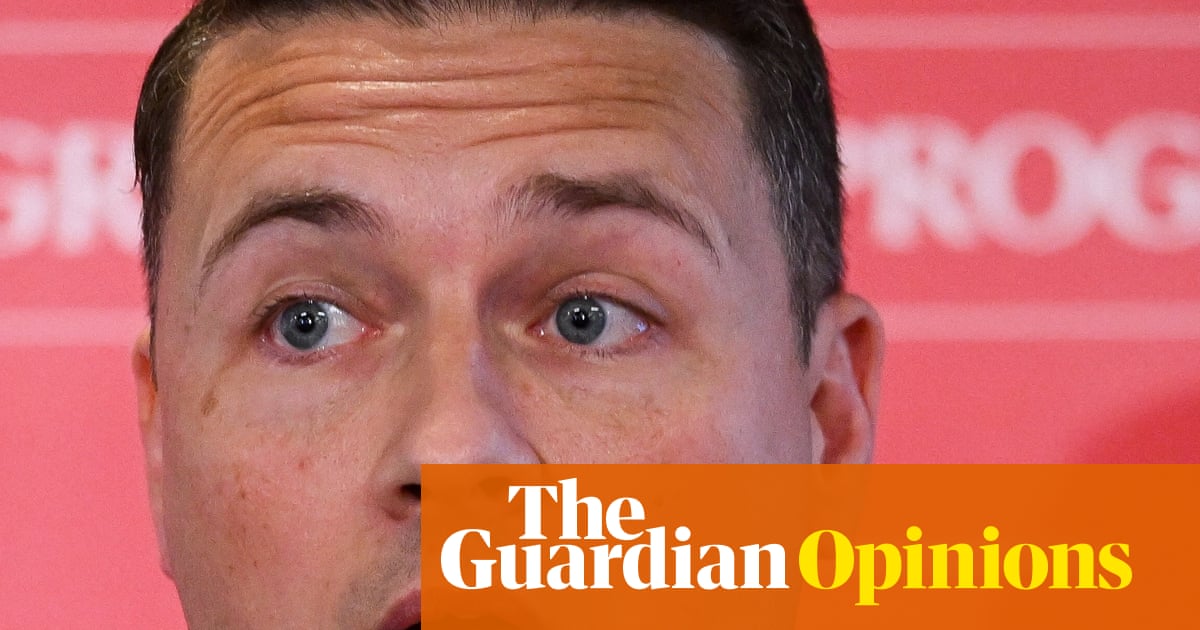
Towards the end of a miserable summer last year, Arthur Fils received a message from a friend imploring him to listen to a song. Fils was soon confronted with the sound of his own name. “My friend sent me the song saying: ‘Look, they are talking about you.’ I listened and I was like ‘Oh yeah’,” he says, theatrically mimicking his excitement. “That’s cool.”
There was a depressing irony to the lyric. The popular French rapper La Rvfleuze repeatedly referenced Fils in the chorus of Serrure #5, likening the noise Fils generates through his performances on the court to the rapper’s impact in his own arena: “Arthur Fils, j’fais du grah sur le court,” he rapped. In reality, Fils’s career was worryingly soundtracked by complete silence.
At 21 years old, Fils is one of the most talented players of his generation. Armed with a forehand off the charts with its heaviness, he complements his supreme athleticism with a well-rounded game. He is one of the few around with even vaguely realistic ambitions of one day consistently challenging Jannik Sinner and Carlos Alcaraz, but for eight months, between his withdrawal at the French Open last May and his return in February, he was sidelined with a stress fracture in his back.
The mere mention of Fils to anyone involved with French tennis at times last year elicited several deep, sorrowful sighs and there were legitimate doubts whether he would return at full strength. The only person who was not particularly concerned about Fils’s future was the man himself. He could feel the stress radiating from his coaches, though. “Now they are very chill as well because they see I can play some good tennis and I’m still here,” he says.
It takes just a short amount of time around Fils to understand he is about as extroverted as is humanly possible. On the court, his charisma is eternal. It manifests in the immense self-confidence and his passionate, theatrical fist-pumps and celebrations. He is just as exuberant outside his workplace. Fils has been nothing but extremely kind, curious and familiar in our many meetings, whether eagerly answering questions or chatting casually about discovering his favourite barber in Brixton, south London where some of his family live.
While Fils’s competitiveness is the driving force behind his success, it can also be his great undoing. When he was younger, his temper was out of control: “Every match I was losing my mind,” he says. “I was going crazy; breaking the racket, screaming, hitting the ball out. Everything. But just because I was losing. I hate losing and so I was getting very mad.”
Maturity has provided Fils with greater self-control, but he also leans on the people around him to help him keep his head. During his tight opening match last month in Madrid, Fils’s constant ranting prompted his fitness trainer, Lapo Becherini, to tell him to “shut the fuck up”. When Fils argued back, Becherini repeated the command. Fils won the match.
His excited retelling of this interaction numerous times post-match was hilarious, but in a sport where players often surround themselves with yes men, it also reflects well on his relationship with his team. “When something is going wrong on the court, they talk to me straight and that helps me,” he says.
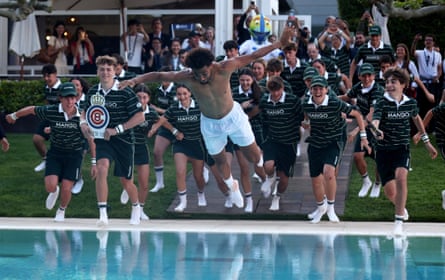
“It’s not like something is wrong, but they’re going to tell me; ‘No, no, no, everything is good, keep going like this, the same way.’ That’s not going to help me. If I have people that I can trust, they’re going tell me sometimes bad things, they’re going to be tough on me. But if I’m mature enough to take it, then it helps me.”
In his short time on the tour, it has been fascinating to witness so many opponents attempting to test his patience and temper: “Older people are always going to try to teach you some lessons,” he says. “Some of them are pretty good. Some of them are just because of ego. And when it’s because of ego, then they just say that because you are younger and that’s it. Some guys tried to get under my skin because I was young.”
As many of his contentious moments with opponents are relayed to him, including Dan Evans, Alexander Zverev and Thiago Seyboth Wild needling Fils during matches, his mouth slowly forms a mischievous smile. The assertion that he is tough and never backs down instantly provokes a fiery response: “No, no. Hell, no. I never back down from a fight,” he says. “It’s how my dad raised me. My mom as well.
“When guys are talking to me, we’re on the same level. I’m not the kid and they’re not the adult.”
Fils’s relationship with his father, Jean-Philippe, is at the core of everything he has accomplished. It was Jean-Philippe, a former basketball player, who first envisioned his eldest child’s success and has guided his son every step of the way. He has described his son’s career as a project, throwing his time, resources and sporting expertise into ensuring its completion. The pair are incredibly close and Fils’s father accompanies him to nearly every tournament.
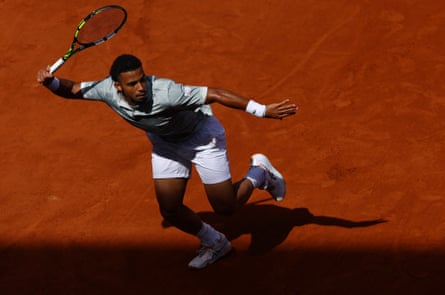
Jean-Philippe hails from Haiti, emigrating to France when he was 10 years old. Fils unsurprisingly cites his Haitian roots as the source of his fighting spirit and the tough love from his father that has been key in his success: “It’s a different mentality. It’s not a French mentality,” he says. “It’s tough. It’s really tough. He has been through a lot of things so he tried to make me understand life a bit more.”
There is one particularly obvious example of his father’s lessons. During his youth in Essonne, a small district south of Paris, Jean-Philippe deliberately made his son train on a horrendous, decrepit court despite having the means to play elsewhere. Fils believes that court helped to build his character, instilling in him greater perspective and grit. He is blunt about the state of it: “It was a disgrace,” he says, laughing.
Not even Fils could have anticipated the progress he has made so early into his comeback. He sits at No 5 in the ATP Race after a series of remarkable, consistent results yielded his first two Masters 1000 semi-finals, in Miami and Madrid, and an ATP 500 title in Barcelona.
These are a reflection of his ambition and hard work. Fils and his team, which now includes Goran Ivanisevic alongside his primary coach, Ivan Cinkus, used Fils’s extended time on the sidelines to make a startling amount of changes to his game. He has lengthened his service motion and shortened his forehand swing, learned how to properly slide in open stance to his backhand corner on all surfaces and chose to significantly drop weight from his muscular frame, primarily to lessen the stress on his back. He is, by far, a better player now.
Few countries are as cynical and critical of their athletes as France. Even this magnificent comeback has been accompanied by some negativity before the French Open starts this weekend. The general subject of proving doubters wrong prompts Fils to directly call out a particularly harsh pundit by his name. “In Barcelona, I saw one guy talking very bad about me: Simon Dutin,” he says, shaking his head.
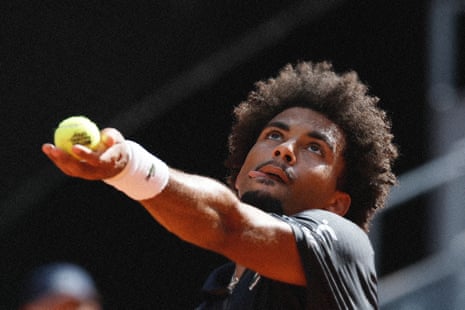
“So I was very happy to win the title to show him that he was completely wrong. I try to not react to these things. I try to not see them. But when it’s coming to me, then I have to see them and I have to think about it.
“I was very surprised about what he said and not happy with the way he said the things. But when I won the title, it was the best answer.”
There will be plenty more criticism and potential distractions to come and despite how he endeavours to avoid reading about himself on social media, there is no way for the 21-year-old to avoid the frenzy that accompanies being France’s latest candidate to follow Yannick Noah’s 1983 triumph at Roland Garros, the last time a Frenchman or black man won a grand slam singles title.
The most effective thing Fils can do to protect himself is to ensure that the noise he continues to generate on the court drowns out everything else.