3 hours ago
10
3 hours ago
10
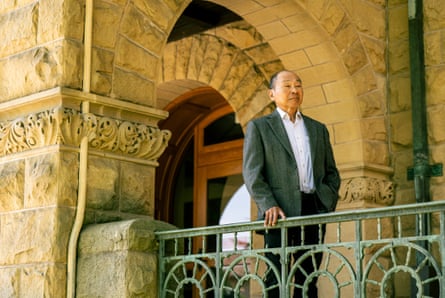
There are not many public intellectuals who can say they’ve been cited by Capt James T Kirk of the Starship Enterprise, but Francis Fukuyama is one of them. In Star Trek VI: The Undiscovered Country, William Shatner’s character is in a reflective mood, and speaks to the Klingon chancellor. “Some people think the future means the end of history,” Kirk muses. “Well, we haven’t run out of history quite yet.”
When the film came out in 1991 and in the years that followed, you’d often hear comments like that. They were nods to a thesis so famous it hardly needed spelling out. It debuted in a 15-page essay written by Fukuyama, then a 36-year-old thinktanker, which was published in the National Interest, a right-leaning journal of US foreign policy, in the summer of 1989. There was a question mark in the title: it was called The End of History?. In book form three years later, it became The End of History and the Last Man. But these were subtleties that, as we shall see, got lost.
The essay made its author internationally renowned and helped power a career as a political scientist, philosopher and analyst, specialising in foreign policy and political economy. Fukuyama’s counsel was sought by governments and boardrooms worldwide, from the C-suite of Ford to the tent of the Libyan dictator Muammar Gaddafi. But, as is clear from his new memoir – which is less a conventional autobiography than the story of a life in ideas, one that revisits intellectual shifts and academic schisms and which, by contrast, scarcely mentions the author’s 40-year marriage – it also became something of a millstone.
I ask how he feels about that article. Perhaps the way the Beatles might have come to regard their breakthrough hit She Loves You: grateful for the success, but tired of having to replay it, again and again.
“Well, a little bit of both,” Fukuyama, now 73, says on a video call from California, via a computer which, incidentally, he built himself. “I certainly think that I would not have gotten the attention that I did if I’d used a different title. So that made a difference.”
But there has been a downside. “You know, I get these ridiculous comments, on the internet. If I post a picture of my grandkids, they say, ‘Oh, I thought it was the end of grandkids.’”
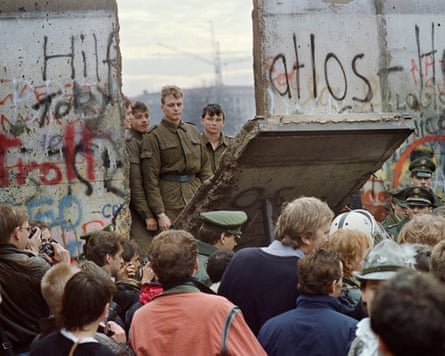
The problem, as Fukuyama sees it, is a 37-year-old misunderstanding – one that took root as soon as the essay was published. Thanks to that simple, memorable phrase – “the end of history” – people assumed that Fukuyama was arguing that, with the cold war winding down and the Berlin Wall about to fall, human conflict, even human events, were drawing to a close. That all the big arguments had been settled, there would be no more war, and the entire world was about to live under US-style liberal democracy. As he puts it in his new book, In the Realm of the Last Man, it was taken to be an expression of “naive liberal triumphalism, and I have been asked several times a week over the past three decades whether I wished to recant my argument. I have written thousands of words and given dozens of interviews seeking to answer this question.”
Indeed, he tells me, that was “one of the reasons for writing the memoir: to finally get down in a very clear way what I was intending and the ways I was wrong, and the ways I believe I’m still right.” The book makes clear his argument was a subtle one, drawn from Hegelian thought and inspired by an earlier interpreter of Hegel, Alexandre Kojève, from whom Fukuyama borrowed that all-important title.
According to Kojève, the end of history was the moment when a principle or set of ideas emerged that could not be bettered, in terms of their ability to satisfy the human beings who lived in a system shaped by them. Kojève himself had playfully proposed the year 1806 as the end of history, since that was the moment when, thanks to his defeat of the Prussian monarchy in the Battle of Jena-Auerstedt, Napoleon brought the code that bore his name to the heart of old Europe, the legal framework that emerged from the French Revolution. As Fukuyama writes, the revolution of 1789 “established the underlying principles of a modern liberal order, namely, the two principles of liberty and equality, or the equality of liberty”.
Of course, those principles were not immediately or fully implemented: even as Napoleon was advancing in central Europe, the French colonial authorities were putting down a slave revolt in Haiti. “But Kojève’s point was that once the idea of universal freedom got out, it was only a matter of time before those principles became accepted and practised around the world.” Even if the time it took was measured in centuries, with plenty of events – including two world wars – along the way.
This was the nature of the argument Fukuyama was making for 1989. Not that liberal democracy was perfect or that it had been achieved everywhere and that all conflict was over. But rather that the evidence had become compelling that there was no better guiding principle or system. And Fukuyama still maintains that view.
“For the last 30-odd years, I’ve been saying that I’m looking for an alternative system that purports to be more humanly satisfying than liberal democracy. And a number of candidates have come along. Some of them, I think, are very implausible.” He cites Iranian-style theocracy as one such candidate. The Chinese model is a more serious contender. As an authoritarian system, he says, it can make decisions more efficiently than liberal democracy. “So the question for me is: is this also a sustainable system? Are we going to see this [replicated] in other places in 30 years? And that is still an open question.” If, over the next generation or so, China turns out to be much more successful than the US, with an exportable model that satisfies human needs, then Fukuyama promises he will be “perfectly happy to concede that I was wrong on the fundamental premise”.
He also accepts that the current consensus on liberal democracy is far from universal, and that the “liberal” part of that idea – the belief in constraints and checks on elected power – is especially vulnerable. He writes that is in part because support for those constraints has often been contingent on a collective memory of how dangerous the world can become without them. A younger generation who have known only peace and prosperity, and for whom the tyrannies of the mid-20th century are ancient history, will only be dimly aware of the perils of unrestrained, illiberal rule.
But surely Donald Trump, born just one year after the defeat of nazism, is living proof that proximity to that dark history hardly entails respect for the guardrails imposed by liberal democracy? How do we explain the US president’s disregard for that danger?
“You know, that is one of the great psychological questions that future historians are going to have to answer. He has had this weird attraction not just to the current Russia and Vladimir Putin but, all the way back in the 1980s, he visited Moscow. He took out these full-page ads attacking Nato way back then, when we were still in the middle of the cold war. I mean, it somehow has to do with his lack of any kind of moral compass beyond his own self-interest. He basically worries about whether he can make money, and if you can make money in a tyranny, that’s fine with him.”
It’s worth getting to the bottom of what Fukuyama meant all those years ago because, once you’re there, you find an idea more interesting than the soundbite versions of his thesis ever allowed. The final paragraph of his original essay declared: “The end of history will be a very sad time.” With the fundamental question of politics essentially resolved, even if far from realised, “the worldwide ideological struggle that called forth daring, courage, imagination and idealism, will be replaced by economic calculation, the endless solving of technical problems, environmental concerns, and the satisfaction of sophisticated consumer demands.” As Fukuyama writes now: “The being who emerges at the end of history is typically someone stripped of struggle, risk and ambition, someone whom the philosopher Nietzsche labeled the ‘Last Man’. We have been living in the realm of the Last Man for some time now.” Once this notion is unpacked, even those who dispute Fukuyama’s reading of 1989 will concede that he had an uncanny inkling of what was to come.
For what he was anticipating was that liberal democratic societies might prove adept at delivering stability and relative material comfort, but that would still leave something profound missing. He cites Socrates’ notion of thymos, or spiritedness: that part of the soul which desires the respect or esteem of other human beings. The last man might have his basic economic needs met, but he would become angry if he believed he was not receiving the recognition that was his due. It amounts to the simple craving for one’s equal dignity to be respected.
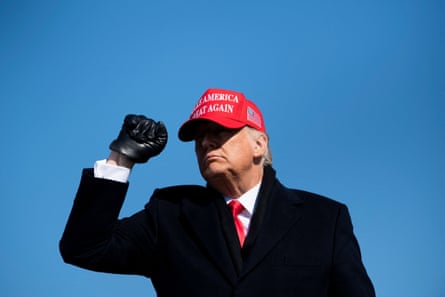
Reading those passages, it’s hard not to think of the worldwide surge of nationalist populism and the Maga movement in particular. “The mass of the people that come to Donald Trump’s rallies feel that the liberal elites have not been respecting them,” says Fukuyama. “One of the things that propelled Trump to the top of the American political system is his recognition that they were being disrespected, and he found a way of talking to them in a manner that didn’t show that kind of contempt. He doesn’t use big words. He tells stupid stories that they think are very funny, and you know, educated people are appalled by.”
This, he says, is a key challenge for Democrats. “If you really want to solve this problem of equally distributed respect … it’s about both listening and talking. I think a lot of elite politicians actually don’t listen to people that are not like themselves. They don’t necessarily listen to ordinary people, and they also don’t know how to speak to ordinary people.” He notes the desperation of Democrats “looking for working-class candidates that they can push” in the November midterm elections, but says the “equal distribution of respect requires both policies that distribute actual material benefits more equally and a different kind of political discourse”. In that context, he likes the look of former Chicago mayor and potential 2028 presidential candidate Rahm Emanuel, a man with a streetfighter’s manner who is also, says Fukuyama, “very funny”.
The other defining trait of the last man is the hunger for a cause, for a life-or-death struggle that might give his life meaning. In 1989, Fukuyama anticipated “a powerful nostalgia” for the age when such battles raged, and that too reads like a premonition of our own era. “Fundamentally we’re living in a really weird time,” he says now. He looks back to Germany of the 1930s. “They’d just lost a horrendous war, millions of casualties. Then hyperinflation. Everybody’s savings get wiped out. You have instability on the streets of the Weimar Republic, and so – it’s not an excuse – but you can kind of understand why people would be drawn to extremist ideologies at that point. But that’s not the world we’re living in in 2026. You know, we’re actually pretty stable, peaceful. And yet you find people on both the left and the right that are saying, ‘This is the worst possible world.’ In America we have the Maga right that says that America is dying. It’s being killed by the other side. And it’s very hard to understand how they can argue that with any kind of historical awareness.”
For the left, at least, hasn’t the climate crisis played a part in contributing to that mood of existential doom? Fukuyama doubts it. “I am sitting in California. It’s a comfortable 70 degrees [21C]. You know, I’m not burning up like you in Europe, so maybe it’s just my personal situation. But I think that climate still remains a rather abstract thing for many people.” He points the finger in a different direction. “Social media and the internet in general have permitted this vast disconnect between actual material lived reality and what people experience online.” He cites the legions of young men in the manosphere, gaming the days away, simultaneously fed a falsely bleak picture of the world and longing for a cause worth dying for, as an illustration of the phenomenon he warned of in the very last sentence of the 1989 essay: “Perhaps this very prospect of centuries of boredom at the end of history will serve to get history started once again.”
There’s a chapter in the new book whose title hints at the other story the memoir tells: On Changing Your Mind. Fukuyama has made the relatively rare political journey from right to left. A former official in the Reagan and Bush administrations, he tells of his time as a disciple of the noted conservative scholar Allan Bloom and as part of the neoconservative gang of thinkers who prepared the intellectual ground for the 2003 invasion of Iraq. Fukuyama renounced his support for that war in February 2004. In the book, he candidly admits that what prevented him from making the break earlier was, in part, less ideological than social and human: he didn’t want to end friendships he had cherished.
Still, his departure from the right was not solely in the sphere of foreign policy. While his former colleagues could only see government as an obstacle to be cleared out of the way, his own studies of societies around the world led him to regard a capable state as essential. As if to confirm how far he has travelled, one chapter of the book is titled Learning to Love Bureaucrats.
I ask whether his perspective on the world might have differed from other Republicans and conservatives because of his Japanese-American roots, which are detailed affectingly in the book. It tells of his grandmother, a “picture bride” who left Japan at 21 when she was put on a “steamer to Los Angeles all alone, where she was to marry a stranger 10 years older than herself”, and of an uncle left “penniless” after the store he built was effectively confiscated when he, like all Japanese-Americans on the west coast, was interned during the second world war. Did he see things differently because he was a member of an ethnic minority that had suffered a bitter history of exclusion?
“No, I don’t think so,” he says immediately. “I’ve tried to avoid thinking of myself as an Asian-American my whole life, because I just don’t like that sort of identity politics. It’s true that, after 11 September, you had certain rightwing people in the United States saying, ‘Well, we ought to put Arab-Americans in camps.’ And, yeah, of course, I felt that that was really wrong based on my family history, but I don’t think that made me especially sensitive to those sorts of issues.”
What changed his mind was a changing world. Even if he still thinks the big question has been resolved, events matter. The Iraq war and the crash of 2008 upended his worldview. As he puts it, “If you’re an intellectual and you believe certain things about the use of military force in foreign policy and about unregulated markets in economics, and both of them lead to big disasters, you ought to rethink some of those assumptions.” For Francis Fukuyama, an end to history never meant an end to thinking.