3 hours ago
12
3 hours ago
12
Twenty-three years ago, María Monges looked around her flooded neighbourhood and knew something had to be done.
Founded in 1998 in Buenos Aires province’s San Martín district, the community of Costa Esperanza sits on the banks of the Reconquista, Argentina’s second most-polluted river and owes its name to the fictional location of a hit Argentine youth telenovela of the time, Verano del 98. But the real place is very different from the idyllic coastal city where the protagonists of Argentina’s answer to Dawson’s Creek met their first loves or sang around bonfires.
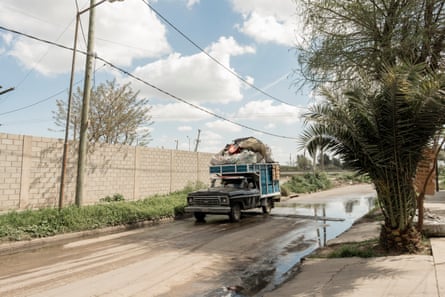
“You don’t know what it was like – when we started cleaning up, all the streams were blocked up everywhere: rubbish, dead dogs … a bit of everything. It was unsanitary, but we carried on working anyway,” says Monges, now 61. She started knocking on doors, getting people out to work with her, and in 2005 got the provincial administration to give them tools, uniforms and training. Now Monges leads 9 de julio, a workers’ cooperative that, from Monday to Friday, cleans up streams flowing from the river. “Every day, we will find rubbish,” says Monges. “It’s like people don’t understand.”
The Reconquista is 51 miles (82km) long, located in the north-east of the province of Buenos Aires and flows through 18 municipalities. About 4-5 million people live in its basin. It flows into the Luján River, which then connects with the Río de la Plata estuary.
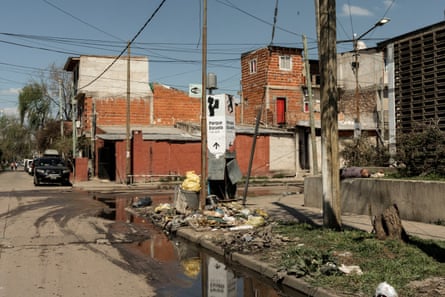
Since at least the 1970s, the river has been a dumping ground for untreated sewage, industrial waste and landfill leachate. It has the state sewage company on its banks, along with homes that lack adequate infrastructure, residents connecting their drainpipes so that waste is discharged directly into the water. Several factories located in the district of San Martín, known as “the Industrial Capital”, also throw their waste into the river.
“All of this not only pollutes the water, but also the soil and the air. In this area there’s no access to drinking water … all the aquifers are contaminated,” says Natalia Gavazzo, an anthropologist and researcher at the National Scientific and Technical Research Council. Gavazzo directs the Migrantas en Reconquista project, which conducts research and carries out initiatives in the region to strengthen the socio-environmental strategies employed by women in the neighbourhoods of the Reconquista river basin. She adds that the environmental activism in Costa Esperanza is carried out primarily by women. “They are not just victims,” she says. “They are also the key agents of mitigation and adaptation; they possess a wealth of knowledge that is central to the survival of their communities.”
But the Reconquista is just one of the troubled rivers in La Plata, the giant system that connects multiple waterways across Uruguay and Argentina. According to the WMO State of Global Water Resources report, out on Thursday, major parts of La Plata river basins have experienced recurring below-normal water levels between 2021 and 2025, caused by persistent multi-year drought conditions.
La Plata basin includes the Paraguay River, which has consistently recorded water levels at their lowest since 2020. Analysis of WMO data shows that the Paraguay River’s water levels have been consistently below normal for the last six years, with its 25 driest months since 1991 registered after 2020.
The drought and pollution issues plaguing La Plata and the Reconquista are affecting many more of the world’s rivers. As Gavazzo puts it, “climate change has an uneven impact around the world – the north produces the emissions, but we in the south foot the bill.” For the anthropologist, the same is true at a local scale. “People in gated communities throw out rubbish, but it ends up here,” she added.
Juan Borús, who recently retired from the National Water Institute and is one of the country’s leading hydrologists, says that governments should “tackle every one of these sources of pollution individually, which is an extremely costly, painstaking task that requires regulation”, but that “companies that discharge complex effluents evade the rules … They’ve been doing it all their lives.”
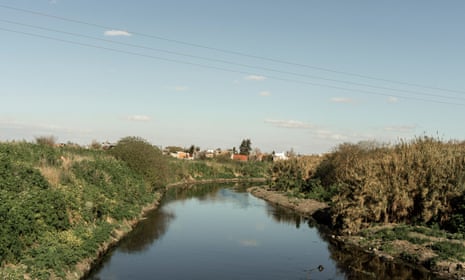
In 2001, the Buenos Aires province created the Reconquista River Basin Committee (Comirec) to clean it up, but it had limited impact, and parts of the river where Costa Esperanza is located still exhibit “severe deterioration”, according to its early 2026 reports. High levels of E coli (a bacterium that indicates the presence of fecal matter) and low levels of oxygen make it “not a suitable environment for aquatic life” and “a risk to the population”, according to Patricio Carmona, a biochemist specialising in environmental analysis.
after newsletter promotion
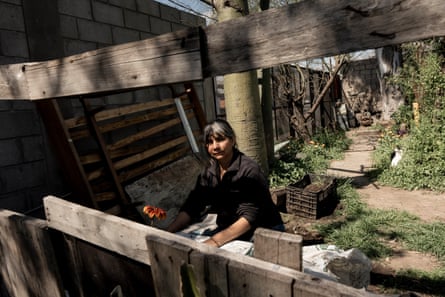
“The smell is like an acid,” says Lorena Batista, 47, a neighbour who works at the National Institute of Industrial Technology. “It is nauseating,” adds Zulma Monges, María’s daughter. The stench, they agree, becomes unbearable in summer, and when the wind blows they have to close their windows. It is not only the smell – neighbours have suffered from skin conditions such as hives, rashes, sores and scars, respiratory and lung problems, and gastrointestinal diseases, although Zulma says the skin conditions have become somewhat rarer since her mother’s community squad started picking up the rubbish.
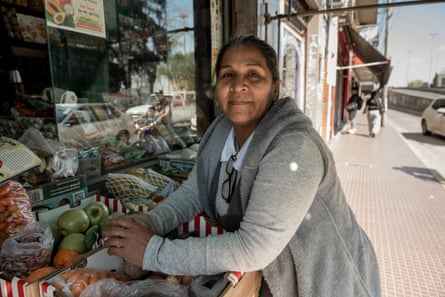
Once a month, residents meet to discuss problems and contact representatives from the local government, to whom they address their concerns – accumulated rubbish or water cuts, for example. “It’s very much a part of our lives; it’s already become an integral part of the neighbourhood’s culture,” says grocer Rosa Valencia in her shop, laden with coconuts, plantains and yerba mate.
And there are other efforts under way to clean up the river. The San Martín University’s School of Habitat and Sustainability is developing artificial wetlands – a nature-inspired method that could be installed on site to help filter out persistent pollutants and restore the area’s biodiversity. A group of several local organisations, Foro por la Recuperación del Río Reconquista, is campaigning for the creation of an ecological preserve. “Many years ago, before the landfill was built, that area was a large marshland with beaches,” they claim in their petition.
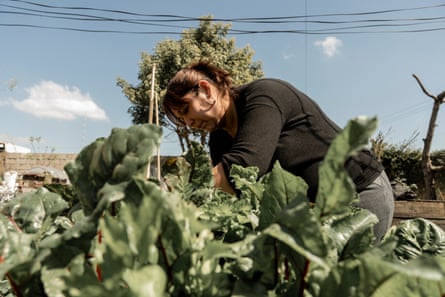
“Older folks used to tell us: ‘we’d go fishing there, we’d spend our weekends there; there were always, always, always lots of animals’,” says Zulma Monges. The area, she says, is overpopulated, and “the few green spaces we do have, we’re maintaining them as a community”. Then she pulls out her phone and shows a picture of one of the streams, just after it was cleaned by her mother’s squad.
“It’s beautiful when it’s clean,” she says. “The thing is, you have to stop the rubbish from reaching the neighbourhood. But this whole area … look, it’s beautiful.”
-
Over the next year, in the Our Rivers series, we’ll be focusing on the environmental challenges facing the world’s rivers, looking at the waterways around the planet that are overengineered or suffocating and drying up, and those that are being opened up again and given new life.