3 months ago
102
3 months ago
102
This time last year, Maimuna Memon was surfing an almighty career high. The Lancashire-born composer, writer and actor had just won an Olivier award for her performance in the musical Natasha, Pierre and the Great Comet of 1812, based on a section of War and Peace. But then it all went silent. “I didn’t expect to skyrocket but I did think, ‘OK, what’s next?’” she says. “And it was a rather quiet year, which was tough.”
It turned out to be useful, in terms of “stripping the ego away”. She went to Galway to be with her mother, a nurse and fiddle-player. “I watched her play and saw these incredible musicians playing for the love of it – not for how they will be reviewed, or to win any awards, or any of that.”
Still, the aftermath to her Olivier win sounds peculiar. Memon, 33, is no ingenue. She received critical acclaim for her portrayal of Mary Magdalene in Tim Sheader’s production of Jesus Christ Superstar, sang her own compositions in the National Theatre’s adaptation of The Grapes of Wrath, and was first Olivier-nominated for the musical Standing at the Sky’s Edge. How did she make sense of that eerie quiet?
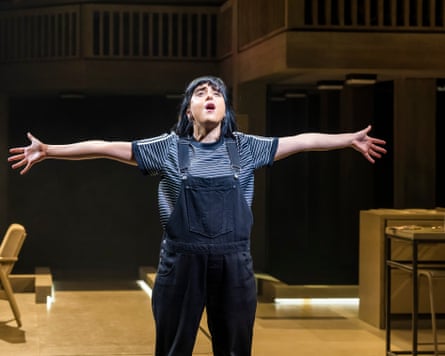
Memon, a calm presence whose words reflect thoughtful self-awareness, isn’t sure (“Whether it was because of how I felt about myself, I don’t know …”), but says times are hard for many people in her industry. “It’s brutal right now. Celebrity casting is massive and is reducing the amount of jobs available. I’m not criticising the people making the decisions but I am saying that it is affecting working actors. A lot of people I know who are incredible had a really shit time last year.”
Memon pushed through, and is now starring in a new version of her musical Manic Street Creature, which she performed at the Edinburgh fringe in 2022. It is a semi-autobiographical gig-theatre show following singer-songwriter Ria from Lancashire to London, as she records a debut album and falls in love with Daniel. “She finds out Daniel has bipolar disorder,” explains Memon, “and it’s about her navigating how best to support him. But in that pursuit, she forgets to look after herself.”
It is no surprise Memon made a career partly from composition. Her Irish mother and her Pakistani-born father, who is a doctor, were both music-obsessed when she was growing up. “There was no exposure to theatre in my family. I didn’t really understand what theatre could be, but I knew that I loved music. My dad had stacks of CDs. He’d play us Deep Purple, Bob Marley, Lionel Richie, Michael Jackson, all the cool 70s and 80s stuff. He loved traditional Indian and Pakistani music too. My mum played a lot of trad Irish music, which I absolutely loved.”
She took violin lessons, then began teaching herself piano and guitar. Her three brothers are musicians too. “My dad didn’t get one doctor or accountant,” she says, laughing, but adds seriously: “He worked really hard [after emigrating] so that I could have the opportunity to be an artist myself.” Her mother did the same.
Memon grew up in Darwen, a town between Bolton and Blackburn, without the multicultural vibe of those regions. “It was a very, very white area,” she says, speaking of the family fence being vandalised: “We had the P-word sprayed on it.” Yet she didn’t have a bad time there, she stresses, and has fond memories. Returning now is a different experience again. “It was really interesting going back this Christmas and seeing the St George’s flags all over the town. I thought, ‘Is this my home any more? What does this mean for me?’ I’m so proudly northern, so proudly from Lancashire. For a long time, I was on the offensive but lately I’ve been thinking about what is afforded to people there and I’ve been trying to look at it with more empathy. There’s not enough of a conversation. There’s always shouting back and forth.”

When she was in her teens, having found her tribe in Darwen, her father got a job in Australia. “If you think England’s racist, we moved to a very small town outside Brisbane and it was even worse.” She returned to study at the Oxford School of Drama, and has worked in the UK ever since. Does she feel a sense of outsider spirit as a result of these moves, as well as her mixed heritage? “I think so. I’ve always felt a little bit on the peripheries.” But she harnesses it in her work: “It’s why I write, because I was sick of seeing a lack of nuance on screen and stage.” However new writers are not being given enough opportunities, she adds, only days before the National Theatre’s director, Indhu Rubasingham, sent out a public warning about the very same thing.
Celebrity casting can exert its own damage on playwrights, she suggests, taking away from the integrity of the writing because some audiences come to see the celebrity rather than the play. “I think we should have more belief in the fact that a good piece of writing will sell. When I graduated 10 years ago, it was possible for someone you’d never heard of to be playing the lead in a massive play. It used to feel like theatre would create new names.”
The dream part, for Memon, is Dot in the Stephen Sondheim musical Sunday in the Park With George, which will be played by Ariana Grande in London next year. “It won’t come round for a while now, will it?” There’s no doubt Grande is a brilliant performer, she adds. “I’m jealous, really,” she says, laughing, “but how can you possibly compete with that?”