2 months ago
96
2 months ago
96
Italy’s embattled tourism minister has resigned, heeding a call to step down as the prime minister, Giorgia Meloni, strives to restore credibility after a bruising defeat in a referendum that has thrown her far-right government into turmoil.
The resignation on Wednesday of Daniela Santanchè, a prominent and brash member of Meloni’s Brothers of Italy party, came after the prime minister took the unusual step of calling in a public statement for her to go.
Italy’s constitution states that prime ministers can propose a government minister to the president, who in turn makes the appointment, but they do not have the power to unilaterally sack one.
Meloni and the justice minister, Carlo Nordio, have rejected calls from some opposition leaders to themselves resign over the referendum on judicial reforms, which marked the first major political setback for the prime minister, who since coming to power in October 2022 has led one of the most stable governments in the history of the Italian republic.
But since the results came in on Monday two justice ministry officials have fallen on their swords. Andrea Delmastro, the justice ministry undersecretary and a member of Brothers of Italy, resigned after it was revealed – days before the judiciary referendum – that he had held shares in a restaurant with links to the mafia.
Giusi Bartolozzi, the chief of staff to Nordio, also resigned on Tuesday. Bartolozzi, who faces the possibility of being sent to trial over Italy’s release and repatriation last year of a Libyan general wanted for alleged war crimes, caused a furore during the referendum campaign by likening the judiciary to a “firing squad” that needed to be eliminated.
Santanchè, who is involved in several legal proceedings over allegations of fraud and false accounting relating to her business activities, had until Wednesday afternoon resisted pressure to do the same.
But, in a statement addressed to Meloni, Santanchè said she was quitting, adding she had been unwilling to resign immediately because she didn’t want to be made a “scapegoat” for the referendum defeat.
“I have no problem saying: ‘I obey’ in doing what you ask,” she said, adding that she would not hide “a bit of bitterness” over the outcome of her ministerial career.
Santanchè denies any wrongdoing in relation to the legal proceedings.
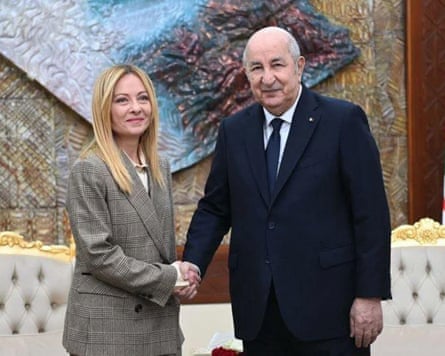
Meloni, who travelled to Algeria on Wednesday for talks with leaders on boosting gas supplies from the north African country, has been urged by opposition parties to urgently address in parliament “the evident political crisis” embroiling her government.
Italians turned out in force to reject amendments to the country’s post-fascism constitution that would have ushered in changes to how judges and prosecutors are recruited and governed, including separating their career paths, establishing two governing councils selected by lottery, and creating a court to handle disciplinary matters.
Meloni’s government said the reforms were essential for impartiality, to weed out what she called the leftwing political “factions” ruling the judiciary. Opponents said the proposals were a highly partisan project that would weaken the power and independence of judges and prosecutors.
In reaction to the defeat, Meloni said her government would “move forward, as we always have done, with responsibility, determination and respect towards the Italian people and Italy”.
But the credibility of her leadership is being tested ahead of general elections in 2027. Italian prime ministers usually pressure ministers to resign behind the scenes rather than making public statements.
Santanchè, known for her brash style, has been under investigation since 2023 and until the referendum fallout had enjoyed the support of Meloni despite persistent calls from the opposition to resign. The prime minister’s unusual move this week revealed her newfound weakness, said analysts.
“In the history of the Italian republic, I don’t believe a prime minister has ever been forced to admit their political impotence with a press release,” said Enrico Borghi, a politician with the centrist Italia Viva party. “This clearly shows that, beneath the surface, there are tensions and rather significant clashes within [the ruling coalition].”
Borghi added: “We have gone from the narrative of the strongest prime minister in Europe and the one who created a bridge between Brussels and Washington, to the prime minister who cannot even get rid of an overwhelming presence within their executive.”
The outcome of the referendum generated a record turnout and has galvanised the opposition, which is seeking to build a credible challenge to Meloni in time for the next general election.
Elly Schlein, the leader of the Democratic party, which in recent recent years has gained significant wins in regional elections as part of the “large camp” alliance including the Five Star Movement, said the referendum turnout marked “a splendid” moment for Italian democracy.
“With such a high turnout, there was a clear political message that the Meloni government must listen to and reflect upon,” she told reporters at Rome’s foreign press association. “She must start dealing with the real priorities for Italians, such as health, education and jobs.”
Analysts say that while Meloni might be tempted to cut her losses and seek a new mandate through early elections, she is unlikely to do so given the war in the Middle East and economic pressures. “Our base case therefore shifts to elections in the first half of 2027, with a rising probability that the next parliament proves fragmented, if not outright hung,” said Francesco Galietti, the founder of Policy Sonar, a political consultancy in Rome.