2 months ago
78
2 months ago
78
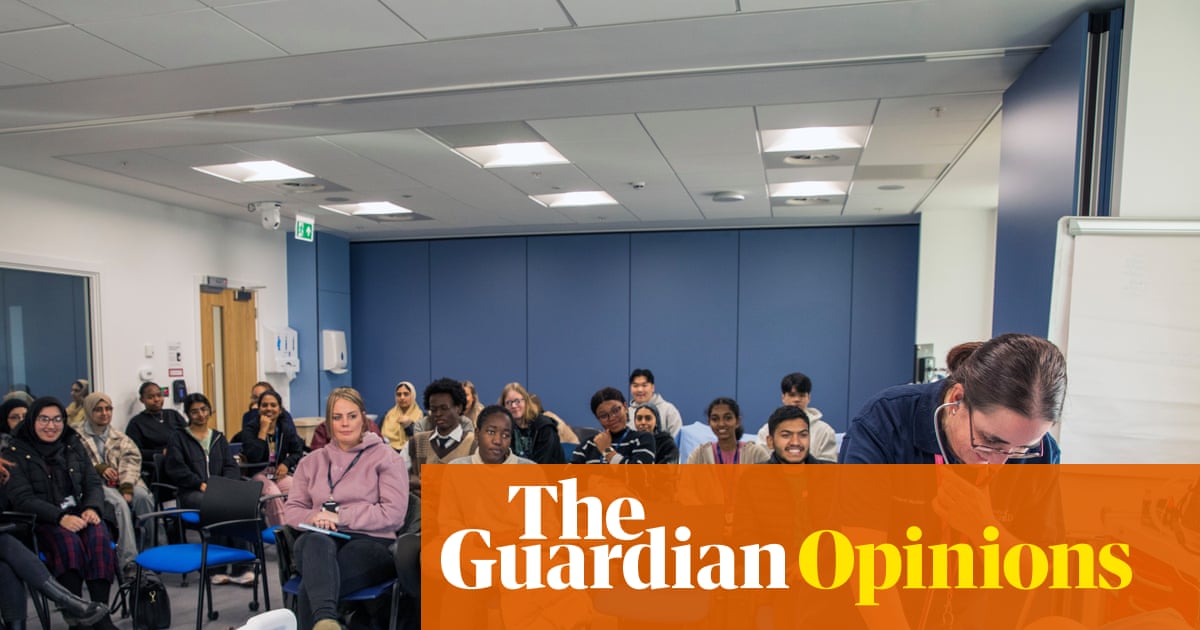
As important and accurate as Tania Roettger’s portrayal is, it unfortunately fails to mention key factors in the unstoppable rise of fascists in Germany (In Berlin, I took an evening class on fascism – and found out how to stop the AfD, 24 December).
It is not only the unbearable pandering of conservatives and reactionaries to rightwing extremists and their positions, but, above all, the fact that the federal government, composed of precisely these conservatives and reactionaries together with the Social Democratic party, is doing everything it can to maintain and reinforce the main reasons for voters drifting towards Alternative für Deutschland: threats to living standards due to rising costs of living and, above all, rising rents, accompanied by increasing social inequality.
As long as the federal government does not even attempt to halt these subjectively and objectively threatening developments, but continues to increasingly jeopardise social cohesion in the interests of global finance capital, the influx to the fascists will continue. This is much more important than symbolic firewalls and grandiose declarations.
And one more thing: just as National Socialism drew its momentum in the early 1930s from the fear of large sections of the population of big business on the one hand and Bolshevism on the other, today the combined fear of the global financial elite on the one hand and the ecologically necessary but ideologically condemned ecological restructuring on the other is fuelling the rise of rightwing authoritarianism.
Dr Jens Holst
Berlin
Tania Roettger’s reflection provides a necessary historical baseline, but it risks leaving us intellectually unarmed against the Fascism 2.0 movement’s 21st-century evolution. By searching for 1930s markers, specifically uniformed paramilitaries and explicit biological racism – we miss the “administrative fascism” currently taking root in western democracies.
The primary disconnect lies in the target and the terminology. Historical fascism (Fascism 1.0) was obsessed with ethnic purity based on 20th-century race science. Today’s far right has pivoted to “civilisational exclusion”. In a post-9/11 landscape, Islamophobia has become the functional equivalent of the antisemitism of the 1930s. By framing exclusion as a defence of “western values” against an “unassimilable” global south, modern movements practice racialisation without using the word “race”, making their ideology palatable to a liberal mainstream.
Crucially, we must recognise that targeted hate begets indiscriminate hate. When the state normalises the exclusion of one group, it erodes the legal and moral guardrails that protect all citizens. The requirement for a “paramilitary force” is now an anachronism; modern fascism weaponises the security state itself. From militarised border regimes to bureaucratic “remigration” plans, violence has become legalised and procedural.
Modern fascists no longer lead with “superiority” but with “siege”. By weaponising grievances over “wokeness” and “demographic replacement”, they frame authoritarianism as a defensive necessity. If we only look for the ghosts of 1945, we will remain blind to the fascism of 2025 and beyond. To stop this tide, we must address the functional reality of their agenda: the demonisation of the global south and the slow, administrative erosion of universal human dignity and rights.
Ahmed Dirie
San Jose, California, US
Clearly, the most eye-catching focus when monitoring and guarding against the growth of fascism is a separate party or movement with a set of explicit policies – including those outlined by Tania Roettger.
But in the current climate, in Europe and beyond, we should be equally wary of the roles both of the state itself and of dominant media. In the UK we can see, for example, a creeping heavy-handedness in policing and the use of designations of “terrorism” as a tool of state oppression. This is already reminiscent of fascism’s warping of the rule of law.
Meanwhile, popular media already mimics the worst excesses of 20th-century totalitarian propaganda by glossing over, ignoring and distracting from these abuses, while also giving a free pass to those on the far right. It is this convergence of interests, rather than “just” a specific and separate anti-democratic party, which gives cause for real concern.
Paul Gander
London