1 month ago
68
1 month ago
68
After a chaotic and miserable eight months, in which England’s Test team lost the Ashes in Australia, a home series against New Zealand, a captain, a coach, their once rampant self-confidence and a fair amount of respect, the appointment of Stephen Fleming gives them a chance to pivot towards a future that suddenly looks beguilingly bright, if mainly because for now it exists only in the imagination.
On Friday, Rob Key, the managing director of men’s cricket since April 2022, refused to admit to making any mistakes in that time. But as he explained the process behind Fleming’s recruitment, he occasionally and inadvertently damned himself. When he spoke about creating an environment designed to hone “all these players with so much potential who need refinement”, he said: “A lot of it’s about, can we bring someone in who can get this team to do the basics bloody well?” It probably didn’t need to take four years to realise such a person might be useful.
“You try and set things up so that you have the best chance of success – but not only success, to sustain success,” Key said. “That’s what English cricket’s got to do. We have moments where we win series. Australia has success and repeats it. That’s what we need to do. We can’t just have … a brilliant two or three years. We need it to be better than that. And that’s what I think is going to happen, going forward.”
With the ousted Brendon McCullum still on the payroll, and with no appetite to jeopardise recent improvements in the shorter formats, Key found himself in the awkward position of having lost faith in someone, while also having to recruit a replacement specifically to work alongside him.
“I’ve never met anyone who said a bad word about his leadership,” Key said of Fleming, who is an eminently qualified coach despite his prior focus on white-ball cricket, has broad experience of the English game, and is a great friend of McCullum’s.
He appears a very good answer to a very complex set of requirements, and was so irresistible that Key was happy to overlook the fact that his first act after being appointed in the middle of the English summer, and with three imminent Tests against Pakistan to be followed by two months of inactivity, will be to go on a family holiday.
His job, once he arrives in September, will be not only to improve the present team, but to give more consideration to its future. Key spoke about succession planning, and it has been clear since Ben Stokes – voluntarily – and McCullum – less willingly – left the dressing room that insufficient thought had been put into the preparation of England’s future leaders, both players and coaches.
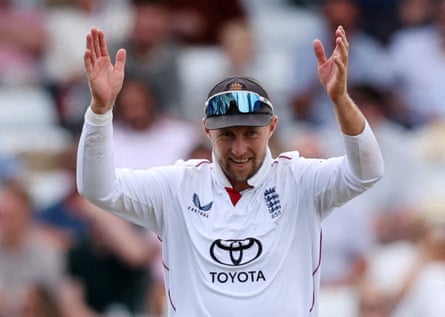
Fleming appears keen to remedy the coaching side. “One of the first things he spoke about was actually that we have a duty to bring coaches through, to upskill, to give them experiences,” Key said. “[Since] I started this job we’ve tried to make a lot of moves in how we educate our coaches, how we get the best people qualified, educated to do it. Now it’s not happened quick enough, but that’s a massive part of what we’re going to try and do. Stephen spoke about it at length. It’s not a quick fix. We have tried and we are trying with different levers to solve that. Next time, you don’t want someone to go: ‘I have to appoint an English coach.’ What you want is English coaches to be top of the list.”
The debate over the captaincy, and the decision to return it to the 35-year-old Joe Root, also demonstrated a paucity of alternatives. It is not true that England have made no attempt to encourage the next generation and it must be conceded that when they did so most clearly – by picking the then 21-year-old Jacob Bethell to captain last year’s T20 tour of Ireland, with the selector at the time Luke Wright talking about “providing him with the opportunity to further develop his leadership qualities on the international stage” – the move was widely criticised.
after newsletter promotion
But clearly Bethell is not ready to captain a Test team he has played in only nine times, and though Harry Brook is five years older at 27 and much more experienced he too was not deemed ready. “All of this happened a little bit too soon, probably,” said Key, whose position was that while important work had been done to prepare a couple of more senior players for the captaincy, by the time a vacancy arose those players had turned out not to be good enough to be in the team, let alone to lead it.
“The shame is their form got in the way of them being able to stay in the side,” he said of Zak Crawley and Ollie Pope. “Then that void wouldn’t have been there as much. I think we would have had two outstanding leaders … We’ve got leaders, they’re just in the white-ball setup at the moment.”
Fleming’s arrival is a chance to draw a line under the past four years, a time of spectacular success followed by an equally spectacular unravelling. “I’m as optimistic as ever that we’ve got the best people to take English cricket forward,” Key said. “I feel like we’ve had a speed bump in Test cricket over the last six months, but there’s so much potential.” That beautiful, imaginary future glows rosy on the horizon.