2 months ago
81
2 months ago
81
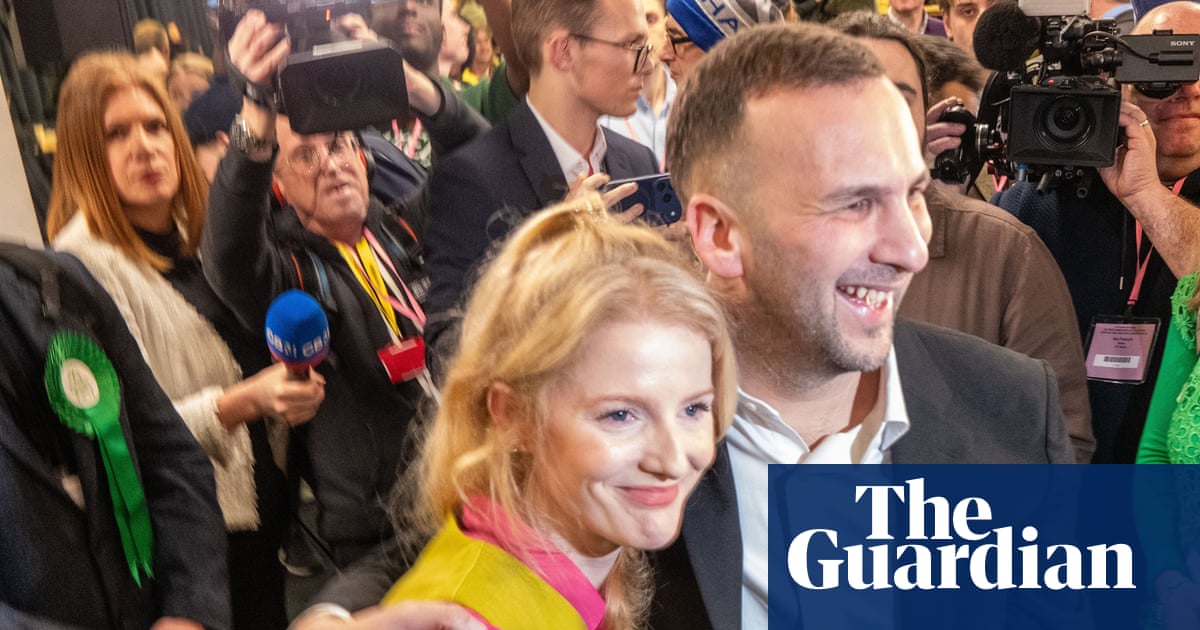
Kosovo’s prime minister, Albin Kurti has won an emphatic election victory, marking a resurgence for the nationalist leader and ending a political deadlock in Europe’s youngest state.
The win in Sunday’s snap election strengthens Kurti’s mandate to push through domestic reforms, including welfare expansion and higher salaries for public workers, although he faces significant problems including tensions with Serbia and health and education systems that lag behind Kosovo’s Balkan neighbours.
With nearly all votes counted, Kurti’s Self-determination party led with more than 49% of Sunday’s vote, official results show, meaning he requires only some small coalition partners to form a majority.
It is a sign of a turnaround for Kurti, whose failure to win enough votes in the last poll in February or form a coalition with larger opposition parties meant that parliament did not function for most of 2025, an impasse that led to delays in the delivery of about €1bn in international funding that is vital for one of Europe’s poorest countries.
At stake in Kurti’s fresh term is Kosovo’s relations with its international allies, including the US, and its attempts to join the European Union, which Kurti supports.
Ilir Deda, a political commentator, said: “It’s a political earthquake that has shattered the opposition parties, and we are going to feel the consequences of this result for the next decade.
“Kosovo has decided to replace this political pluralism with a model of very strong government and weak opposition, like other countries in the western Balkans.”
Sunday’s poll took place over the holiday period when Kosovo’s diaspora are typically at home in force, which may have aided Kurti, who was prime minister for four months in 2020 and has held the role continuously since March 2021. According to an exit poll by Ubo Consulting, 61.7% of people from the diaspora voted for Kurti’s party.
Tahir Shabani, 58, who lives in Germany but returned to Pristina, the capital of Kosovo, to vote, said: “We are tired of this nine-month blockade that has cost us our nerves, cost Kosovo millions of euros, and set back our development. With this result there is a solution, which is why we are happy,.”
Still, others wanted to see immediate changes after the impasse, especially in the quality of life, healthcare, and education. Skender Halimi, 52, who voted in Pristina, said: “Institutions must be established and the state must continue to function. We have a lot of work to do, just as the prime minister said. The budget must be approved, we must approve international agreements, and progress must be made“.”
Kosovo declared independence from Serbia in 2008 with US backingafter the 1998-99 war that ended in a Nato bombing campaign against Serbian forces trying to crush an uprising by the 90% ethnic Albanian majority.
Despite international support, the country of 1.6 million has struggled with poverty, instability and organised crime. While more than 100 countries recognise Kosovo’s statehood, Serbia, Greece, Spain, Russia and many others do not.
Tensions with Serbia flared violently in 2023, prompting the EU to impose sanctions on Kosovo – in part due to Kurti’s policies against the Serb minority that live in northern Kosovo. The measures are likely to have cost Kosovo hundreds of millions of euros.
While that damaged Kurti’s reputation at home and abroad, as campaigning began this month the EU said it would lift sanctions.
Deda said: “I think the electorate interpreted it as a sign that there are no problems between the Kurti government and the west.”