2 months ago
137
2 months ago
137
It is time to consign Diego Maradona’s Hand of God to a museum piece. For 40 years that moment and Maradona’s unforgettable “goal of the century” coloured the soul and passion of Argentinian football. Today things are very different, and the main reason is Lionel Messi. By asserting himself over the memory of Maradona, Messi is establishing a new Argentina.
An impressive 2–1 semi-final victory over England showcased a revitalised Argentina who go into Sunday’s final against Spain relying on a simple, powerful weapon: excellent football.
“For English football, this is more painful than the Hand of God,” Tomás Abraham says. He has dedicated his life to writing, studying philosophy and analysing society and the human condition, although his greatest passion lies elsewhere: football.
At 79, Abraham organises his daily schedule around Champions League and Premier League matches, which he follows from his spacious flat in Colegiales – a trendy neighbourhood in Buenos Aires – or from his book-filled office, where he shuts himself away for hours to write.
“The English consider the Hand of God to be illegal, a cheat,” Abraham says. “And this hurts all the more because they were defeated by a superior team that they were particularly keen to beat. The wound runs deeper.”
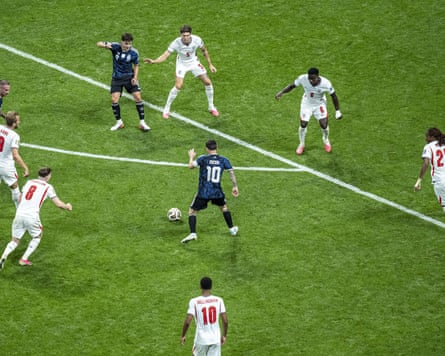
For many years, a large proportion of Argentinians looked down on Messi, clinging to the Maradona myth. Messi couldn’t be Messi; he had to be Maradona. While the rest of the world dreamed of having their own Messi, a staggering number of Argentinians maintained that he would dissolve like a sugar lump in a cup of tea the moment he came up against a couple of tough defenders in the Copa Libertadores.
Which is why Messi’s greatest triumph is that he has ceased to be viewed through the prism of Maradona and earned the recognition – and unanimous affection – of his people.
Maradona was more than a footballer; he was also the essence of Argentinidad, or at least a certain kind of Argentinidad. For a long time, it was impossible to understand Maradona without first understanding Argentina, but there came a point when it became impossible to understand Argentina without first understanding Maradona, so intertwined and similar had the two become.
Maradona embodied the brilliant and haughty Argentina, the Argentina convinced of its destiny as a superpower. That is also why Maradona felt entitled to express his opinion and pass judgment on everything: on George Bush and the pope, on Fifa, on his idols Fidel Castro and Hugo Chávez. He could say one thing and its opposite, loving and hating the same person in a matter of months.
A tremendous talent in many respects and often kind-hearted, Maradona was also adept at disparaging, hurting, attacking and provoking. Ultimately, he resembled his country too closely, with its great lights and inevitable shadows.
As the product of a good state education, Maradona was a man who understood the meaning and weight of every word. He had a talent for expressing himself, despite having been born and raised in very humble circumstances.
Messi, a child of a somewhat more spineless Argentina, lacks that talent; his vocabulary is limited, his sentences are short and lack depth, although they have improved markedly in recent years. This is how he feels comfortable, and this is how he has shaped a different kind of Argentinian football identity (and Argentinian identity).
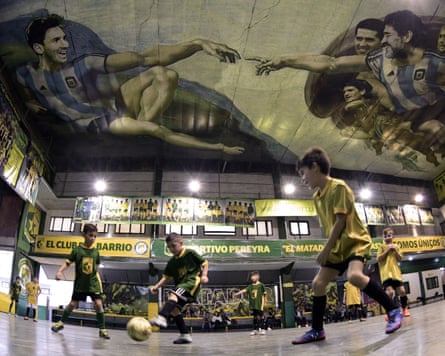
Carlos Mac Allister played alongside Maradona for Argentina. He is also the father of Alexis Mac Allister. He has been in the US for weeks watching his son at the World Cup and will be at the final.
“The difference between Diego and Leo is their private lives,” he says. “And that’s not to speak ill of Diego. I’m not going to explain what he himself has already said. Thanks to Diego being Diego, Messi is Messi today. With an understanding of what happened, Messi was able to work out how to take the game to the next level.”
Another explanation for why the Hand of God is in a symbolic museum lies in the inquest seeking to establish why Maradona died on 25 November 2020 and whether his death could have been prevented. The inquest was not front-page news here, nor did it generate sustained public interest. It was as if Argentinians, ashamed of the harsh circumstances in which Maradona died, preferred to subtly turn the page. And what better way to do so than by embracing Messi?
after newsletter promotion
After the victory over England, Messi expressed moving words for Maradona, who had once criticised his lack of leadership: “I’m sure Diego is enjoying this immensely from up above. Let him enjoy it, because it’s a gift for him too.”
To dwell on the Hand of God is to delve almost into football prehistory, to talk about something no longer possible, as the columnist Héctor Gambini pointed out in Clarín, Argentina’s most widely read newspaper.
“None of the players who took part in this Argentina v England match had even been born when Maradona scored his immortal goals,” he wrote. “Goals that VAR would have disallowed: the first for a handball by the Blues’ No 10. The second for a foul by the Blues’ No 2 [Sergio Batista] on the Whites’ No 4 [Glenn Hoddle], following which Argentina regained possession, the ball ended up at Maradona’s feet and, 13 seconds later, in the English net.”
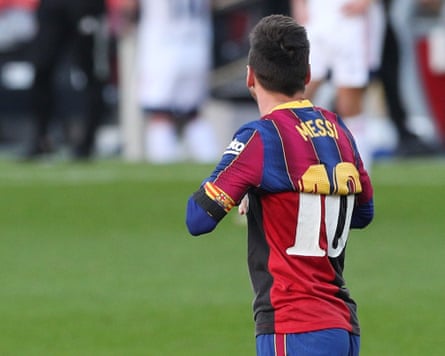
Mariano Israelit, one of Maradona’s closest friends, says Maradona is no longer No 1. “Diego was the greatest of all … up to a point. But Messi has now surpassed him; what Messi has achieved is unsurpassable. Diego played for a team like Napoli, which was basically 10 donkeys and Diego. Messi played for a Barcelona side surrounded by stars. We have to be realistic and honest; I take my hat off to Messi.”
Israelit criticises the English stance on their 1986 game by harking back to the 1966 World Cup final. “An Englishman has no right whatsoever to say that Maradona scored with his hand or that he cheated, because the only tournament they ever won, they won with a goal that wasn’t a goal.”
What can we expect from the final? Abraham does not look favourably on the European champions. “They ignore everything we’ve contributed to Spanish football: Alfredo Di Stéfano and Lionel Messi,” he says.
Argentina has enriched Spanish football, and Spanish clubs have helped Argentinian players develop. The list of Argentinians who have played and managed in Spain is dizzying: Di Stéfano and Messi, yes, but also Mario Kempes, Maradona, César Luis Menotti, Carlos Bilardo, Lionel Scaloni. The country’s greatest players and managers. And thousands more.
Mac Allister highlights that Argentina are no longer just Messi, as they were at the start of the World Cup. The team have woken up. “I see an Argentina team that had been playing at 60% of its capacity, but which played at 90% against England,” Mac Allister says. “Against Spain, it will need to play at 100%. One thing is clear: we were playing with heart and soul, but we were lacking a bit of finesse. Not any more – Argentina dominated England.”
Or, as the Uruguayan journalist Emiliano Hernández Pereyra puts it, fed up with many of his compatriots – frustrated after a very poor World Cup – criticising neighbouring Argentina: Argentina make them jealous.
“These lads have everything I want for my country, but there are a lot of stubborn Uruguayans. Do you think Argentina are just lucky? Please … It’s an extraordinary team; they’ve got a certain something that no other team has.”