2 hours ago
9
2 hours ago
9
Berlioz wrote his setting of the Faust story for concert performance, counting on the fact that what went on in his audience’s mind’s eye would be more fantastical than anything that could be portrayed on stage. The forces he employed aren’t on the same scale as those for his Requiem – written almost a decade earlier, in 1837, and heard here earlier this month – but are still huge. Here they came in the form of the period-instrument orchestra Les Siècles, plus the Choeur de Radio France and, joining in the closing five minutes, the Radio France children’s choir – conducted by Jakob Lehmann, making an energised Proms debut.
Les Siècles’ period instruments brought their own grainy texture to the palette, from the chattering piccolos representing Méphistophélès’s malignant spirits and the silky violin swoops lulling Faust to sleep, down to the inclusion in the orchestra of an ophicleide, an instrument that’s an evolutionary dead end on the tuba’s family tree. The Hungarian March sounded snappy, as did the brass fanfares, echoed at one point by a small band up in the gallery.
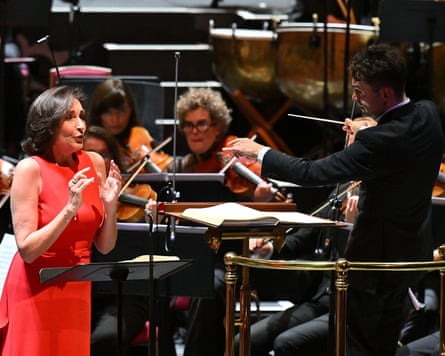
Yet alongside the vividly colourful passages were some that made you wish you could pick the performance up and put it down in a different, less tricky venue. In this very particular hall, Berlioz’s teemingly detailed music often needed more space from Lehmann or a crisper, more forensic approach to ensemble. As it was, the palette at times turned murky, the accompanying figures merging into a blur. And while it was in some ways a treat to hear the choral music sung so well – the Choeur de Radio France was 80-strong, and you rarely get to hear a professional choir on that scale – their well-blended sound didn’t always cut ideally through the orchestra.
The soloists were a strong team, with John Osborn’s tenor soaring incisively yet smoothly up to the heights in the title role, the soprano Véronique Gens singing especially radiantly in Marguerite’s first aria, and Thomas Dolié dispatching Brander’s drinking song with vigour. But it was Gerald Finley’s entrances as Méphistophélès – all black suit, scarlet tie and eyebrows – that made the dramatic aspect of this legend come alive.