2 hours ago
10
2 hours ago
10
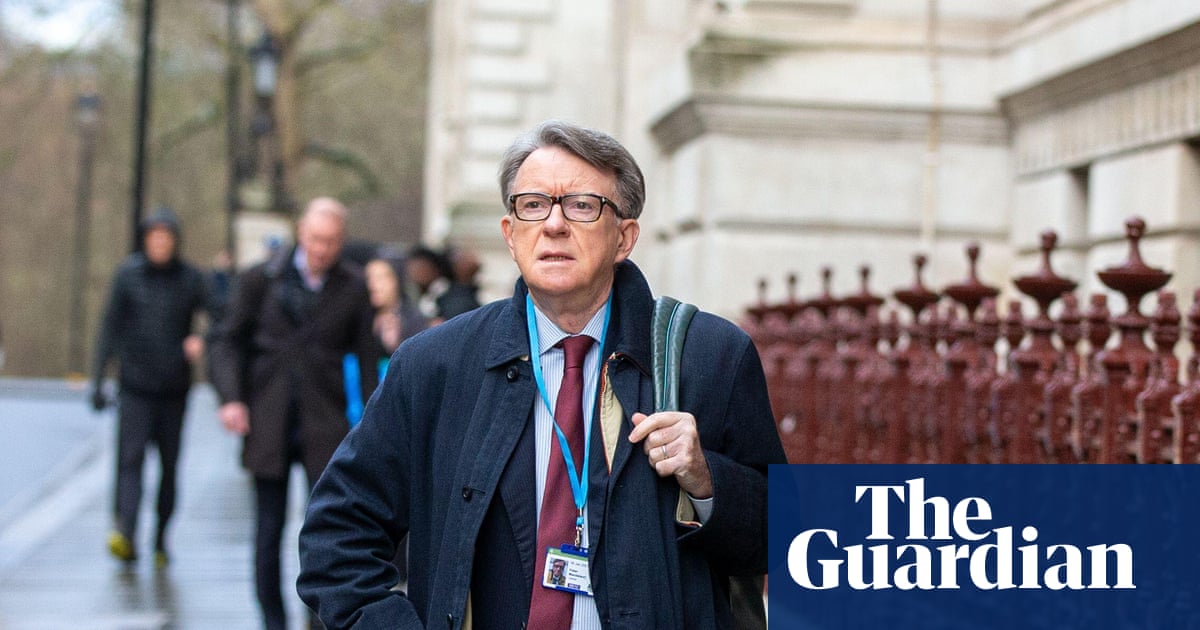
Peter Mandelson was receiving sensitive security briefings about the Foreign Office’s work, and was in discussions with the head of MI6, before he had completed the developed vetting process, newly released documents reveal.
Declassified emails show the ambassador designate and Richard Moore, the former chief of MI6 – a role known as “C” – had agreed to meet in early January 2025 before Mandelson went to Washington.
Before taking up the UK’s most high-profile diplomatic posting, Mandelson also believed he could see secret documents without vetting, because he held the position of privy councillor as a former cabinet minister, the files say. Officials eventually decided clearance was needed.
The documents published on Monday shed new light on the appointment of Mandelson as the UK’s ambassador to Washington.
But despite running to about 1,500 pages, some crucial documents were withheld, and MPs said many questions still remained unanswered.
The documents also revealed in embarrassing detail the internal Labour criticism of Keir Starmer, including by Mandelson himself, who said the prime minister tended to buckle under pressure and lacked verve.
Starmer’s decision to appoint him as the UK’s top diplomat has proven to be one of the most consequential decisions taken by the prime minister, unsettling his already restive MPs and raising questions about his political judgment.
An initial tranche of documents, disclosed by the Cabinet Office in March, had revealed Mandelson was offered a highly classified briefing from the Foreign Office (FCDO), as well as access to sensitive IT systems, before he was officially appointed to his role at the end of January 2025.
A month later the Guardian revealed the FCDO had overruled a decision to deny Mandelson security vetting clearance.
The latest documents provide some new details about the vetting process.
Mandelson, the documents show, was advised by the FCDO to submit a “handful” of names of his overseas contacts, including close ones, to “reassure” the security team he had been comprehensive – “even if it’s all quite artificial”.
The 1,500-page release, which was triggered by the humble address process, did not include information “prejudicial to UK national security or international relations”, after a redaction process carried out by the intelligence and security committee (ISC).
There were no details about the measures taken to mitigate serious security concerns that were raised about his appointment. The Guardian revealed last week these concerns included his associations with senior figures in China, Russia and Israel and a £1m loan.
Also missing from this tranche of documents was any evidence to back up the claim from Olly Robbins, the senior government official sacked for his role in appointing Mandelson anyway, that the vetting body had considered him to be “a borderline case”.
A nine-page summary document compiled by UK Security Vetting (UKSV) was not released after Scotland Yard confirmed it had requested that some documents not be made public, as they may use them in a future prosecution.
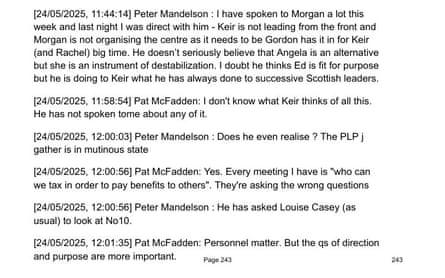
The Metropolitan police had already asked that emails between Morgan McSweeney and Mandelson over his links to convicted child sex offender Jeffrey Epstein, be held back and – the Guardian understands – messages to Starmer’s former chief of staff on the day of the cabinet reshuffle.
Another key omission is Mandelson’s declarations of interest form, a template of which was published in the first tranche, but the completed version has been withheld by the police. This document should detail any steps taken to mitigate commercial conflicts of interest.
The files reveal Mandelson “declined to comply” with a request to hand over his personal phone and allow the government to publish WhatsApp messages and other information related to his appointment.
But it is the revelations on Mandelson’s access to sensitive security briefings before he formally took up the role what will again turn the spotlight on Starmer’s political judgment in appointing him in the first place, a decision the prime minister has since said he bitterly regrets.
While he was still going through the developed vetting process, a meeting was agreed with C at MI6’s headquarters, apparently on 15 January 2025. Mandelson was not granted clearance until two weeks later.
As well as plans to meet C, emails note Mandelson had already met in early January with “Q”: the head of MI6’s technology branch, Blaise Metreweli, who has since taken over as the head of the agency.
Intelligence officials told counterparts in the FCDO that, in addition to meeting with C, they wanted to use Mandelson’s presence as a chance to “arrange wider briefings” on topics including Russia’sand Ukraine, China, counter-terrorism, cybersecurity and the Middle East.
At the same time, Mandelson was in the process of declaring to vetting officials his ties to top figures in Russia, China and Israel including Oleg Deripaska, who had been sanctioned by the FCDO.
An aide of Mandelson told MI6 they should be aware he had not yet received DV clearance but had been given access to “higher classification material on a case-by-case basis”. The official said it was for C and other senior MI6 officials to judge what was appropriate.
It is not clear from the documents whether Mandelson’s meeting with C and the security briefings went ahead.
The documents also reveal the difficulties faced by vetting officials seeking to gather information on Mandelson given the breadth of his contacts.
Mandelson asked them whether they wanted to know about “literally every foreign national I have ever met?” He was told to provide details of people he had “personal friendships with” or has “personal business connections to”.
Officials discussed potentially delaying a vetting interview due to a lack of detail about some of Mandelson’s contacts, leading one senior official to note: “This is crazy. He knows EVERYONE!! They need to go ahead with the interview.”
Darren Jones, the prime minister’s chief secretary, told MPs that some messages between Mandelson and ministers were not available due to disappearing messages, or device changes. He also told the Commons there would be a debate on the documents this Wednesday.
The documents were released after the Tories forced the disclosures about the appointment of Mandelson, who was sacked in September last year after documents published in the US laid bare the depth of his friendship with Epstein.
Since then, questions over the appointment have led to the departure of Starmer’s chief of staff, Morgan McSweeney, and the top official at the Foreign Office, Olly Robbins.