2 months ago
85
2 months ago
85
In the Philippines, she spent three years providing end-of-life care for a family’s grandmother. When the grandmother died, family members told the healthcare worker to arrange her own way to the United States, where they operated home healthcare facilities.
In California, they promised, she would have a place to stay and a stable job. They would look after her just as she had cared for their grandmother.
In 2018, the caregiver – who asked to be identified as Bella – arrived in Los Angeles on a tourist visa. She imagined herself working in healthcare facilities tucked in verdant hills or in beach communities.
Instead, Bella, 57, said she landed in a shadow network of home healthcare jobs. She was shuttled among multiple facilities to avoid compliance checks and paid a fraction of a living wage. One job lasted eight months, she said, and paid $30 a day for 24-hour patient care.
“I’m thinking: ‘How could I live with that situation?’” said Bella. In Filipino culture, the concept of utang na loob, or a deep-seated sense of obligation to repay kindness, kept Bella tied to the family that she said ultimately exploited her labor and left her undocumented in the US.
To break free, Bella lived in a church for months. Many in the same situation fall deeper into the cracks of a system ripe for abuse, but Bella eventually joined a workers’ rights group that provided immigration and social services. She now earns just enough as a part-time independent home caregiver to pay taxes and rent a small room with a one-window view.
That fragile sense of stability has been shaken by news of US Immigration and Customs Enforcement officers arresting people who look like her at workplaces and at immigration check-in appointments.
“It’s too much,” Bella said about the anxiety of the ICE arrests. She limits trips outside of home for essentials – which include work – because patients rely on her care.
In the US healthcare system, Filipinos make up a large percentage of the workforce – 4% of registered nurses are of Filipino descent, which is more than double the Filipino American population, according to National Nurses United.
The large number of Filipinos in healthcare work includes undocumented people, who fill workforce gaps and care for ailing people. Approximately 2% of undocumented immigrants in the US are from the Philippines, according to data from the Migration Policy Institute.
Amid heightened levels of immigration arrests, many Filipino healthcare workers say they are providing essential care while in the grips of anxiety over their own safety.
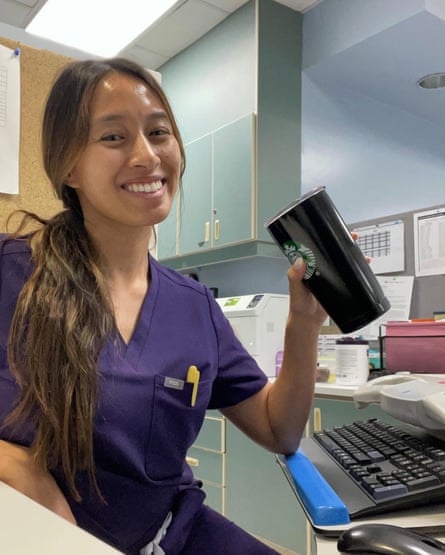
ICE agents have walked past Veronica Velasquez, a physical therapist, in the hallways of the Los Angeles hospital where she works. Her heart raced each time. The Philippines native was brought to the US when she was 11 years old and granted temporary protection under the Deferred Action for Childhood Arrivals (Daca) program. She understands intimately the fear and vulnerabilities of the undocumented community.
“This is a hospital that’s supposed to be for the community, and it does not feel safe,” said Velasquez, 33. “This is supposed to be a healing space. This is supposed to feel like a space where I should feel safe. This is my place of work, and it 100% does not feel that way.”
A history written in care
The presence of Filipinos in the US healthcare industry is part of a centuries-long history tracing back to the US occupation of the Philippines.
In the mid-20th century, nursing education exchange programs were set up between the US and the Philippines. By the 1970s, Filipino healthcare workers were being trained and exported to the US as skilled labor, said Valerie Francisco-Menchavez, a sociology professor at San Francisco State University and author of Caring for Caregivers: Filipina Migrant Workers and Community Building During Crisis.
Many schools and universities in the Philippines today offer nursing programs that help graduates find healthcare jobs in other countries. In the US, Filipino caregivers are part of the backbone of a healthcare system facing critical labor gaps, said Aquilina Soriano Versoza, founder and executive director of the Pilipino Workers Center of Southern California.
“[Caregivers] wouldn’t be coming here if there weren’t the need for the labor,” said Versoza.
Some immigrate on skilled worker visas or, like Bella, overstay tourist visas. Both paths leave caregivers vulnerable, especially since many support families back home.
Christina Fadriga knows the trade-offs. To provide for her four children, she made the solo journey to the US in 2006 to work as a caregiver.
“I’m proud to be a caregiver in America,” said Fadriga, 60. But lately, the ICE raids have put her caregiving community on edge. As a green card holder, Fadriga is required to split her time between the US and the Philippines to maintain her permanent resident status. Her children are grown now, but she always feels torn about her nomadic existence – especially now.
There’s a lot of fear in the community, said Fadriga. Fed by news and social media posts about ICE arrests and detentions – which have included permanent residents and US citizens – friends advised her not to return to the US.
Others urged her not to be afraid.
“But how can you not be afraid?” said Fadriga.
‘We care about people’
Healthcare workers know better than anyone what it means to live on borrowed time.
“Today you’re sick. Tomorrow, it could be someone else. The next day, it could be my mom or me,” said Angelica Mateo, a licensed vocational nurse and a contract specialist with SEIU-UHW at Kaiser Permanente’s Los Angeles area clinics.
Mateo, who immigrated as a child and became a US citizen in 2021, said her immigrant background made her especially attuned to patients’ anxieties.
“We got into this career because we care about people,” said Mateo, 39. “We never did it with the mentality of, like: ‘I’m going to be the best nurse for citizens only.’”
Almost 60,000 people are in ICE detention, according to federal data. In one case, a longtime green card holder was detained at a Seattle airport after visiting the Philippines.
Such stories ripple quickly through the Filipino American community, where being undocumented has its own unofficial name in Tagalog: “TNT” – tago ng tago, or “always hiding”.
Velasquez, the LA physical therapist, tries to be a reassuring presence for this community in hiding. She posts videos explaining patients’ rights and how to seek support if treating patients under ICE detention.
“We are human beings, just like any other citizen or non-citizen,” said Velasquez. “We are just here trying to survive, just like everyone else.”
Living and working in the grips of heightened immigration enforcement has taken a toll on Bella’s mental health, especially in hiding. Sometimes she imagines speaking directly with leaders in charge of immigration policies.
In those times, she imagines asking a simple question: do you have elderly parents or children who need care?
If so, chances are, in those homes, domestic workers just like her are performing most of the household care duties.
So, where is the utang na loob or sense of obligation to repay kindness for this kind of essential work?
“Most of the caregivers who are here, we are not here to harm America,” said Bella. “We are a help in this country.”