3 months ago
147
3 months ago
147
Key events Show key events only Please turn on JavaScript to use this feature
Details are still emerging about the attack on the US embassy in Baghdad, with some conflicting reports about what struck the embassy.
Two security officials told AFP the embassy complex was hit in the attack, though the exact cause was not clear. One security source said a drone had hit the embassy, while another said a projectile, believed to be a rocket had fallen on the diplomatic complex.
Earlier, Associated Press cited two Iraqi security officials as saying that a missile has struck a helipad inside the compound.
The embassy has not yet commented on the reports, but has perviously warned of “attacks against US citizens, US interests, and critical infrastructure”, saying that Iran-backed groups have “attacked US businesses and US-operated energy infrastructure and may continue to target them.”
The attack followed strikes that earlier killed two members of a powerful Iran-backed group in the capital.

Peter Beaumont
In its current phase, the Israeli-US war against Iran and its proxies has become a proving ground for two competing concepts of military escalation, each of which threatens to become a trap, writes the Guardian’s senior international reporter, Peter Beaumont:
On one side, Donald Trump and Benjamin Netanyahu have failed thus far in their ill-defined and shifting strategic aims. Despite killing Iran’s supreme leader, Ali Khamenei, and other key leaders in the opening salvo of the campaign, the clerical regime remains and Iran’s stockpile of highly enriched uranium is unsecured. Airstrikes are intensifying and hitting a greater number of targets.
Tehran’s counter is a “horizontal escalation”, one long prepared by the regime, that is intended to widen the conflict geographically, with strikes on the Gulf states, and also in terms of the costs to Washington and the global economy, not least in energy supplies.
The coming days and weeks are likely to reveal important lessons, not least about the potency of US military power in an increasingly fragile and multipolar world.
Read the full analysis below:
Iraq has downed a drone targeting a US diplomatic centre near Baghdad Airport, Iraqi security sources told Reuters. This follows reports earlier that a missile struck a helipad inside the US Embassy compound in the capital.
Trump says Iran 'totally defeated', 'wants a deal' he won't accept
US president Donald Trump said Friday that Iran has been “totally defeated” in the US-Israeli military campaign against the country and wanted a deal he would not accept, despite Iranian officials pledging to continue the fight.
The Fake News Media hates to report how well the United States Military has done against Iran, which is totally defeated and wants a deal - But not a deal that I would accept!” Trump wrote on his Truth Social platform, without elaborating.

Israeli military tells Iranians to 'immediately evacuate' an industrial area of Tabriz
The Israeli military has issued an evacuation warning for a designated industrial area in Tabriz, in northwestern Iran, saying it will “conduct operations in this area in the coming hours”. The warning, issued on social media, tells citizens to “immediately evacuate”.
Summary
Donald Trump has said Iran will be hit “very hard” in the coming days, describing leaders of the regime as “deranged scumbags” who it was a “great honor” to kill, as Tehran residents reported relentless bombing and violence continued to spiral across the Middle East, write Guardian journalists Jason Burke and Deepa Parent.
For the full report on the latest events, read the wrap here:
Missile strikes helipad inside the US Embassy compound in Baghdad
A missile has struck a helipad inside the US Embassy compound in Baghdad, two Iraqi security officials told Associated Press.
The US Embassy in Baghdad has not yet commented on the reports. On Friday, the embassy renewed its Level 4 security alert for Iraq, warning that Iran and Iran-aligned militia groups have previously carried out attacks against US citizens, interests and infrastructure, and “may continue to target them.”
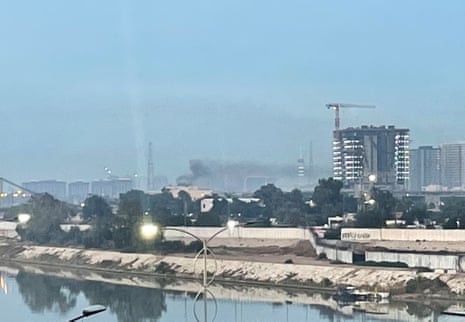
The embassy complex, which is one of the largest US diplomatic facilities in the world, has been repeatedly targeted by rockets and drones fired by Iran-aligned militias.
Opening summary
Hello and welcome to our live coverage of the ongoing conflict in Iran and across the Middle East.
Iran’s armed forces threatened on Saturday to destroy US-linked oil infrastructure after president Donald Trump said the US had bombed Iran’s oil hub of Kharg Island.
The military said in a statement cited by Iranian media that oil and energy infrastructure belonging to firms that cooperated with the US would “immediately be destroyed and turned into a pile of ashes” if Iran’s energy facilities were attacked.
The announcement was in “response to statements” made by the Trump, who earlier said on social media that strikes had “obliterated” military targets on Iran’s Kharg Island.
If you are just tuning in, here is a quick recap of the latest:
-
Trump said he had chosen not to wipe out the oil infrastructure on Kharg Island, which serves as the export terminal for 90% of Iran’s oil shipments. But he added: “Should Iran, or anyone else, do anything to interfere with the Free and Safe Passage of Ships through the Strait of Hormuz, I will immediately reconsider this decision.”
-
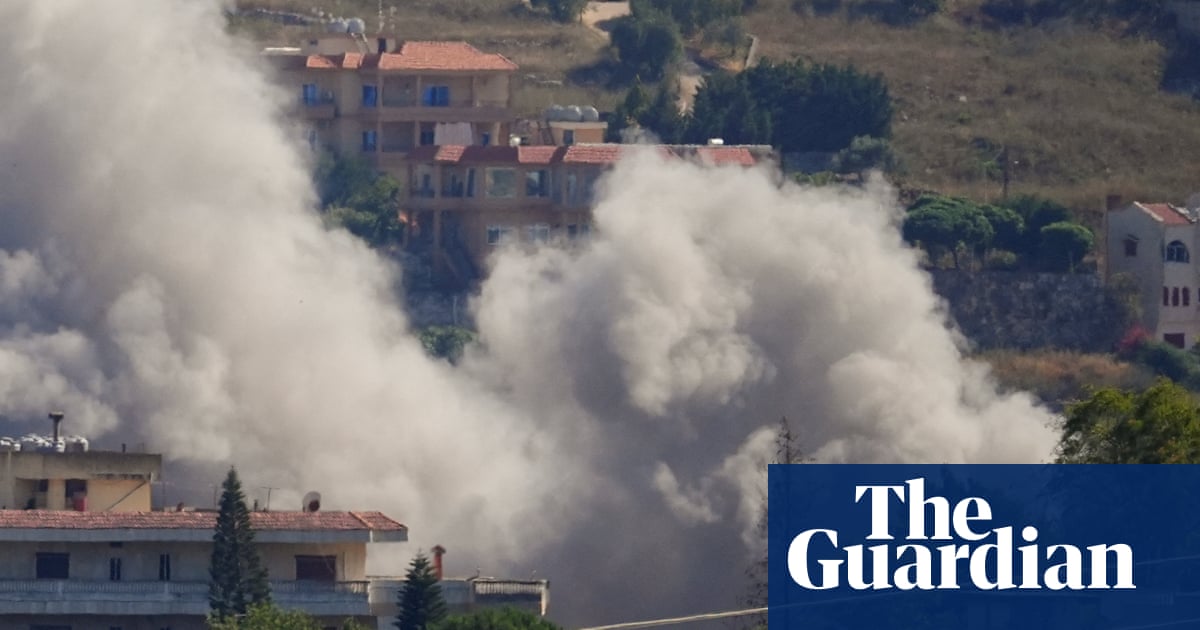
Explosions rocked Iraq’s capital Baghdad on Saturday after two strikes targeted the powerful Iran-backed group Kataeb Hezbollah, killing two members including a “key figure”, security sources told AFP.
-
At least 12 medical personnel were killed in an Israeli strike on a healthcare center in the town of Borj Qalaouiya in southern Lebanon, the Lebanese state news agency reported, citing the health ministry.
-
Israeli strikes have killed more than 100 children in Lebanon, according to the latest data from the Lebanese health ministry. A total of 773 people have been killed since Israel’s first strikes on the country on 2 March, with a further 1,933 people wounded, the ministry said in its daily report. It said 103 children had now been killed in the strikes, and a further 326 children have been wounded.
-
Qatar’s interior ministry said it was evacuating a number of “key areas” as Iran presses its retaliatory air campaign against Gulf countries. In Doha’s central Musheireb district some residents received phone alerts telling them to “evacuate the area immediately... to the nearest safest place as a temporary precaution”.
-
The US energy department said it expects initial deliveries of oil from its strategic petroleum reserve will begin moving to the market by the end of next week. Members of the 32-nation International Energy Agency, announced earlier this week they would unlock 400m barrels of oil in an effort to bring down prices.
-
The Pentagon is moving additional Marines and warships to the Middle East, the Wall Street Journal and other outlets reported. US defence secretary Pete Hegseth reportedly approved a request from US Central Command for an element of an amphibious ready group and attached Marine expeditionary unit (MEU). There are differing reports about the size of the contingent to be deployed, but the group typically consists of several warships and 5,000 Marines and sailors.
-
The UN under-secretary-general for humanitarian affairs and emergency relief coordinator, called for humanitarian aid to be allowed to pass safely through the strait of Hormuz as the US-Israeli war on Iran continues to disrupt one of the world’s most vital shipping routes. In a statement, Tom Fletcher said this will make it harder and more expensive to deliver critical supplies, including food and medicine. Only 77 ships have so far crossed through the critical waterway this month.