3 months ago
97
3 months ago
97
There’s a common sentiment among my hijab-wearing friends: a plain black headscarf is the equivalent of putting your hair in a slickback bun. A slickback bun is classic, timeless and polished – it can go with almost anything.
But, it can also look a little tired. I love bold prints, and it isn’t just me. A friend of mine gravitates toward leopard prints and pashmina-style scarves, a nod to her Kashmiri heritage. And it’s not only an aesthetic choice – for many hijab-wearing women, patterned scarves feel like a push against the idea that Muslim women should blend in.
Loud and proud printed hijabs are having a full-throttle revival. At London fashion week last weekend, hijab-wearing models appeared in jewellery-adorned scarves, inspired by traditional Yemeni fabrics, at the show of British-Yemeni designer Kazna Asker. Florals, tartans, polka dots, and graphic motifs fill my TikTok feeds. Keffiyeh-inspired designs sell out within hours. For gen Z Muslim women in particular, the printed scarf has shifted from something coded as “too much” to a deliberate part of an outfit.
Driving this resurgence is Vela, the US-based label founded in 2009 by sisters Marwa and Tasneem Atik whose scarves, featuring everything from Bambi-style prints to Syrian-inspired motifs, regularly sell out within minutes of going on sale. “There’s no better way to stand out in your style and your fashion than in the printed hijab,” says Tasneem. For her, this new wave represents a “boldness” among Muslim women, and an assertion of how they want to be seen. It signals a move away from blending in for safety and comfort, toward dressing in a way that stands firm in their identities.
The brand has become a cornerstone for young Muslim women online, spawning a subculture of ‘Vela girls’ who share styling tips and tutorials on TikTok and Instagram. Its popularity has even inspired knock-offs on fast-fashion sites such as Shein, prompting criticism that the fast-moving trend cycle risks feeding the same culture of overconsumption that modest fashion once positioned itself against.
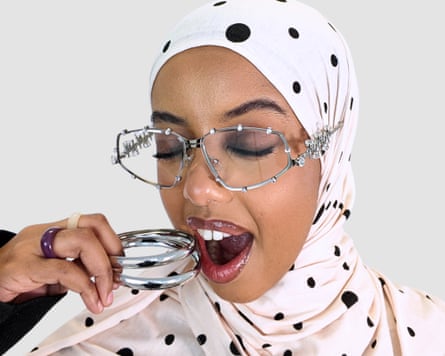
In the UK, Sooqlina, a London-based modest fashion retailer founded by Lina Salih in 2024, represents this new wave. After noticing there was a gap in the market for digitally printed jersey-material hijabs, Salih released polka dot and plaid headscarves, which sold out within a few days.
All of these colourful, patterned styles are a refreshing break from the hijab styles that dominated during the mid-2010s. This was when the aesthetic that dominated was sleek and controlled: chiffon fabrics, careful draping, and a palette of beige, taupe, and black that aligned neatly with fashion’s wider obsession with minimalism and quiet luxury. It was also when modest fashion became a more widely acknowledged term beyond Muslim circles or something?. Muslim influencers were launching their own hijab brands; online drops featuring neutral hijabs sold out.
For Hafsa Lodi, journalist and author of Modesty: A Fashion Paradox, these muted tones were more than a trend. “Besides aesthetic factors, the post-9/11 Islamophobia of the time also impacted how Muslim women dressed,” she says. “Donning neutral palettes rather than loud prints helped visibly Muslim [women] blend into a society that constantly ‘othered’ them.”
Salih remembers how, for many, darker colours became a “safety net”. “Post-9/11, Muslim women in the west wanted to blend in, stay safe, and not draw attention.” In that context, printed hijabs, common in diaspora households, began to feel excessive, harder to style, and easier to be read as “too much”.
Now, that narrative has flipped. Marwa Atik describes a post-Covid generation as “very much over being plain and solid and minimal”. They are also more likely to be political. Vela’s keffiyeh-inspired hijabs, some printed with Urdu phrases about strength and resistance, have repeatedly sold out since late 2023. But Marwa says, “it’s not a trend. People were doing it in solidarity” with Palestinians. Tasneem adds: “Muslim women are not afraid to be seen.”
“For most Muslim women who are first- or second-generation immigrants, prints have always been embedded in our culture and history,” says Salih. “Growing up seeing our mums and aunties wearing them confidently was the standard, not the exception.”
This shift to patterns is part of a booming global market. Muslim spending on apparel and footwear is projected to reach $428bn (£327bn) by 2027, and fashion influenced by Islam is increasingly mainstream – even as politicians continue to single out and stigmatise women that wear the hijab and burqa.
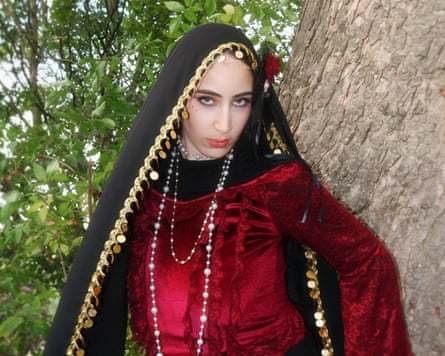
On social media, the results are evident. Diana Lomani, a 23-year-old social media manager and content creator who posts fashion content, describes the subcultures she has seen emerge: “There are Gyaru [a Japanese fashion subculture] hijabis now – that wasn’t a thing five years ago. People realise you can wear prints on your hijab like a T-shirt. When people see us styling hijabs uniquely, they realise we’re actually people instead of dehumanising us.”
At the same time, experimenting with her personal style has brought joy. “People tell me that they didn’t know a headscarf could be styled, it’s made me enjoy wearing it a lot more,” she says. Lomani often weaves her Palestinian heritage into her style, wearing headbands, decorated with tatreez (Palestinian embroidery), and gold coin jewellery with her headscarf. “It’s an invitation to spark conversation,” she says.
For the Vela founders, this reclamation of culture is integral. Many of their customers are women in the diaspora trying to connect with their roots. Their Baladi collection, loosely translated as “home”, was designed with this in mind. Their prints draw on cultural references and symbolism of Guinean, Egyptian and Pakistani cultures. In an increasingly polarising and Islamophobic climate, Marwa says this representation is a “form of resistance”.
Plain or black scarves might still be a go-to for comfort and familiarity, but seeing friends and other young Muslim women embrace bold and expressive personal style makes me feel part of something bigger. It’s energising to be in a generation that wears its culture and faith unapologetically on its sleeves … and on its heads.
To read the complete version of this newsletter – complete with this week’s trending topics in The Measure and your wardrobe dilemmas solved – subscribe to receive Fashion Statement in your inbox every Thursday.