2 months ago
58
2 months ago
58
Key events Show key events only Please turn on JavaScript to use this feature
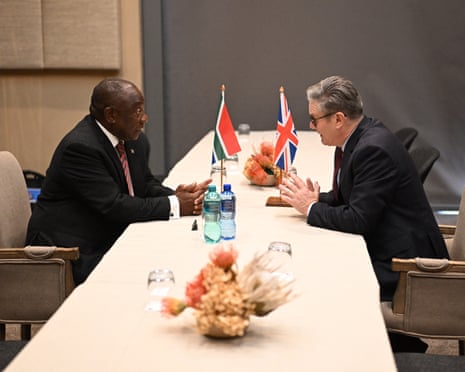
Prime minister Keir Starmer had a bilateral meeting with South African president Cyril Ramaphosa on the sidelines of the G20 summit on Friday.
The two leaders discussed the 11-hour flight from London to Johannesburg in brief remarks in front of reporters, according to the PA news agency.
“I wanted to be here,” Starmer told Ramaphosa. The South African president appeared in good spirits, joking that he would have to jump over the table to bypass waiting photographers and reach his seat.
Commenting on the latest energy price cap, Liberal Democrat energy spokesperson Pippa Heylings said that “it is time” for the government to “live up to their word” on bringing down energy bills.
Heylings said:
Energy bills are still far higher than five years ago, on top of sky-high mortgages and rents and prices in the shops.
The government has pledged time and time again to bring down energy bills – it is time for them to live up to their word and stop tinkering, committing to a real long term plan.
Liberal Democrats have a plan: we would slash energy bills in half by removing the renewables levy from bills, creating new energy loans for homeowners to insulate their homes and boosting renewables – the cheapest, cleanest and most popular form of energy.
Lib Dems to force vote on creating new customs union with EU

Rowena Mason
The Liberal Democrats are forcing a vote in parliament on creating a new customs union to put pressure on Labour MPs to take a more pro-EU stance.
Ed Davey’s party is writing to all Labour MPs urging them to back a new bill in favour of a customs union with the EU, believing this is the best way to boost growth and raise revenue, rather than tax rises.
The bill, tabled by Al Pinkerton, the Lib Dem spokesperson on Europe, will be voted on by MPs in early December, two weeks after the budget. It is largely symbolic and not likely to pass because it does not have government support.
However, the Lib Dems are hoping to demonstrate support among pro-EU MPs for the idea of a new customs union.
The letter highlights recent analysis from the National Bureau of Economic Research which found that Brexit has reduced UK GDP by 6-8%.
Separate analysis by the House of Commons Library commissioned by the Lib Dems has found that the boost to growth from a more ambitious trade deal with the EU could generate at least £25bn a year for the public finances.
The Lib Dems said they were calling for the UK to negotiate a new customs union with the EU, covering most goods but not agriculture, and in which the UK would be consulted during negotiations on new EU trade deals with third countries.
Davey said:
The chancellor has admitted the damage Brexit has done to our economy, including burying British businesses in mountains of red tape, yet the government is refusing to take the steps needed to fix it.
A customs union with the EU is the single biggest lever this government could pull to turbocharge the UK economy.
We will work with MPs across parliament who want a closer trading relationship with Europe – to cut red tape, boost growth, and properly fund our public services.
Treasury chief secretary James Murray said next week’s budget would set out how Rachel Reeves intends to “cut debt”. He said:
Currently we spend £1 in every £10 of taxpayer money on the interest of our national debt. That money should be going to our schools, hospitals, police and armed forces.
That is why we are set to deliver the largest primary deficit reduction in both the G7 and G20 over the next five years – to get borrowing costs down.
At the budget next week, the chancellor will set out how we will take the fair choices to deliver on the public’s priorities to cut NHS waiting lists, cut debt and cut the cost of living.
His comments came as official figures, released on Friday, showed that UK government borrowing stood at a higher-than-expected £17.4bn last month, marking the third highest level for October since records began.
The Office for National Statistics (ONS) said borrowing was £1.8bn less than in October last year.
The figure was more than the £15bn expected by most economists and higher than the £14.4bn forecast by the UK’s independent fiscal watchdog, the Office for Budget Responsibility (OBR).
Borrowing for the financial year to date was £116.8bn, which was £9bn higher than the same period a year ago.
Shadow chancellor Mel Stride said:
Borrowing so far this year has been the highest on record outside the pandemic. If Labour had any backbone, they would control spending to avoid tax rises next week.
He said the Tories had a “clear plan to control spending, live within our means, and reduce taxes”.
Responding to the latest ONS government borrowing statistics, Liberal Democrat Treasury spokesperson Daisy Cooper said:
This is just the latest reminder that the government is failing to turn things around – they lack any clear vision for our economy. At the budget we need a proper plan to kickstart growth, starting with a new UK-EU customs union.
Starmer calls Farage ‘spineless’ over tackling racism in Reform party
Kiran Stacey
Keir Starmer has accused Nigel Farage of being “spineless” when it comes to tackling racism in his party after the Guardian revealed allegations he made xenophobic and antisemitic comments while he was at school.
The prime minister said the Reform UK leader had “questions to answer” about the comments and chants alleged, which included songs about the Holocaust and accusations of bullying towards ethnic minority schoolboys.
He added Farage had a “track record” when it came to racism, pointing to his failure to discipline his fellow Reform MP Sarah Pochin after she complained about the number of black and brown people she saw in adverts.
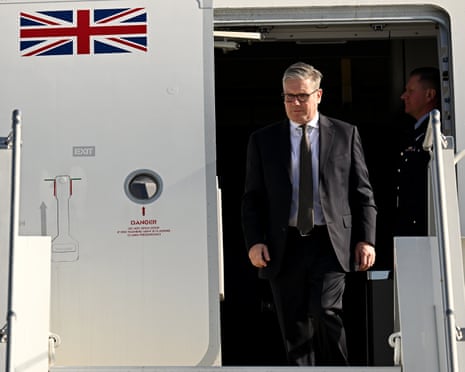
Speaking to reporters on the way to the G20 summit in Johannesburg, Starmer said:
He needs to explain the comments, or alleged comments that were made, and he needs to do that as soon as possible.
He hasn’t got a good track record in relation to this because Sarah Pochin, his MP, made some clearly racist comments and Nigel Farage has done absolutely nothing about it.
He added:
The man is spineless. If that had been someone in my party, I’d have dealt with it straight away. He needs to explain the latest allegations, and whilst he’s at it, he needs to explain why he’s too spineless to take action in relation to what is obvious racism in the comments of his fellow MP.
So far he’s said absolutely nothing about it. He’s got plenty to say on lots of things, apart from showing some leadership when it comes to racism.
The prime minister’s words mark his strongest condemnation yet of the Reform leader since the Guardian revealed earlier this week multiple allegations of racist language and behaviour while at Dulwich College, the elite south London school he attended.
Farage has denied the accusations, saying his school colleagues had misremembered events from 45 years ago. He added on Thursday night:
For the weakest prime minister in living memory to call me spineless is utterly ludicrous.
In response to Pochin’s conduct, Farage has called the comments “ugly” but not racist and has failed to take any disciplinary action against her.
On the topic of energy bills, energy consumers minister Martin McCluskey said today:
We know that energy bills remain too high. That is why we are taking immediate action, with millions more families receiving £150 off their bills through the expanded warm home discount scheme this winter.
We are taking the long-term action needed to bring down bills for good with the government’s clean power mission.
We are also delivering our new golden age of nuclear, with cheaper, clean electricity to power millions of homes, kickstart economic growth and create thousands of jobs.
However, shadow energy secretary Claire Coutinho disagreed. According to the PA news agency, she said:
Ed Miliband promised to cut everyone’s energy bills by £300 but more and more experts are sounding the alarm that his plans will lock us into paying higher bills for decades.
Despite gas prices falling, independent experts, energy suppliers and academics say it’s the extra costs of Ed’s net zero targets that are putting upward pressure on bills.
This week we had a report that green levies on bills will soar by another £260 by 2030. We simply cannot afford this – cheap energy has to come first.
Tim Jarvis, director general of markets for Ofgem, said:
While energy prices have fallen in real terms over the past two years, we know people may not be feeling it in their pockets.
The price cap helps protect households from overpaying for energy. But it’s only a safety net and there are practical ways that customers can pay less for their energy.
While wholesale energy costs are stabilising, they still make up the largest portion of our bills which leaves us open to volatile prices.
Households in Great Britain face surprise rise in energy bills from January
Jillian Ambrose
Energy bills will rise for millions of households in Great Britain from January, after the industry regulator announced a surprise increase in gas and electricity costs.
The energy regulator, Ofgem, said on Friday that the quarterly price cap covering January to March will rise by 0.2% for the average annual dual fuel energy bill to £1,758, from £1,755 in the current quarter.
Ofgem said, when adjusting for inflation, the cap is 2%, or £37, lower than the same period in 2025.
The change in the cap – which dictates the maximum that suppliers can charge their 29 million household customers for each unit of gas and electricity – amounts to an increase of 28p a month for an average household.
Tim Jarvis, the director general for markets at Ofgem, said:
While energy prices have fallen in real terms over the past two years, we know people may not be feeling it in their pockets.
The price cap helps protect households from overpaying for energy. But it’s only a safety net and there are practical ways that customers can pay less for their energy.
Bills for this winter are expected to remain about 50% higher than they were before the invasion of Ukraine triggered a rise in energy market prices that spurred the cost of living crisis.
The unexpected increase comes after experts at Cornwall Insight had said they expected prices to fall by 1% because of lower wholesale energy prices.
Ofgem said wholesale prices were currently stable and had fallen by 4% over the past three months, but that conditions remained “volatile”.
It said that the cap had risen after a change in its calculations for an average bill based on customer usage, and “temporary” increases to costs linked to the warm home discount scheme.
Starmer says he will 'robustly' protect UK's national insterests amid China trip rumours
Keir Starmer insisted he would “robustly” protect the UK’s national interests in response to speculation he will visit China early next year and the country’s controversial embassy in London will be approved, reports the PA news agency.
The prime minister said that no visit to China had yet been confirmed, while officials refused to comment on speculation about the planned embassy. But Starmer defended his approach to dealing with Xi Jinping’s country, which was to “cooperate where we can and challenge where we must, particularly on national security”.
The decision on the embassy is due next month. But as the Guardian reported yesterday, MI5 officers told the House of Commons speaker at a private meeting that they can tackle the risks of a proposed Chinese super-embassy in London, opening the door to its approval.
The Guardian understands that in a meeting held with Lindsay Hoyle in the summer, senior figures from the Security Service indicated they were “very relaxed” about the prospect of a 20,000 sq metre embassy being constructed at Royal Mint Court near Tower Bridge.
It is considered that the espionage risks stemming from the large outpost can be managed.
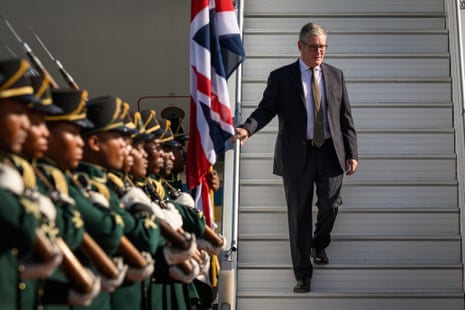
Starmer is at the G20 summit in South Africa, where China will be represented by premier Li Qiang. Asked if he would meet the Chinese premier during the summit, Starmer said:
The meetings I’m having at the G20 aren’t confirmed yet. Nor is any visit confirmed yet.
Our approach is the same approach as we’ve always taken, which is cooperate where we can and challenge where we must, particularly on national security.
You saw that this week, in relation to espionage, we had a statement in the house setting out the action the government is taking along with MI5 because we will always robustly protect our interests.
Critics of China fear the proposed new embassy, on a huge site close to the City of London and crucial data cables, will be used as a base for espionage.
A decision on whether to approve it will be made by Steve Reed’s Ministry of Housing, Communities and Local Government after a quasi-judicial process expected to end on 10 December.
Approval of the embassy would remove one of the diplomatic barriers ahead of the long-expected visit by Starmer to China as he seeks to build business ties with the world’s second-largest economy.
Agenda of the day
Here is the agenda for the day, according to the PA news agency:
Friday: Keir Starmer has arrived in Johannesburg for the G20 summit in South Africa. The pime minister is expected to have bilats at 9.20am before meeting business leaders and visiting a train depot at 11.55am.
10am: The third reading of the animal welfare (import of dogs, cats and ferrets) bill will take place in the House of Lords. It is also the second day of the committee stage in the chamber for the assisted dying bill.
3.30pm: Starmer will co-host the Global Fund Summit with South Africa president Cyril Ramaphosa.
Liz Kendall is on morning media round for the government, while shadow chancellor of the duchy of Lancaster Alex Burghart is on for the Conservatives.
National security 'will always come first', says cabinet minister amid reports government could approve new Chinese embassy
Good morning and welcome to Friday’s UK politics blog. National security “will always come first”, science secretary Liz Kendall said this morning amid reports the government could approve a new Chinese embassy in London.
Kendall declined to comment directly on the reports, saying decisions on the embassy “will be taken through the proper process”. But she told Sky News:
We are clear-eyed about our relationship with China and national security will always come first. That is absolutely non-negotiable.
But where we can safely work with China, whether that’s on the economy or areas like research, that’s what we’ll do, because we want to get the best outcome for the British public.
Asked about reports that Keir Starmer could visit China next year, she said:
I don’t know about the prime minister’s diary plans for the new year, but what I do know is that he takes all of those issues extremely seriously.
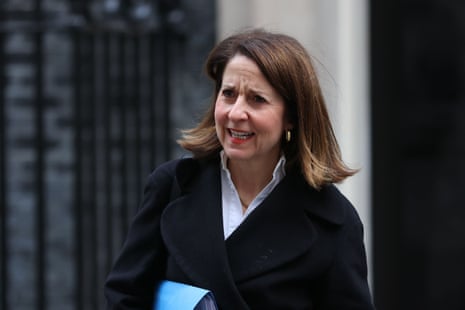
In other news, the UK government borrowed more than expected in October, official figures show, in the final snapshot of the public finances before Rachel Reeves’s crunch budget.
The Office for National Statistics said the government borrowed £17.4bn last month. That was lower than the same month last year, but still marked the third highest October deficit in the public finances on record. It is also higher than the £15bn City economists had forecast.
Speaking on the morning media round, Treasury chief secretary James Murray said next week’s budget would set out how Reeves intends to “cut debt”, saying that money spent on national debt should instead be going to “our schools, hospitals, police and armed forces”.
Meanwhile, household energy bills are to rise by 0.2% from 1 January after Ofgem increased its next price cap. The regulator said energy bills will rise by about 28p a month for the average dual-fuel household in England, Scotland and Wales.
Responding to the news, shadow energy secretary Claire Coutinho criticised Ed Miliband, claiming that “his plans will lock us into paying higher bills for decades”. Coutinho said:
Ed Miliband promised to cut everyone’s energy bills by £300 but more and more experts are sounding the alarm that his plans will lock us into paying higher bills for decades.
Despite gas prices falling, independent experts, energy suppliers and academics say it’s the extra costs of Ed’s net zero targets that are putting upward pressure on bills.
This week we had a report that green levies on bills will soar by another £260 by 2030. We simply cannot afford this – cheap energy has to come first.
I’ll bring you updates on all of the above and more as they come in. But first, here are some other developments:
-
Keir Starmer has defended his decision to travel to South Africa for the G20 summit days before the budget and despite the planned absence of Donald Trump. The prime minister arrived in South Africa on Friday morning for two days of summit discussions and bilateral talks on topics including sustainability and economic growth.
-
Starmer has accused Nigel Farage of being “spineless” when it comes to tackling racism in his party after the Guardian revealed allegations he made xenophobic and antisemitic comments while he was at school. The prime minister said the Reform UK leader had “questions to answer” about the comments and chants alleged, which included songs about the Holocaust and accusations of bullying towards ethnic minority schoolboys.
-
The UK’s response to Covid was “too little, too late”, a damning official report into the handling of the pandemic has concluded, saying the introduction of a lockdown even a week earlier than happened could have saved more than 20,000 lives. In a written parliamentary statement, Starmer addressed the failings identified in the report of the previous government.
-
Rachel Reeves has been urged by 40 Labour MPs to drop plans to fund NHS buildings with private finance initiatives (PFI) that would saddle the health service with debt. The Labour MPs, including Cat Eccles, Clive Lewis and Rebecca Long-Bailey, pressed the chancellor to commit to investment in the NHS without the use of private capital and warned that a return to the New Labour era of private funding for public projects would be damaging for trust in the government.
-
The Liberal Democrats are forcing a vote in parliament on creating a new customs union to put pressure on Labour MPs to take a more pro-EU stance. Ed Davey’s party is writing to all Labour MPs urging them to back a new bill in favour of a customs union with the EU, believing this is the best way to boost growth and raise revenue, rather than tax rises.