3 months ago
122
3 months ago
122
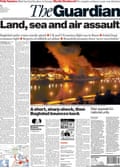
The allied attack on Iraq began on 20 March 2003. The Guardian’s 4am edition on Friday 21 March carried the headline: “Land, sea and air assault.” The report was by Julian Borger in Washington and Rory McCarthy in Camp As Sayliyah, on the outskirts of Doha, the capital of Qatar. It opened: “The ground war began in Iraq last night as British and American marines stormed beaches on the Gulf coast in an assault on the south-eastern city of Basra, while explosions lit up Baghdad under a heavy bombardment by cruise missiles.”
The first British fatalities came shortly afterwards when a US helicopter crashed in Kuwait, killing all on board. Suzanne Goldenberg’s front-page report from Baghdad revealed that only two hours after the decapitation effort, Saddam Hussein himself had made a defiant appearance on television. A Guardian leader stated that the plain fact was this first “surgical strike” had missed its mark. Even had it reached its target, it would have been difficult to applaud. “State-ordered assassination sets an abominable precedent that encourages unwelcome emulation … The US must tread carefully – for the legal and moral grounds for this war are already very shaky.”
By then, events had moved on. The violent display of the “shock and awe” assault on the regime’s infrastructure in and around the capital came that same night. The headline on the Saturday 4am edition read: “Full-blooded onslaught is launched on Baghdad”. Julian Borger, Richard Norton-Taylor and Rory McCarthy contributed to the report, describing the “successive waves of aerial attacks on centres and symbols of Saddam Hussein’s power in an attempt to break the nerve of his regime”. The presidential complex on the west bank of the Tigris River was razed in little more than 10 minutes.
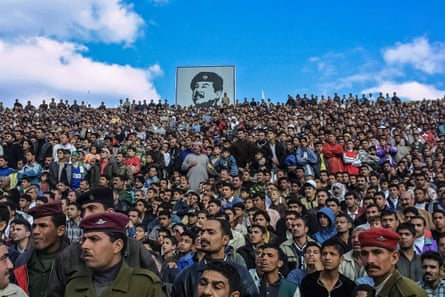
Goldenberg and the photographer Sean Smith had already been in Iraq for a couple of weeks when the impending war began to close in on normal life. Smith’s photographs of what would be one of the last meetings at Baghdad racetrack, a football match and a wedding party all had more than a touch of pathos. Smith, via Israel-Palestine and Afghanistan, was already known for chronicling the casual brutalities of war. No one would better capture “the indignity and smoky pointlessness” of the Iraq conflict than Smith, as the Channel 4 News presenter Jon Snow put it in an introduction to a collection of his work.
“Sean totally had my back in Iraq or in Lebanon,” Goldenberg said. “There are lots of people I won’t go out with in war situations; I don’t want to be with somebody who is not calm. I’m not saying you shouldn’t be afraid, but you should be able to deal with your fear. You should know when to leave, when you’ve got enough and when to go, and how to weigh those dangers. I never worry about that with Sean. I’d never, ever, even for an instant think that Sean would ditch me in a difficult situation.”
He was also very good with people, despite having an awkward relationship with the picture desk in London, which left him for periods feeling, to use his word, “ostracised”. It could be that, with camera in hand, he moved more easily in the menacing air of Iraq at that time than in the subtly politicised atmosphere of the Guardian’s offices in Farringdon Road.
Smith had arrived burdened with a satellite phone (its use was forbidden in the hotel, the dish being likely to attract gunfire) and old-fashioned photographic equipment, including cumbersome developing trays and liquids. This was in case the weapon that the Americans were threatening to use to put Saddam’s electronic equipment out of action should accidentally do the same for the Guardian’s. Smith neglected to provide himself with the strongly advised helmet, flak jacket and chemical warfare protection suit. This was not bravado or the dangerous idea of a charmed life. It was more like fatalism, arising out of his idea of the random nature of war.
For the moment, Smith and Goldenberg had to observe the “shock and awe” attack on Baghdad from the relative safety of the Palestine hotel on the eastern bank of the Tigris (they were still staying at the hotel in April when a US tank fired a shell at a 15th-floor balcony, killing two cameramen).
An image of the blitzing of Baghdad ran across the front page, alongside Goldenberg’s account: “From the east side of the river, it was like watching a gigantic video game. As soon as one building was hit, low-flying jets struck again, barely before there was time to register the damage. They set off great jets of fire as easily as the flick of a cigarette lighter … People crept out of their homes and drifted towards the collection of riverside restaurants for a better view. It was impossible to deny the sense of shock that descended on Iraqis, reduced to spectators to the elimination of a regime that had controlled every aspect of their lives since the time before many were born.”
The foot of the page was taken up by a vivid dispatch from James Meek in the southern Iraqi town of Safwan. “Yesterday afternoon a truck drove down a side road … laden with rugs and furniture. Booty or precious possessions? In a day of death, joy and looting, it was hard to know. As the passengers spotted European faces, one boy grinned and put his thumb up. The other nervously waved a white flag. The mixed messages defined the moment: Thank you. We love you. Please don’t kill us.”
James Meek was not among the several hundred journalists embedded with US and British forces. Embedding was a device that, viewed one way, provided reporters with unprecedented access to the action; viewed another way, it was a system that enabled the military hosts to exercise tacit or actual control over media coverage. Meek, by various definitions, was a unilateral, or a “maverick”, “out of pool” journalist – that is, a journalist working exclusively for his employer and not required, as pool reporters attached to the military were, to share his reports with other papers. The great advantage the unilateral gained was easier access to the Iraqi citizens. Yet in the end, the differences were not so sharply defined. The free-range Meek, as the war progressed, confessed to becoming attached “by an umbilical cord” to army units, who were often helpful. “The CIA even lent us jump-leads to start our car,” he said.
Meek’s colleague, Jamie Wilson, was one of the embedded, in his case with the Royal Navy on HMS Marlborough as it made its way up the Khor Abdullah waterway to shell Iraqi positions on al-Faw peninsula. His satellite and mobile phones were confiscated as he boarded. He was told in advance when the invasion would start and his conversations with the news desk over the ship’s secure radio were closely monitored, “presumably to curb my natural instinct to shout, ‘It’s going to start on Thursday!’” he said.
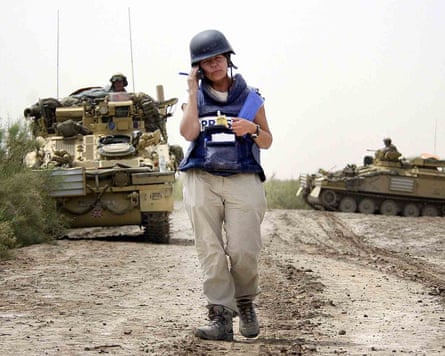
More dramatically, Audrey Gillan was embedded with the 105 men of the Household Cavalry’s D Squadron, an advance reconnaissance arm of the 5,500-strong 16 Air Assault Brigade. A persistent criticism from other journalists was that the embeds, whether working for visual media or print, quickly assimilated, identifying themselves with their host units – typically through the use of what some saw as the incriminating pronoun “we”. In fact, Gillan very rarely used it in that way. An exception was a piece in which she wrote about the squadron’s first rest after it had been on the frontline for 13 days and lost three men – one killed by friendly fire, the others in an accident when their Scimitar tank overturned into a canal. The half a dozen times “we” cropped up in her report indicated relief at the respite from danger.
Gillan remembered how it began. The introductions had been made at Camp Eagle in Kuwait. “Along with Daily Mail photographer Bruce Adams, the only other journalist with the squadron, I was shown into a large Bedouin tent filled with semi-naked, tattooed soldiers, men I would come to spend the next five weeks with. Towards the back were the officers, and it was here that I found squadron leader [Maj] Richard Taylor. He sat us down and said, in the politest of Household Cavalry tones: ‘When we are out in our vehicles in the field we live together, eat together, sleep together, fart together and wash our bollocks together. Do you think you can handle it?’ … I was shouted at and ordered around – I simply became ‘one of the boys’. Learning to swear like a trooper probably helped, too.”
The Household Cavalry had come under heavy attack from Iraqi artillery and in fierce battles with T-55 tanks. Gillan wrote: “I watched men desperately try to resuscitate their fallen colleagues and shake at their inability to fight with fate. I saw them weep as they learned of the death of men they had spoken to just that morning, men they had worked with for years, drunk with, played football with. Sometimes, as we took incoming fire, they hugged me, but they hugged each other as well.”
Despite prewar pledges to do everything possible to minimise civilian casualties, there were the inevitable disasters. Less than a week into the war, a bomb struck a market in Baghdad, killing 14 people: “Wayward bombs bring marketplace carnage”, read the headline on Goldenberg’s report. The accompanying photograph of a clearly recognisable victim of the bombing was taken by the Serbian photographer Goran Tomašević of Reuters. The paper was both praised and strongly criticised for publishing it.
Near the beginning of April, in an article for G2, Fiachra Gibbons addressed the threat the war posed to Iraqi antiquities. He described the dangers of irreparable loss in a country that was a treasury of ancient cultures. It was an augury of worse to come. Ten days later, a dispatch from Luke Harding was headed: “Mosul descends into chaos as even museum is looted”. Harding reported that the Pentagon had promised that thousands of soldiers would prevent such things. In the event, they were nowhere to be seen. Two days after this, Jonathan Steele’s report from Baghdad drew attention to the Iraq Museum, which was suffering the same fate.
Yet it was the human casualties that made the deepest impression. One of the most moving dispatches came from Goldenberg on 9 April 2003. It marked the last hours of resistance to US forces as they swept through the capital. It ran on the front page. The headline was simply a quotation from Goldenberg’s text: “A picture of killing inflicted on a sprawling city – and it grew more unbearable by the minute”. A six-column photograph by Jerome Delay of Associated Press was captioned: “Bodies lie on top of each other in the morgue of al-Kindi hospital in eastern Baghdad where the flow of casualties has overwhelmed doctors.”
Goldenberg had gone to see for herself: “In two adjoining stalls of the casualty ward of Kindi hospital, the main trauma centre of eastern Baghdad, a girl, long black plait held off her forehead by a red alice band, was laid out beside her little brother. Their mother lay across the aisle, beige dress soaked in blood from hem to armpits. Another brother slumped on the floor, insensible to the fact that he was sitting in his mother’s blood. A neighbour who had followed the family to hospital said the girl had been called Noor Sabah and was 12 years old, though she looked smaller next to the doctors who surged into the examining cubicle. Her brother, Abdel Khader, who began the day neatly dressed in dark trousers and a check shirt, was four or five. When their two small corpses were loaded on to the same trolley to take them to the morgue, even the nurses were reduced to tears.”
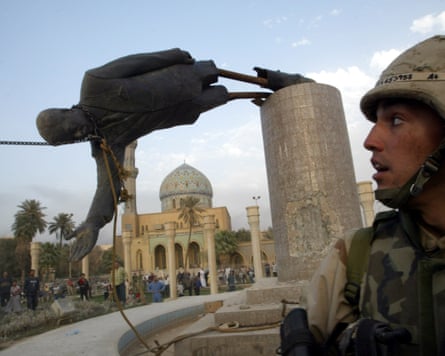
The collapse of the regime was – too neatly – symbolised by the toppling of the statue of Saddam in Firdos Square on 9 April 2003. The following day’s Guardian carried Goldenberg’s 1,800-word account beneath the headline: “The toppling of Saddam – an end to 30 years of brutal rule”. After witnessing the statue’s fall, Goldenberg headed across the Tigris to Saddam City, a huge, overcrowded residential district. “The tanks had been and gone, and a carnival of looting was under way … There was no sign of police, or the militias from the ruling Ba’ath party … Saddam City was in the grip of the very nightmare Iraqis had envisaged for the ending of this war: rioting and lawlessness.”
Harding, who had been in Kurdish northern Iraq for several weeks, was able to record ecstatic scenes in Sulaymaniyah, the regional capital, when news of the collapse of Saddam’s regime seemed finally incontrovertible. Thousands celebrated and a group of US special forces soldiers were mobbed with shouts of “I love George Bush” and “We love America. We love Britain.”
Harding and Steele, who had made the journey out from Baghdad, were both present when US marines took over Saddam’s home town of Tikrit. It marked the end, the Americans announced, of “major combat operations” in Iraq.
A flurry of polls and statistics accompanied the fall of Baghdad. A new Guardian/ICM Iraq tracker poll showed support for the war running at a record level of 54%, having risen from only 29% in mid-February. Opposition had dropped to an all-time low of 23%. But as Bush delivered his televised victory address to the US nation, the accompanying Guardian leader carried a note of caution: “War’s loose ends – Iraq is not yet as free as Bush claims”. Was it worth it, after all? “Mr Bush and Mr Blair seem to have no doubts even though both Saddam and his weapons remain embarrassingly elusive … A free Iraq would certainly be a laudable achievement. The trouble is, for all Mr Bush’s jolly nautical self-congratulation, it has not happened yet.”
The deputy features editor, Charlie English – who in the run-up to the war had produced an edition of G2 devoted to the cautionary horrors of the war over Kuwait – now produced another special edition of G2 devoted to some of those who had lost their lives, whether American, British or Iraqi. As in the 1991 war, he had been struck by the absence of any accounting for the loss of Iraqi lives. The Guardian’s attempt to compile a memorial that regarded deaths impartially, so far as nationality or allegiance were concerned, personalised the war in a way that some found objectionable. “So once again the Guardian comes over all sanctimonious about the Gulf war dead,” wrote one reader. Others thought it showed G2 at its best. “We had ambitions to do many more but it was very difficult to do,” said English. “Many people still wrote thanking us for it.”
There were other voices demanding to be heard, including those from the generation who had grown up in Baghdad under the Ba’athist regime. Throughout the war, the Guardian had published work by two Iraqi friends in their late 20s, both of whom worked initially as interpreters for western journalists. Both came from middle-class Baghdad families. They had been at school together, studied architecture at university and had a strong urge to share the experience of their lives in Iraq as Saddam Hussein’s regime came tumbling down.
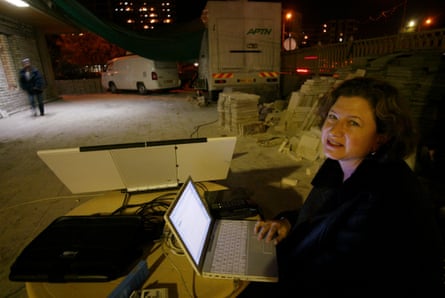
Up to and through the conflict, Salam Pax, the slightly older of the two, was establishing an international following as the “Baghdad Blogger”, despite determined attempts by the regime to close down communication through the internet. His web diary became, for many thousands in Britain and elsewhere, a point of contact with an Iraq they felt it easy to identify with.
Salam’s terrestrial base was his “chaotically untidy” bedroom in his family home in a well-to-do suburb of Baghdad, although he also wrote from the architect’s office where he was employed. His pen name (which combined the words for “peace” in Arabic and Latin) was a pseudonym for Salam Abdulmunem. By the time the war started he was already, in the Guardian’s estimate, “the most famous web diarist in the world”.
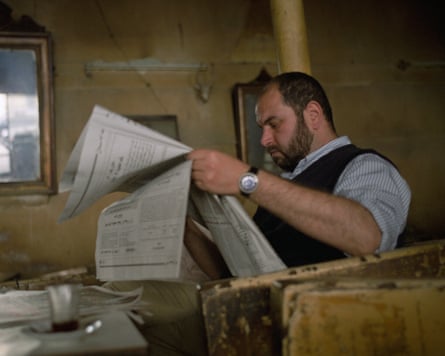
As features editor Ian Katz wrote, “Salam’s diary was quite simply the freshest, most exciting writing coming out of Iraq. Two things were instantly striking. The first was its almost giddy irreverence about Saddam’s regime … The second was he was just like us … addressed us in perfect idiomatic English, was obsessed with David Bowie lyrics and awaited the release of the new Massive Attack album as eagerly as any Glastonbury regular … Another ingredient added to the diary’s powerful, subversive appeal: it was, heaven forfend, very funny.”
So easily accessible did some readers of the blog find it that they were sceptical of the author’s authenticity – something Salam found greatly irritating, as he told Rory McCarthy, who tracked him down to his home in May 2003.
War had been an almost permanent background to the lives of his generation. He would write in his blog on 12 February 2004, addressing the victors, “Saddam is gone, thanks to you. Was it worth it? Be assured it was. We all know that it got to a point where we would have never been rid of Saddam without foreign intervention; I just wish it would have been a bit better planned.”
Ghaith Abdul-Ahad, the other friend, was fully identified by his real name on his first appearance in the Guardian, quoted in a report by James Meek as Baghdad fell. Meeting Meek turned out to be a life-changing moment. Both were in the centre of the city when the statue was toppled. Abdul-Ahad had started his day by going to the hotel where the western journalists were lodged, only to be waved away. He went on to Saddam’s palace and then to the headquarters of the Mukhabarat, the Iraqi intelligence services, where he was also turned away. “I saw a red SUV coming, and tried to get a ride.” He chanted the words that had worked elsewhere. “‘Hi, I am British journalist, blah blah …’ ‘Oh really?’ answered the man behind the steering wheel. ‘What a coincidence! So are we. I’m a Guardian reporter. Who are you working for?’ ‘Well, uh … freelance.’ By the end of that day, I had my first job in the world of journalism with that reporter, James Meek. We walked into town, James and I, and saw people burning and looting. I was happy: yes, destroy everything, undo the last four decades of the totalitarian regime, because from this carnage a new country will be built.”
For the first year, working for the most part as a fixer and interpreter, Abdul-Ahad took a view on the war similar to that of his friend Salam Pax. Writing in April 2004 on the first anniversary of the conflict, he said, “Do I regret the war, especially now that things seem to be moving towards chaos here? Not at all. I still think we are much better off than under Saddam. At least now we are free to dream.”
As time went on, his view began to change. In September 2004, he was witness to an attack by American helicopters in Baghdad on a crowd of civilians who had been celebrating around a burning US armoured personnel carrier: at least 13 civilians were killed and more than 50 injured. Abdul-Ahad photographed the mutilated victims as they lay dying. “You know, [at the outset] I was not a war correspondent. I was an architect. I saw the first dead body in my life on 10 April 2003 – and then I was sucked into this kind of journalism, into war reporting … It became so normal to see body parts that I remember when I came to London for a break in 2005, I carried these huge cameras in case there was a car bomb – it used to be the most natural thing for me to be prepared for a car bomb. The killing, the sectarianism, the kidnapping, you name it, you see your society turned into a society of zombies and I think that’s when I realised that you can’t bring change and democracy through war …
“Now, a decade later, I would prefer to go back to live under the military dictatorship, to run away from military service, rather than have this intervention, because Saddam could have collapsed in two years, five years, 10 years, and it would have been a bloody collapse but it would have been a genuine Iraqi collapse … So now a decade later I have to say No.”
During the decade after the invasion, Abdul-Ahad would win an impressive cluster of major British journalism awards. The purchase price was high. In 2007, he was wounded by shrapnel from a grenade while covering fighting in Lebanon. In 2009, he was held hostage by the Taliban for six days in Afghanistan, and in 2011 he was imprisoned for two weeks by the Libyan army during the country’s civil war, and released only after Alan Rusbridger, the Guardian’s editor-in-chief, flew to Tripoli to appeal directly to Muammar Gaddafi’s son Saif.
Abdul-Ahad has continued to report for the Guardian from some of the world’s most distressed areas and dangerous conflicts, including Yemen and Somalia. Throughout, he has remained an eloquent and courageous commentator on the complexities of the ongoing conflict in his own shattered country.
This is an edited extract of Witness in a Time of Trial: Inside the Guardian’s Global Revolution Volume Two: 1995-2009 by Ian Mayes (Guardian Books, £25). To support the Guardian, order a copy from guardianbookshop.com. Delivery charges may apply.