2 months ago
114
2 months ago
114
The league’s board of governors met this week and voted to explore bids and applicants for teams exclusively in those two cities, beginning the process for its first expansion in more than two decades. Bids are expected to be in the $7bn to $10bn range per franchise.
Commissioner Adam Silver had previously described this year as a target for a decision on expanding the 30-team league, which last added a new franchise in 2004. The league will now evaluate bids over the next several months.
“Today’s vote reflects our Board’s interest in exploring potential expansion to Las Vegas and Seattle – two markets with a long history of support for NBA basketball,” Silver said in a statement Wednesday. “We look forward to taking this next step and engaging with interested parties.”
Wait, the NBA has new teams?
It soon may. The NBA’s board of governors voted this week to approve a formal exploration of adding teams in Seattle and Las Vegas. The league is reportedly targeting the 2028-29 season for debuts.
Why?
These markets look ripe – sports-mad large urban areas with viable arenas. But mainly because for billionaires, too much is never enough. The NBA has been at 30 teams since the Charlotte Bobcats arrived in 2004. The value of franchises and media rights have since skyrocketed and the Los Angeles Lakers were sold last year for a record $10bn, giving fresh momentum to a process the league has been considering for a few years. According to ESPN, the NBA could demand an expansion fee of $7bn to 10bn per team – delivering about $500m into the pockets of the owners of each current franchise.
Isn’t that outrageously expensive?
Yes! But it could still be a good deal.
The NBA has a history of failed and relocated franchises – including in Seattle and nearby Vancouver. However, these days team valuations are only going up, driven by the league’s 11-year, $77bn media deals that began this season. In 2025 the average team was valued at $5.5bn – more than double the estimate from three years prior, according to Sportico. The least valuable team, the Memphis Grizzlies, was put at $4bn. So it’s a solid bet even at such an eye-watering price. Back in 1966 the Seattle SuperSonics’ original ownership group paid a $1.75m expansion fee – the equivalent of $17m in today’s money.
How did Vegas go from zero major league men’s teams to four?
In the past, Vegas’ reputation as a seedy tourist-oriented city and the leagues’ previous anti-gambling stances counted against it. It was seen as a place for boxing, wrestling and other exhibition-type one-off events designed to fill hotel rooms, rather than a location for numerous regular-season games that rely on a committed local fanbase.
But now sports are all-in on legal betting, the metro area’s population has soared to about 2.5 million, and the city has modern venues. The first major pro team, the Golden Knights, were an instant success when they joined the NHL in 2017. The NFL’s Raiders relocated from Oakland in 2020 and MLB’s Athletics plan to take the same road in 2028. The NBA has staged its summer league in Vegas since 2004, as well as Cup games, so it’s familiar with the city.
Who would own the teams?
Not LeBron James. Though the Lakers megastar has previously expressed a desire to own a team in Vegas, he firmly ruled that out when speaking to reporters earlier this month. The Athletic reported that James’s partner, the Fenway Sports Group – which owns Liverpool and the Boston Red Sox – balked at the potential price tag.
Some reports have surmised that the owners of the NHL’s Kraken would be in pole position in Seattle, which would be logical. There has also been speculation that Amazon founder and Washington Post owner Jeff Bezos might be interested. (Buying a major league basketball team after eliminating the Post’s sports desk would seem a tad weird, but these are strange days.)
What happened to Seattle’s first NBA team?
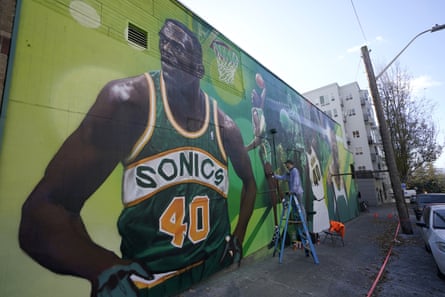
The Seattle SuperSonics boomed and busted and were reborn in 2008 as the Oklahoma City Thunder. The Sonics won their lone NBA title in 1979 but then went mostly quiet. The team signed Kevin Durant in the 2007 draft for what proved their final season in Washington state. Amid failing to strike a deal with local and state officials over renovating their arena or building a new one, majority owner Howard Schultz – the former Starbucks boss – sold the team for $350m in 2006 to an Oklahoma-based investment group that controversially but predictably dispatched it to Oklahoma.
The Thunder flourished and are the reigning NBA champions. Schultz called the sale the “biggest regret of my professional life”.
Is there room for two more teams?
In an enormous country of more than 340 million people? Of course. That said, the bigger the league, the more diluted the talent pool, and the NBA depends heavily on star power.
Prosperous Seattle is the 15th-biggest urban area in the US and can easily support a franchise in a modern arena. Vegas is smaller but has enough rich people to fill luxury boxes. The NBA’s global appeal makes it an attractive night out to many international visitors (though that’s a dwindling cohort). That said, Vegas isn’t a huge TV market – only the 40th biggest in the country, per Nielsen – and its tourism-dependent economy is slumping.
What would the teams be called?
Seattle has surely maxed out its climate and location-related team names – it’s already got the Mariners, Seahawks, Kraken, Sounders, Storm, Reign, Orcas, Torrent and Seawolves. We get it: it’s rainy and coastal. The city has a proud coffee tradition but we can expect the team to forgo anointing itself the Grinders or the Roast in favour of the obvious: resurrecting the SuperSonics brand, tapping into a rich seam of history and nostalgia and righting a perceived wrong as it drops anchor. (Sorry.)
Considering the NBA’s recent betting scandals, it’s debatable whether the Vegas team would follow the WNBA’s Aces and go for a gambling-related moniker. The hostile desert environment has no shortage of vicious critters that could offer inspiration in addition to the glitz of the city itself, though US sports are already rife with snakes, scorpions and wildcats, Miami brings the Heat and Phoenix shines its Suns.
Where would they play?
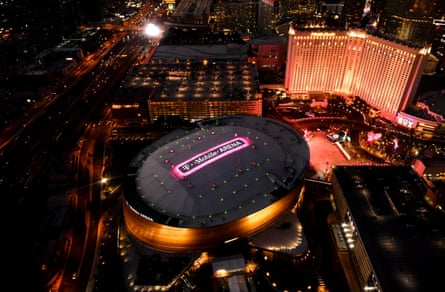
There’s plenty of talk about constructing a new arena, as you’d expect in a dynamic city that loves to build spectacular edifices. It’d be cheaper and more logical, at least in the short term, to share T-Mobile Arena, the Strip-situated home of the Golden Knights. It has hosted the NBA Cup semi-finals and final since 2023. But a sensible and restrained choice wouldn’t feel very Vegas, would it?
A decade too late to save the Sonics, the KeyArena near downtown Seattle was renovated with private money for $1.15bn and rebranded as Climate Pledge Arena in 2020 by locally headquartered Amazon, who acquired the naming rights to highlight their avowed commitment to sustainability. How that squares with the company reportedly donating $1m in 2024 to the second inauguration fund of a coal-loving and regulation-repealing US president is one question. Another is: could an NBA team share it with tenants including the WNBA’s Storm and NHL’s Kraken? Certainly.
How would they fill their rosters?
In addition to the usual draft, there would be an expansion draft. Typically these require existing teams to produce lists of unprotected and protected players. The new franchises form their squads by picking no more than one unprotected player from each team. Sounds simple … too simple.
There’s ample scope to complicate proceedings by making trades and deals with salaries, roster balance and other conditions imposed by the league in mind. There could be some shock names on unprotected lists if existing teams see the draft as a chance to offload overpaid and underperforming stars.
Would there be conference realignment?
Those who paid attention in geography class don’t need telling that Seattle and Las Vegas are firmly in the western US. So they’ll go in the Western Conference. To balance the two conferences at 16 teams each, one club would need to join the Eastern: probably Minnesota or Memphis. Maybe New Orleans, but they’re conveniently close to the Texas teams.
Minnesota makes the most sense because they’re distant from the other Western teams but relatively near to a cluster of Eastern teams in the midwest. That may also help competitive balance by moving a reliably-strong team to a usually-weaker conference.
Would this be it for expansion?
For the foreseeable future. Exclusivity helps keep franchise values high and sustains more power in the hands of individual owners. Still, there are plenty of mid-sized American cities that could make a case: Nashville, Baltimore, Austin, San Diego, Tampa, Pittsburgh, Cincinnati, Kansas City, St Louis.
Success in Seattle could revive chatter about Vancouver regaining a team, while NBA commissioner Adam Silver has referenced Montreal and Mexico City as contenders. But economic uncertainty – such as currency fluctuations – and burgeoning international political tensions make it unlikely that the league would look outside the US for another franchise in the short or medium term. It’ll focus on continuing to bring teams to Europe for regular-season games and forming a new European league.