3 months ago
143
3 months ago
143
Cardiopulmonary resuscitation (CPR) is a dramatic intervention, but researchers say TV portrayals are often misleading – potentially influencing whether viewers feel able to carry it out themselves.
According to the British Heart Foundation (BHF) there are more than 30,000 out-of-hospital cardiac arrests every year in the UK.
But while CPR by bystanders can help save lives, the American Heart Association (AHA) notes the percentage of people in need who receive it is only about 35-45% globally.
The AHA has since 2008 attempted to increase such rates by stressing that people who are not trained, and hence might not feel comfortable giving breaths or searching for a pulse, should only perform chest compressions on adults – a position shared by the NHS.
Now researchers say TV shows often depict lay people carrying out additional steps, potentially perpetuating barriers to viewers carrying out the life-saving intervention.
“People are watching thousands and thousands and thousands of hours of television every single year, but people go to see their primary care physician once a year. So a lot of people are gaining most of their health content from the stuff that they watch on TV, the stuff that they experience on TV,” said Ore Fawole, lead author of the new study at the University of Pittsburgh.
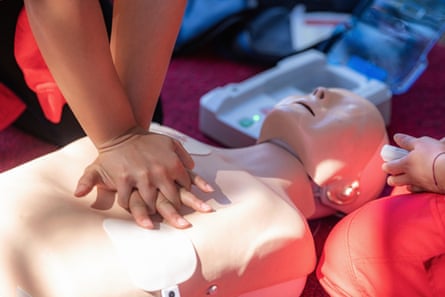
Writing in the journal Circulation: Population Health and Outcomes, Fawole and colleagues report how they searched IMDb for TV episodes in the US depicting out-of-hospital cardiac arrests and CPR, excluding reality programmes and episodes released before 2008.
Among other shows, this encompassed episodes of Dexter, Quantum Leap, Homeland, The Walking Dead, Breaking Bad and Manifest.
The team found that of the 54 episodes showing CPR being administered out-of-hospital by a layperson, only 16 showed compression-only CPR. Meanwhile, 26 episodes showed breaths being given along with compressions, and 23 showed the layperson checking for a pulse.
“We do a lot of community trainings, and in those, we often have people who say: ‘When do I check for a pulse? When do I check for breaths?’ And so we are not sure if that’s all due to what they see on screen, but the results of this study combined with our observations suggest that people are being influenced by it,” said Dr Beth Hoffman, another author of the study from Pitt Public Health at the University of Pittsburgh.
Indeed, studies have previous suggested health storylines on fictional TV shows can influence viewers, while among other cases in 2023, 12-year-old Austen Macmillan rescued 30-year-old Jason Piquette by carrying out chest compressions after seeing them depicted in the show Stranger Things.
The researchers also found only 20% of the 54 episodes showed the cardiac arrest happening at home, despite this being the setting for about 80% of cases in real life, while over half of the fictitious patients receiving some form of CPR were under 40, despite the average age in real life being 62.
“A lot of the CPR we see being performed and being received [on TV] is by white males,” added Fawole.
Lizzie Moscardini, RevivR programme manager at the British Heart Foundation, who was not involved with the study, said television can influence what people do in real life.
“Our own advert with Vinnie Jones showing how to perform hands-only CPR gave people the confidence and skills to act, and it saved lives. This new research highlights the flip side: without following the most up-to-date advice, TV can also create confusion about how to perform CPR properly,” she said.
Moscardini added it was crucial people nearby act quickly and correctly in the case of a cardiac arrest, adding that in the UK a 999 call handler would guide callers through starting chest compressions.
“We urge everyone to take a few minutes to learn CPR,” she said. “Our free online tool, RevivR, can teach you the skills in just 15 minutes.”