5 hours ago
13
5 hours ago
13
He saw the first one on September 11 itself. “Missing”, said a hastily designed poster on the window of a bar in Tribeca providing food and water to first responders. It was a plea for information about a person who had vanished in the deadliest terrorist attack in US history.
“I was like, ‘Wow, this is going to be …’” recalls Phil Buehler, an artist and photographer who had watched the twin towers collapse from his office window. “But you knew that there would be very few survivors. You knew it then.”
The missing posters kept coming in the days after 9/11, and Buehler kept photographing them. But having amassed more than 500 images, he put them away in a box on a top shelf because he could not bear to look at them.
As the 25th anniversary of the atrocity neared, he decided to revisit them and will put a selection on public display for the first time this week. Countenance: The 9/11 Missing Posters, an installation at Most Holy Trinity – St Mary’s church in Brooklyn, places 144 pictures across 24 translucent vellum panels, in vertical pairs reminiscent of the twin towers.
The World Trade Center was always a favourite subject for Buehler. He had been photographing it since 1973, when he was 16. On September 11 2001, as an advisory board member for a tech startup, he had been invited to a conference at the Windows on the World restaurant at the top of the north tower, but turned the offer down (a friend intended to go but was delayed).
“The guy that invited us died that day and I think my friend feels guilty about it,” he says quietly by phone, recalling the day on which nearly 3,000 people were killed by hijacked airliners in New York, northern Virginia and Pennsylvania. “You realise how close – everybody had a story.”
For the next two or three weeks, Buehler pedalled his bicycle through the eerie hush of New York City. Every night he updated a website, posting photographs and dispatches – an early form of what would soon be called blogging.
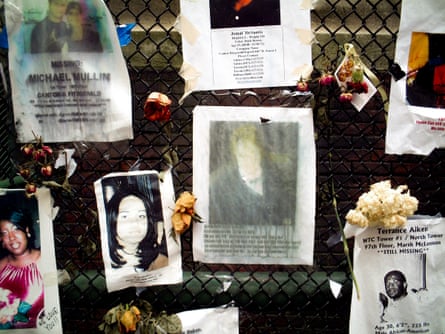
He watched the spontaneous emergence of public shrines. Memorials bloomed in Union Square and Washington Square Park. On fences, subway entrances and storefronts, the missing posters multiplied, each a radical act of hope, though very few of those reported missing would ultimately be found alive.
This was an era before cloud storage, smartphones and ubiquitously accessible digital photos. When families realised their relatives had not returned home, they frantically searched their living rooms for any tangible likeness.
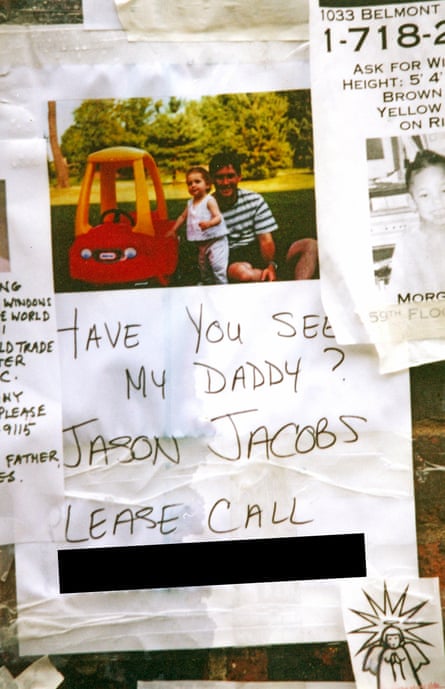
Some posters were designed by colleagues with desktop publishing software, cleanly formatted in neat typefaces. Others were raw, hurried cries for help: a snapshot Scotch-taped to a blank sheet of copy paper, bordered by frantic handwritten descriptions detailing physical marks that might identify an unconscious patient in a trauma ward.
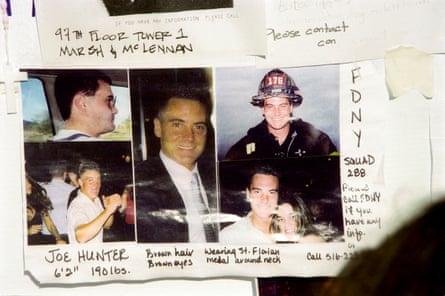
The posters listed height, weight, date of birth, company names, floor numbers and identifying traits: a butterfly tattoo on a lower back, surgical scars, wristwatches, the colour of a tie worn that morning. “They’re very personal,” Buehler says. “A lot of the pictures would be, say, a father holding their kids. One said, ‘Please find daddy.’ This was before digital phones, when everybody had pictures online, so a lot of them were done in copy shops.
“You can just imagine somebody opening up their wedding album and ripping out the photo of a husband or wife and so you see them in a tuxedo. You see a lot of people in graduation gowns; it’s the pictures that we would have on our refrigerator or on the walls of our house that you’re proud of. I saw a lot of graduation photos, a lot of wedding photos, a lot of photos with kids, a lot of photos of men in suits and ties.”
Yet as days turned into weeks, and rescue workers digging through the steaming pile at Ground Zero found only twisted steel and ash, the meaning of the posters underwent a subtle and heartbreaking shift.
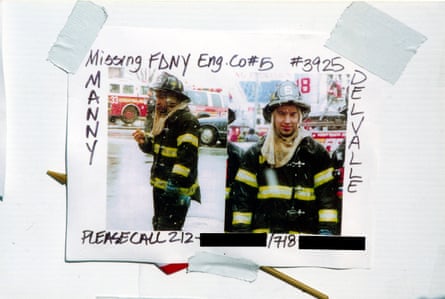
Buehler explains: “When it was pretty clear there were no survivors, the posters started changing from ‘missing’ to almost ‘in memoriam’, but they didn’t say that. They went from explaining he has a tattoo of this on his arm or lower back and this is how tall and how much he weighs to being much more about what they did in life.
“They morphed into ‘has three kids, I miss him’ and all the things they’re proud of: captain of the whatever or coach of the football team or whatever it was. Little memorials and they’re all different.”
The posters also captured the democratic cross-section of the twin towers’ workforce. Within Buehler’s images, elite Wall Street investment bankers in tailored suits hang next to off-duty firefighters, paramedics and transit workers. Latino, Asian, Black and white faces appear side by side.
“You saw the full range,” Buehler says. “You could tell just from looking at a guy in a suit, probably worked at one of the investment firms, and then right next to it would be somebody that works at Windows on the World as a server or waiter. A lot of Latino names. Mixed in there were firemen and women. A lot of service people. It was a big slice of America.”
Eventually, having used about 20 rolls of film to catalogue more than 500 posters on hospitals, fire stations, random fences, roadside barricades and the 69th Regiment Armory on Lexington Avenue, Buehler had the film developed, picked up the contact prints and stopped.
He could not face them. He packed the prints into a box, slipped in several bags containing samples of the dust he had gathered from the streets, added a rain-soaked poster he had salvaged, and shoved the container into the dark recesses of his studio for a quarter of a century.
When Buehler finally opened the box, he turned to Sarah Celentano, a Brooklyn-based curator with whom he had previously collaborated on projects exploring public memory. The show is co-curated by Celentano and Olena Speranska, who was forced to flee her home in Ukraine after Russia’s full-scale invasion in 2022.
Celentano says: “I have a background as a medievalist and art historian and I often see connections between how we think and act today and how we’ve done this historically. That’s why I was so interested in thinking about these photos that Phil showed to me through historic traditions of devotion. They have such an incredible immediacy now, even 25 years later, that makes the person depicted present.”
This tension between the physical image and the spiritual aura of the lost gave the exhibition its title. Celentano says: “Countenance can have two meanings. Both of them are very relevant in the case of what the show is doing. It can mean the human face, but it can also mean a sense of presence.
“It’s something that is referring to the outer and inner aspects of a person simultaneously. What the show’s doing at the initial focus is on the faces of the 9/11 posters – people’s exterior humanity – but ultimately what that does is lead us to something that makes them present in a more profound way.”
As the events of that day gradually fade from living memory to history, Celentano believes the exhibition provides a human bridge. “For somebody who wasn’t alive to remember or witness the September 11 attacks, the emphasis that these photographs put on humanity is the more important part of it.
“They show what people did in the aftermath and how people dealt with or wrestled with their own grief and the way that they so spontaneously worked to memorialise them. It says a lot about how we function as a human society in that way. There’s a larger lesson to be learned.”
For Celentano, the exhibition offers an antidote to the political cynicism of the present day.
“It’s an invitation to empathise and to have compassion with people at a time when some frame empathy as weakness. I’m hoping this installation shows that empathy is actually quite a powerful thing and we should be looking for the humanity in all of us, not just the people who are in these posters but extending that beyond to one another.”
That the work should find its home in Most Holy Trinity – St Mary’s church in Williamsburg is no accident. Founded in 1841, the majestic French Gothic Revival church is an active, multilingual parish that celebrates mass in English, Spanish and Polish. For Buehler, the church provided a spiritual antidote to the commercialism of the contemporary art world. “You don’t put grief on the white walls of a gallery,” he says.
The church’s pastor, Rick Riccioli, a Franciscan friar originally from Montreal, immediately embraced the exhibition when Buehler approached him. The Franciscan order itself carries a 9/11 connection: Father Mychal Judge, the beloved FDNY chaplain who was the first certified fatality, was also a Franciscan.
Friar Rick said in a statement: “Bringing these faces into this church is more than an art exhibition. It is an act of kinship, an act of remembrance, and, for us, an act of prayer. Twenty-five years later, we stand with those who were lost, with those who loved them, and with a city that still carries their memory.”
Buehler is a creator of public memorials, producing installations such as Empty Beds, honouring Ukrainian children abducted since Russia’s 2022 invasion, and Wall of Tears, memorialising children killed in Gaza since October 2023, and In Lieu of Flowers, a sculptural presentation of the obituaries and lives of those who worked at the demolished Westinghouse Plant in Newark, New Jersey.
Milestone anniversaries are an opportunity for reflection and taking stock. Looking back across the arc of 25 years, Buehler speaks with melancholy about the fleeting sense of common purpose that briefly united Americans in the autumn of 2001.
“Post-9/11, America was one country – almost. I know there were groups that hated the Muslims at that time or blamed them, but it was pretty united. The red states, blue states didn’t exist. We still had some kind of working across the aisle. That’s gone.
“When I was in Ukraine, it felt like they were all-for-one and for Ukraine beating Russia. As other people long for a different America, I longed more for how we suffered this tragedy, but the country felt what united us was more important than all those little things that divided us. That was an important moment and maybe the 25th anniversary will remind us of some of that.”
-
Countenance: The 9/11 Missing Posters runs from 5-13 September at Most Holy Trinity – St Mary’s church, 138 Montrose Avenue, Brooklyn