1 day ago
18
1 day ago
18
The reputation of Noël Coward’s plays has involved escaping restrictions: his recorded clipped, waspish tone in key roles and a perception that, at a time when gay men’s careers and lives were at risk, the dramatist could not be socially and emotionally truthful.
Seven years ago, in an Old Vic revival of Coward’s 1942 off-stage comedy Present Laughter, Andrew Scott – as actor Garry Essendine, a gorgon of priapic self-importance – memorably banished the parodic playing style and probed forbidden subtext. Changing Joanna, one of Garry’s love interests, into Joe made characters bisexual or in sham marriages.
That seemed the limit of new life to be found in the play, especially as Matthew Warchus’s production survives in the National Theatre at Home archive. But the Coward estate has authorised a differently radical transformation directed by Lindsay Posner, starting an appetising national tour in Bath.
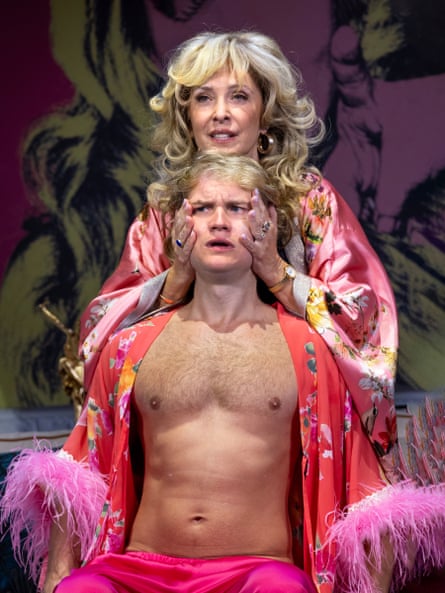
Garry is now Geri, an actress-singer played by Tracy-Ann Oberman, who previously feminised Shylock in The Merchant of Venice. Whereas Garry had a fantasy of playing Peer Gynt, Geri’s Ibsen vanity is being cast as Hedda Gabler. As dramaturg, Oberman reverses six other characters, with Essendine’s secretary morphing from Monica to Monty, and the ex-spouse being Len not Liz.
These re-gendered characters also have a new calendar and atlas, moving from mid 20th century London to New York in the 1970s (Studio 54 has just opened). Peter McKintosh’s Manhattan loft design has walls decorated with mock-Warhols of the star and a poster for a cabaret show called Geri With a G, a nod to Ms Minnelli’s recent Liza With a Z. Coward’s ghastly avant garde playwright Roland Maule is here Rosina, an intense cross-genre experimentalist for whose work no theatre is far enough off-Broadway.
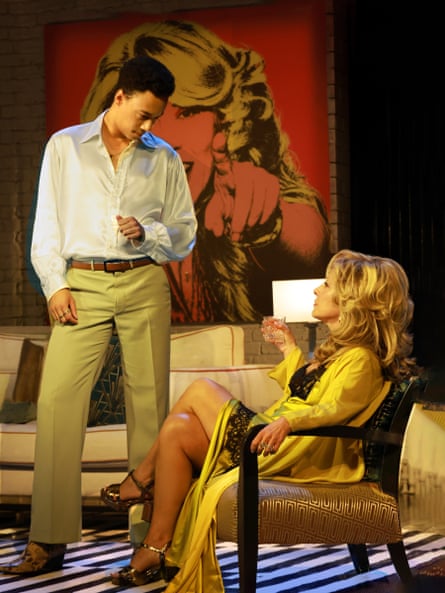
Multiple line revisions interestingly reflect the sexism of language. Whereas Garry was rather admired as a “cad”, Geri is denigrated as a “cow”, although, stingingly, his disparagement of women as “bitches” stays in her mouth. Local and time references are smoothly retooled: Maule comes not from Uckfield but Yonkers and Essendine’s impending trip to take culture to the colonies bypasses Coward’s rather patronised “Africa” for “Australia”. The equivalent of Garry’s terror of soon requiring toupees is Geri’s fear of needing work on her face.
These translations are not as politically powerful as allowing Garry to be gay, although the time shift is vital because no 1940s showbiz woman could have been as sexually ruthless as Geri.
The adaptation’s primary purpose, though, is expanding the classical canon for women. Oberman, playing an actor less good than she thinks, makes it hard to think of many better than her, surpassing even last year’s Hampstead turn as a rude, ruthless matriarch over 20 years in Richard Greenberg’s The Assembled Parties.
In a sequinned pantsuit fighting teeth for maximum dazzle – blond tresses piled as high as the platform shoes that make even funnier the running in the farcical finale – Oberman poignantly recalls 70s American power women Dolly Parton and Farrah Fawcett (both painted by Warhol) in a performance that vocally samples Coward’s clicky diction. James Dreyfus’s enjoyable Monty is, like Lear’s Fool, alone licensed to speak truth to the tyrant. The show is, paradoxically, a daring Coward.