2 months ago
99
2 months ago
99
The floor of the United Nations is rarely handed over to musicians; when it is, it’s to global superstars such as Abba, Beyoncé and K-pop band BTS. So why, then, has a foot-stomping, folk-infused Scottish musical been added to the list of performances so influential they’ve gone on to fill the halls of New York’s General Assembly Building?
The subject of Lifeline, an energetic, imaginative stage account of the life of the father of penicillin, Alexander Fleming, with a modern love story and a Greek chorus of real scientists, provides a clue. This unlikely show tells the story of one of medicine’s most pressing crises: antimicrobial resistance and the deadly global threat of drug-resistant infections or superbugs.
It has also sparked an improbable friendship between its composer and lyricist, Robin Hiley, and Prof Sally Davies, the former chief medical officer, now UK special envoy on antimicrobial resistance (AMR). Davies is a champion of the show and one reason it found its way to the UN in 2024.
“There’s a subsection of people who feel a shiver down their spine when they hear music or look at art because it gets through to them. That’s me,” says Davies, on video call from her study in Trinity College, Cambridge. “I get shivers when things work.” She first saw the play after a civil servant alerted her to its 2018 sellout run at the Edinburgh fringe, as The Mould That Changed the World. “It just grips people, it’s not like anything else. I’ve seen books that pull people in a bit but something about a musical is amazingly powerful if the songs are right.”
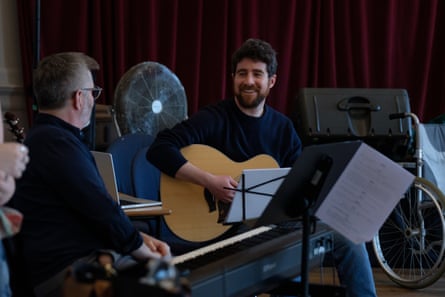
Lifeline opens in London today for a five-week run, and we speak to Hiley, the artistic director and CEO of Charades theatre company, at a rehearsal in his native Edinburgh. He recalls how he first encountered his scientific subject over dinner with a friend, Dr Meghan Perry, a researcher and consultant in infectious diseases. “She cornered me and said: ‘Can you do a show about antimicrobial resistance?’ and started telling me about it. I thought: ‘Great, that sounds just like all the West End shows at the moment,’” he laughs.
They had met through Hiley’s wife, Rachel, a palliative care consultant. After his discussion with Perry, he talked to Rachel about her experiences at work, and became convinced he had a topic that could work on stage. “There were always these incredibly emotionally complex situations which opened my eyes to medicine and how human it is, how based in storytelling, how important empathy is,” Hiley says. “That was an awakening into Lifeline.”
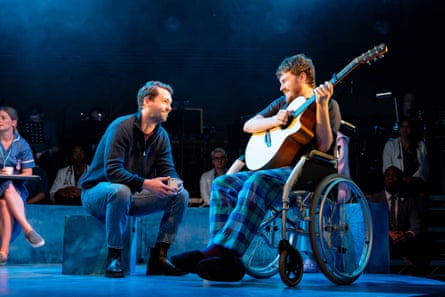
He went away to research AMR, gravitating towards the compelling life story of Alexander Fleming, from his childhood in rural Scotland to his experience fighting in the first world war, to becoming a bacteriologist at St Mary’s Hospital, London, and making the chance discovery of penicillin in 1928. “It’s a fascinating story of perseverance and quiet stoicism. You don’t change the world in a eureka moment,” Hiley says.
In his prophetic 1945 Nobel prize speech, Fleming warned that the ready availability of antibiotics and the practice of underdosing, in which a patient receives insufficient amounts to effectively treat an infection, could one day make infections resistant. The warning was transposed to the present day by Becky Hope-Palmer who wrote the book for the musical, weaving Fleming’s life story – including his relationship with the Greek resistance fighter and scientist Amalia Koutsouri-Vourekas – together with that of a junior doctor in modern Edinburgh, whose estranged childhood sweetheart is brought to her hospital. It provided Hiley with the basis for his score.
Davies threw up her arms in glee and tipped red wine over Hiley on the opening night of the show’s run in Washington in 2022, following a second Edinburgh stint. “The visceral impact really hit me,” she says. “You feel uplifted because it’s so energetic and looks forward – but it also delivers the ‘this is horrible’ [message on the crisis]. I saw how it can get ordinary people and powerful people thinking about issues differently.”
Six months before that opening night, Davies and Hiley had embarked on a tour of ambassadorial residences and consulates, generating funding to take the musical to bigger theatres – and bending the ear of policymakers who could help change nations’ relationships with antibiotics. “We had this plan to get it to the US as a soft power in Sally’s work.” Hiley says. “I was turning up to sing at these posh dinners. I was the show, there in my kilt.”
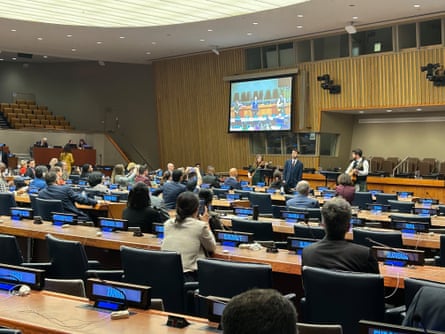
The high-level meeting at the UN, attended by heads of state, followed. “What we wanted was to really give a bit of oomph to this rather dry discussion,” says Davies. Hiley’s folk-musical theatre crossover was the tonic. “Rather than tripping out thinking: ‘We’ve got that all signed off,’ everyone was thrilled because of the music. This is very like climate change: it’s incredibly complex, it involves every system. Some people call it a slow pandemic.” Forecasters estimate AMR will be directly responsible for 39 million deaths by 2050. “Lifeline and the team have re-energised the conversation. Now, whenever there’s a big meeting around the world, they come to me and Robin and ask: ‘Can you play some of your songs?’”
These were pinch-me moments for Hiley, who had been writing songs and playing violin, then guitar, since boyhood: “I spent my youth in my bedroom learning to play all sorts, from folk music to Guns N’ Roses riffs,” he says. Later, he toured with folk-rock bands before founding Charades, the company that is staging Lifeline.
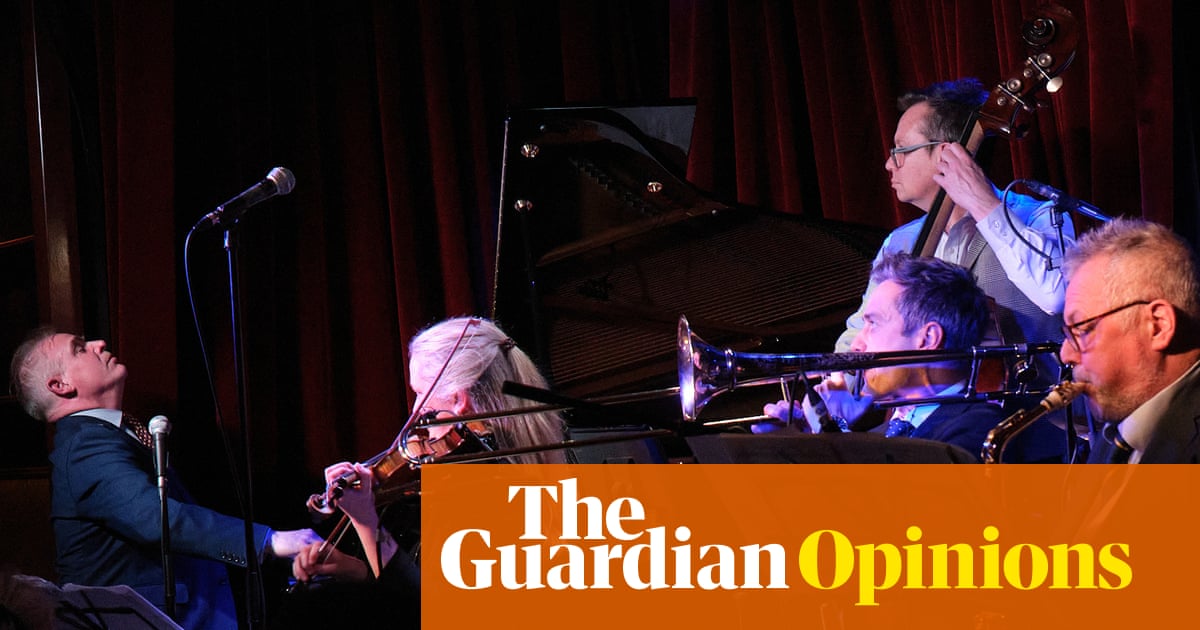
Performing alongside the regular cast in the production is a rotating chorus of 60 real-life scientists – including doctors, nurses, vets, dentists, a researcher from San Francisco and a former Pfizer executive paying his own way – who break the fourth wall to explain their real-life work. “They give us an integrity,” says Hiley, who considers Lifeline “a heartfelt love letter to the medical community past, present and future”.
In Edinburgh, they relied on Hiley’s wife’s hospital and university networks for chorus members; in London, 500 people signed up: “We had three days of five-minute auditions. The talent is wild. We’ve actually got quite a lot of medics who trained in musical theatre and stepped sideways so they’re now locum doctors.”
While the principals perform, the chorus “deliver the scientific bits, because that’s their world. They discuss the two stories that run in parallel. When they converge at the end, we understand the hope is in the collaboration.”
For Davies, the fourth-wall-breaking moment is especially moving. She says: “These three things” – Fleming’s story, the modern love story between the two doctors, and then the chorus of real-life experts explaining why they are there – “all collude, celebrating ingenuity and the heroes that are fighting to get things to work.”
She describes herself as “a critical friend” of the production, “because I want this to be as powerful and right as possible”. She has felt its impact in her life, too, when her goddaughter died in 2022, aged 38, from a drug-resistant infection, then when she had bowel cancer last year, and feared an infection: “I woke with a very high temperature in hospital, my husband was sleeping at the bottom of my bed. He said: ‘Oh no, Lifeline in real life.’ It turned out to be flu but that was his worry at 4am.”
Hiley wants to take his show to as many general theatre audiences as possible, both for artistic reasons and in the service of public health. “People turn to me and ask about this problem, which at the beginning felt absurd,” he says. “Now, I feel a responsibility to say to them: get out of your silo. This is a problem on a global scale, I’m just singing a song about it.”
For Hiley and Davies, inviting one another into their respective worlds has been highly productive. Is the relationship between science and the arts underused? Should we do more of this? “Of course we should,” says Davies. “There’s no doubt that the arts reach people in different ways and for complex issues like these we have to use them. The arts help make things part of our life whether it’s written or visual work or, on this occasion, musical theatre which brings all of that together. The idea that you energise people to say: I care, I can do something, this matters, is wonderful.”
In musicals, says Hiley, “there’s a human story at the heart, regardless of whether it’s the gay community in 1980s New York where Rent is set or the American battlefields in the 1800s in Hamilton. Any of this is just human stories.”
Fleming’s century-old discovery and modern microbiology’s fight on behalf of us all is no different. “I feel like there’s a certain responsibility of the creatives to be sticking to their guns and making things that point people in the right direction.”
Lifeline runs to 2 May at Southwark Playhouse Elephant, London.