3 hours ago
9
3 hours ago
9
You spend a considerable portion of Silent Hill: Townfall in a kind of foetal position, cowering behind objects that will be eerily familiar to anyone who lived in the UK during the 1990s. Cars seem to be modelled on the era’s boxy Volkswagen Golfs; logos adorning phone boxes should narrowly escape the attention of copyright lawyers at BT Group. (For millennials, the deja vu will likely intensify the horror, as if stepping back into a childhood nightmare.) Simon, the nerdy, unassuming star of the game, pokes his head around corners to catch a glimpse of the demonic entities that wish to maim him, before shrinking back down again with a downwards motion of the analogue stick. In such moments, it’s easy to imagine him wrapping his arms around his knees, clasping his eyes shut and wishing himself away from this place.
The game’s setting, St Amelia, is based on the fishing communities of the East Neuk of Fife. The terror lurking here is wonderfully specific: absent lairds, island poverty, an oil-drilling corporation. Anguished beasts lumber down quaint streets lined with sandstone houses and fluttering bunting. This venerable horror series may have shifted to Scotland, yet we remain firmly in classic Silent Hill territory – weather and all. St Amelia finds itself suffused in supernatural fog and the vast majority of its inhabitants have vanished following some kind of mass tragedy. The artful, evocative presentation is such that you can almost taste the in-game air, the briny seaside tang diluted by rainy mist.
Visually, this scuzzy, grotty take on Silent Hill from Glasgow studio Screen Burn leans on bold juxtapositions of colour, shadow, and ominous silhouettes. Sometimes the stricken town is bathed in blood-red moonlight; often, pitch-black interiors are illuminated by harsh white torchlight. The arresting imagery brings to mind found-footage horror films such as Rec and the spine-tingling camcorder sections of UK classic, The Descent. Simon soon finds a portable television with strange, arcane power: it receives odd, elliptical messages from a nurse called Zoe, and tracks nearby monsters whose outline appears in scratchy low resolution on its small screen.
The action is slow-burning and absorbing: Simon lopes about town, hiding from depraved monsters and occasionally bludgeoning them to death with a pipe. To enter some buildings, he has to make an incision with a scalpel in a fleshy door opening as thick, fresh blood oozes out. Gradually, Simon’s reason for visiting St Amelia in the first place becomes clear: guilt. But he’s not the only one racked with it. Zoe, voiced with terrific glassy distance by Kezia Burrows, has her own hangups. The third playable character in this triple-threat portrait of shame and suffering is alpha male Richard, the CEO of an energy company that professed to bring prosperity to the island.
There were times when I was so locked in that the hours seemed to pass by in the blink of an eye, as if time had gone wonky just like in St Amelia. One memorable stretch takes place in a municipal-style high-rise building. Armed with a shotgun, and attempting to avoid the game’s nippiest, nastiest enemies, I ascended and descended each floor, as if playing a brutal, Ballardian take on The Raid. I have never felt such dread at the prospect of entering an open-plan office, knowing what lurked among mouldering office furniture and knackered desktop PCs.
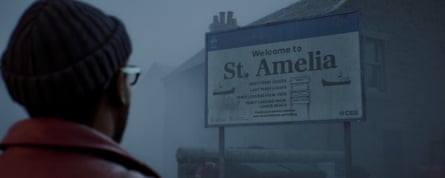
Every element – scavenging for items, creeping between bins, running at full pelt when all else fails – pulls you deeper into Townfall. Its design broadly adheres to diegetic principles, in that most information is conveyed to you within the game: to view the map, for example, Simon physically pulls it out – the action never pauses. To save your progress, you must find a telephone in St Amelia, manually pick up the receiver, and then dial a number.
Puzzles function similarly. You snoop through emails, install floppy disks, and pocket important bits of paper, usually in an effort to gain a key code. These puzzles, though relayed via grounded, dated real-world tech, follow a serendipitous dream logic; even getting stuck feels coherent within the game’s uncanny psychogeographic claustrophobia. (That is, until it doesn’t. Close to the game’s conclusion, one esoteric puzzle about deciphering industrial symbols killed my progress, and my bafflement, frustration and rage had less to do with Townfall’s hallucinatory horror and more to do with its obtuseness.)
after newsletter promotion
Not even a fiendishly illegible puzzle could derail Townfall. This is a taut, smart tale, less about psychosexual terror than psychosocial dread. What’s most surprising is where the game’s sympathies lie: not with Simon, nurse Zoe, or bullyboy Richard, but the people of St Amelia. Their memorial in the centre of town is one of the game’s clearest images, unobscured by fog, though we’re never privy to the exact events that lead to their deaths. Townfall seems to understand that some things should remain shrouded in fog. The fate of St Amelia naturally festers in our imagination. How very Silent Hill.
-
Silent Hill: Townfall is released 24 September; £44.99