3 months ago
138
3 months ago
138
“Give me a sleeping bag and I’ll happily sleep here overnight,” says Kim Mackintosh as she wanders amid the vibrant flora of the Mediterranean biome at the Eden Project on the eve of the tourist attraction’s 25th anniversary.
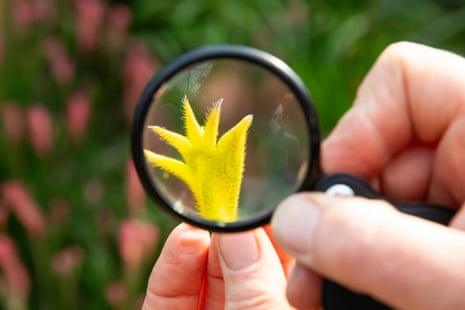
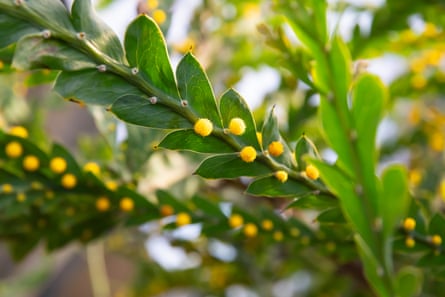
Loupe in hand, the leader of the biome’s horticulture team is marvelling at an array of plants that have recently come into bloom, tenderly examining the yellow furry buds of an Acacia glaucoptera before flogging a Grevillea flower to dispense its rich, honey-flavoured nectar.
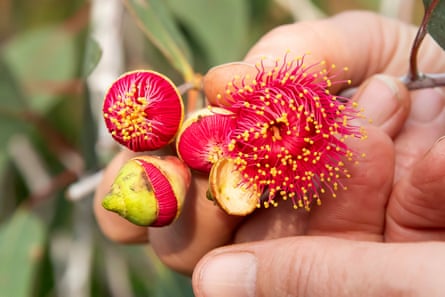
“Now look at this showoff,” she says, proudly removing the cap from a budding Eucalyptus caesia to reveal the dazzling flower within. “She’s got her pink tutu on! And look at those stamens. How crazy is it?”
-
Kim Mackintosh inspects the ‘kangaroo paw’ of an Anigozanthos through her loupe. All photographs by Jonny Weeks
-
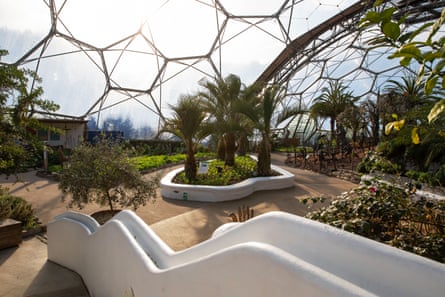
Left: the furry yellow buds of Acacia glaucoptera, commonly known as clay wattle. Right: a verdant display at the heart of the Mediterranean biome
-
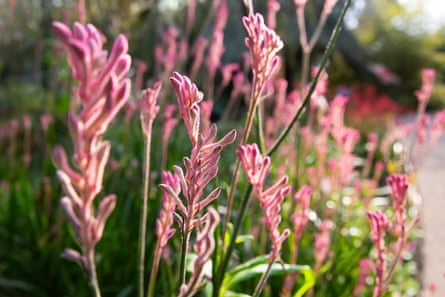
Left: Eucalyptus caesia with its pink tutu and yellow stamen. Right: flowers bathed in afternoon sunlight
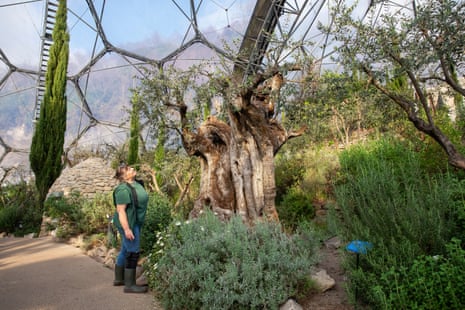
Mackintosh then falls silent as she approaches three ancient olive trees. They were brought to Eden from Portugal, where they were deemed unproductive, and the most senior of them is thought to be up to 1,500 years old.
“We don’t know exactly how old they are and obviously we’re not going go cut the trunks to count the rings, but two of them are so old that the crowns have hollowed out and rotted,” she explains.
“We prune them each year and when I’m doing it I’m very aware that I’m one of an incredibly long line of horticulturalists going back to Roman times who’ve attended to these plants. It’s utterly awesome.”
-
Kim Mackintosh looks in awe at an olive tree thought to be 1,500 years old
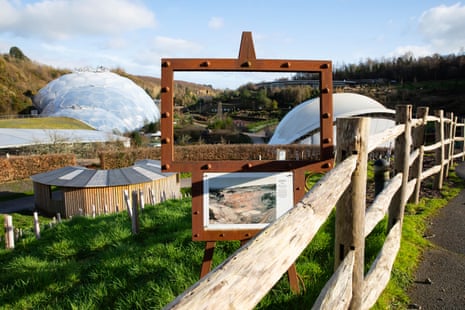
The brainchild of Tim Smit, a Dutch entrepreneur who wanted to reconnect people with nature, the Eden Project was built on the site of a former clay quarry in Cornwall and was part-funded using £56m from the national lottery via the Millennium Commission.
The non-profit charity has welcomed more than 25 million visitors over the past quarter of a century and, according to its latest impact report, generated £6.8bn in total economic impact for the south-west of England during that time.
While most people come to see the spectacular flora – including the titan arum, which opens for only about two days a year and emits a fetid smell – others are drawn in by peripheral activities: Eden has hosted concerts by the likes of Amy Winehouse and Oasis, is home to a winter ice skating rink and has a 600-metre zipwire above the biomes.
However, 2025 was a turbulent year: Eden reported a 10% drop in visitor numbers in the 12 months to March 2025, posted pre-tax losses of £3.5m and cut 75 jobs (almost a fifth of its workforce).
-
A view of Eden Project, with an inset image of how the clay quarry looked previously
-
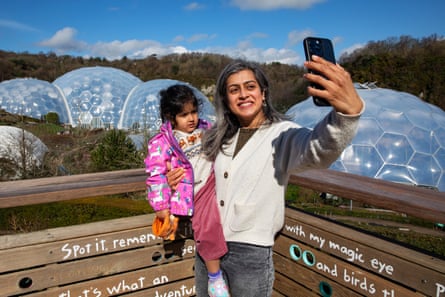
Shivani and Sonia at the visitor entrance overlooking the site
-
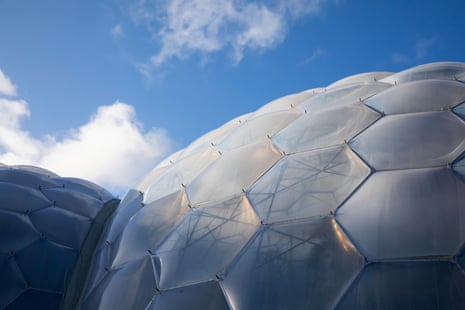
Sunlight and shadows over the rainforest biome roof
The largest biome at the Eden Project is 100 metres wide and 55 metres high. It houses more than 1,000 varieties of plants commonly found in rainforests, ranging from tropical pitchers that eat insects to endangered jade vines.
-
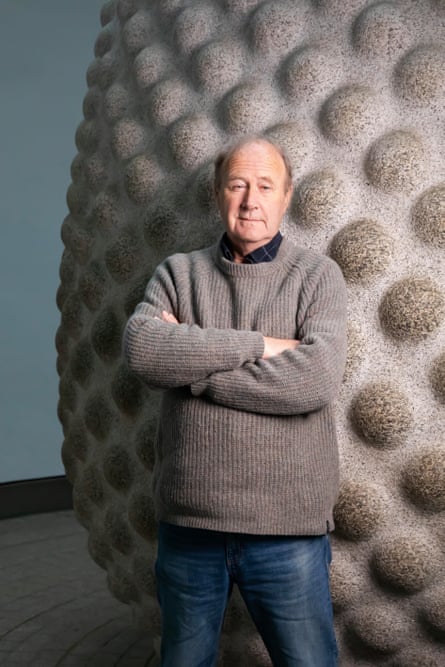
Tim Smit, a co-founder of the Eden Project, pictured by the Seed, in the Core
Roul-roul birds plod timidly through the biome while visitors learn about the importance of cacao, coffee and spices. Temperatures rise to a sweat-inducing 37C at the biome’s canopy.
Smit says the biomes still fill him with awe: “The original aim was to build massive conservatories containing the biggest collection of plants useful to humankind in one place and so, theatrically, create wonder at the sheer abundance of our planet, thereby encouraging us to look after it much better.
“[When walking through them] I feel like a visitor coming upon a once-imagined kingdom, now made real, and I have a sense of thousands of plants communicating with each other, yet we hear nothing.”
-
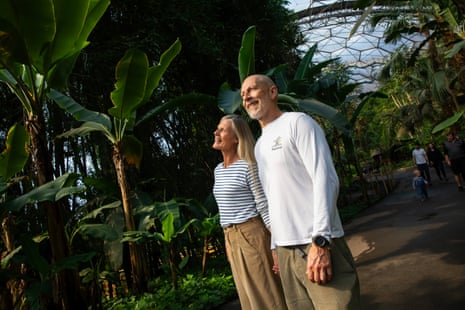
Visitors admire banana leaf plants
-
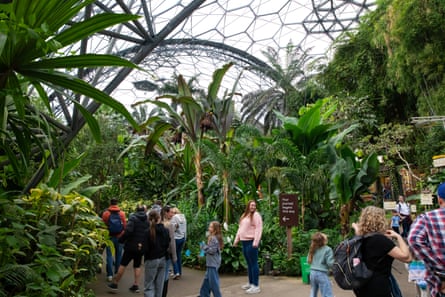
Visitors enter the rainforest biome next to a sign saying: ‘Your journey begins this way’

-
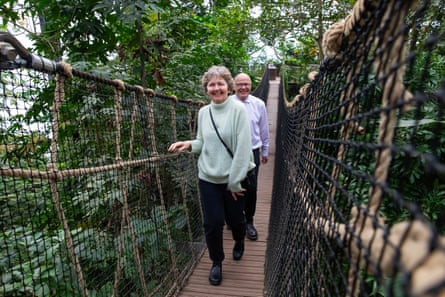
Left: Hugo Hill, aged five, tries to entice a crested partridge, known as a roul-roul, towards him. Right: visitors cross the wobbly bridge in the rainforest biome
-
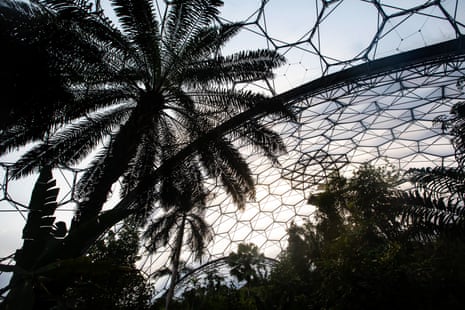
Tropical plants in silhouette beneath the patchwork roof of the rainforest biome
Catherine Cutler, the head of horticulture, has worked at Eden since day one. She says: “It was crazy to be involved at the start. The biomes weren’t completely built and we had a really tight deadline for opening, which actually got brought forward because we needed to start making money.
“We were bringing in tropical plants that needed at least 16 degrees Celsius to grow, but the biomes weren’t yet sealed, the irrigation wasn’t complete, the paths weren’t complete. Remarkably, we didn’t have to dig up and replant anything.”
Cutler adds: “Eden inspires people and reminds them that we’re custodians of the planet. I hope the impact is far-reaching and far greater than we’ll ever know.”
-
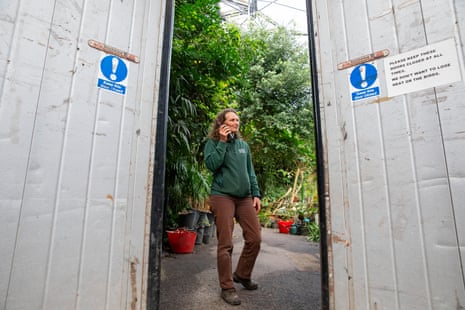
Catherine Cutler on her radio at the service entrance to the rainforest biome
-
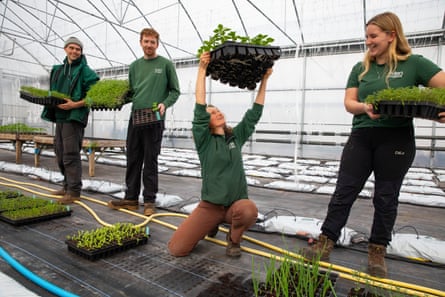
Cutler assessing plant roots alongside three apprentices at the nursery
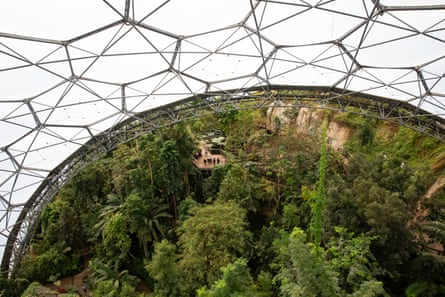
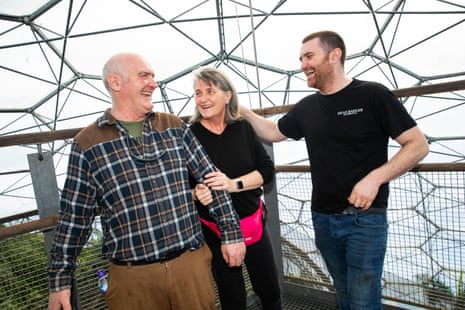
The highest point at Eden is the lookout platform, which is suspended from the rafters. A wobbly staircase takes daring visitors to the summit.
Alex Hill, who is on holiday in Cornwall with his family, says: “It’s a spectacular place: the views, the scenery, we’ve never been anywhere like this before, it’s absolutely stunning. My mum, Liz, will never make it to the top.”
But she does make it, gingerly clutching her husband’s arm. “It was terrifying at first but you’ve got to do something that challenges you every day,” she says.
-
The view down from the lookout in the rainforest biome
-
Vernon Hill (left), Liz Hill (centre) and Alex Hill (right) feeling giddy at the top of the lookout
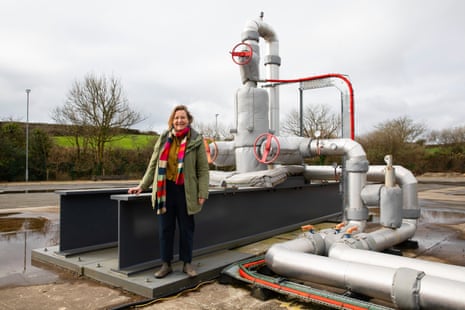
Augusta Grand, the chief executive of Eden Geothermal, is in charge of heating the biomes. She says Eden originally derived renewable energy from a biomass boiler. Then, after failing to convince locals of the merits of installing a 125-metre wind turbine, they turned towards geothermal technology.
In 2021, engineers drilled more than 5,000 metres into the earth at the quarry’s edge; by 2023, Eden was generating up to 800 kilowatts of power from the site.
“The centre of the world is as hot as the surface of the sun, so the deeper you drill, the hotter it gets,” Grand says. “We send water down there through a closed loop system, and when we suck it up again it’s hot (about 72C). We can then take the energy out through a heat exchanger or an ORC (organic Rankine cycle).”
-
Augusta Grand, the chief executive of Eden Geothermal, next to the ‘Christmas tree’, which draws hot water from deep underground
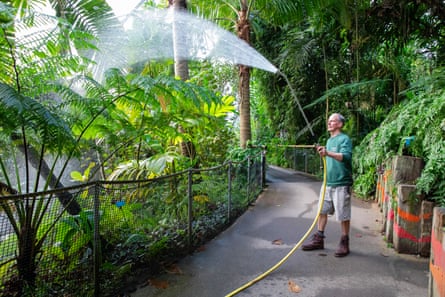
Making it “rain” is simpler. It’s achieved via a combination of sprinklers, natural humidity and manual watering.
However, water management can be problematic when you’re nested 15 metres below the water table: the Eden Project has incurred floods in previous years when pumps and backup generators have failed. Lately, damage to a pipe, possibly caused by subsidence, has staunched the water supply to the popular misting bridge in the rainforest biome.
“The mist is the most theatrical part of the water system because it replicates a cloud,” says Isaac Smith, an engineering technician. “It’s key to the storytelling, so hopefully it’ll be fixed soon.”
-
John Porter makes it rain in the rainforest biome
-
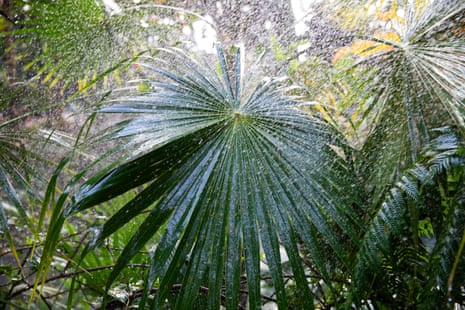
Water splashes off a tropical plant
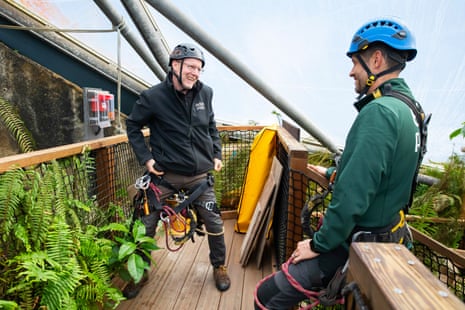
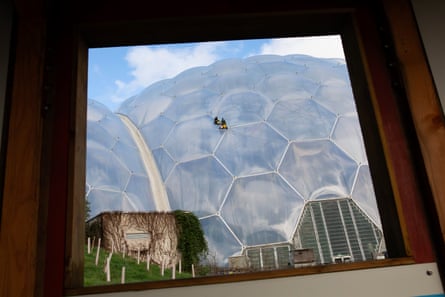
The distinctive biomes themselves are maintained by a team of climbers known as the “sky monkeys”. Each hexagonal pillow is made of Teflon-coated ETFE plastic.
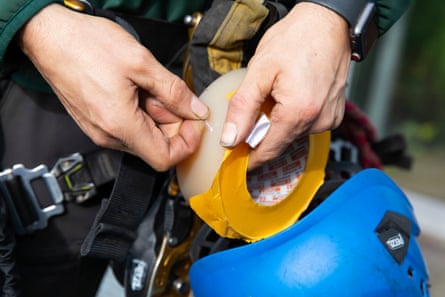
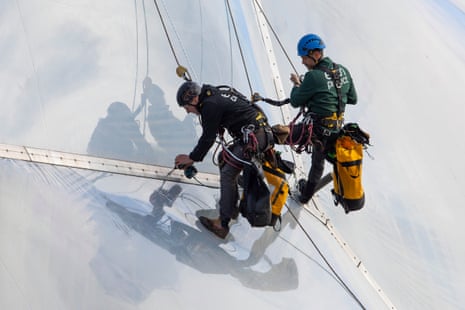
The lead climber, Jamie Robson, says: “The largest pillows are about 8 metres across and they’re made of multiple layers, like triple glazing, so they’re really well insulated, but they do suffer from wear and tear and they can get over-pressurised. Today we had to repair one with tape. It’s £400 a roll. It’s the most expensive Sellotape you could ever find.”
Robson, who was part of the original construction team, adds: “I’m proud to have installed a Cornish landmark and, honestly, after all this time, I still enjoy working on it. It’s one of the coolest building in the world to work on. But it can be a challenge because it can get really slidy, like being on a glacier.”
-
Jamie Robson and David Paul preparing to abseil down the side of the rainforest biome to repair waterlogged pillows

-
Left: ETFE tape, which costs £400 a roll. Right: Robson scores a pillow to drain trapped water from inside
-
A view of the ‘sky monkeys’ abseiling down the side of the rainforest biome
-
Robson and Paul finishing their repair work
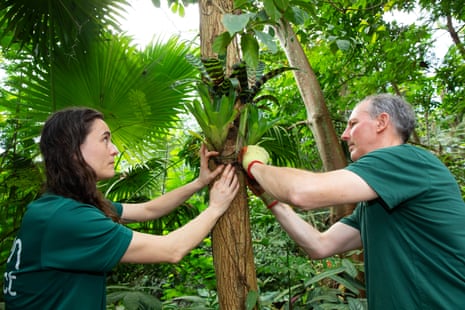
Down in the lower terraces of the rainforest biome, horticulturalists John Porter and Kelly Crawford are tidying up the exhibit. They’re pruning trees, collecting fallen leaves and examining faecal droppings.
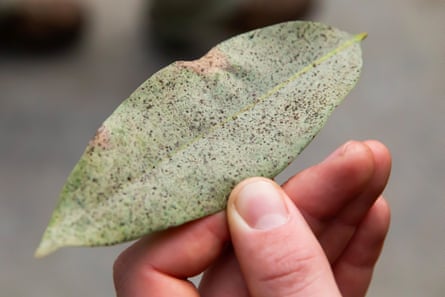
“We have pests like aphids and white flies, which are common in glass houses,” says Porter. “We only have a small ecosystem and we try to buy in natural predators for biocontrol purposes, rather than using sprays.
“There’s one predator called encarsia, which is a miniature parasitic wasp. It will sting and lay an egg inside an aphid, which will kill it.”
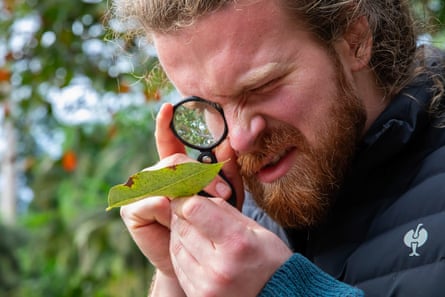
Mackintosh comes to the inspect the leaf and delivers more gory details. “The wasps eat the hosts from the inside out, organ by organ, keeping them alive as long as possible,” she says. “It’s like a horror film inside Eden, but that’s just nature at work.”
-
John Porter and Kelly Crawford re-attaching epiphytic plants to a tree
-
Left: A horticulturist inspects faecal droppings on a leaf. Right: tiny black droppings from a suspected pest
-
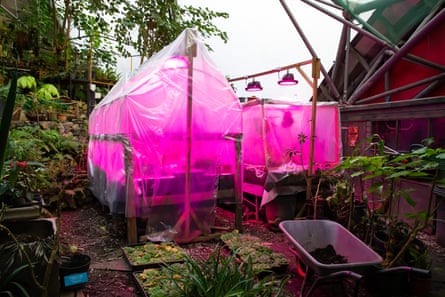
Growing tents in the service area of the rainforest biome
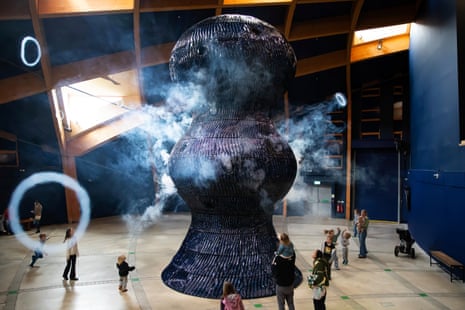
Curiously, Smit says his favourite part of Eden is not within the biomes, but the Core, where a 9-metre ceramic sculpture called Infinity Blue pumps rings of smoke into the air, recalling how cyanobacteria pioneered oxygenic photosynthesis 3bn years ago.
“At night the windows of the building take the appearance of alligator eyes and the giant sculpture blows ghostly smoke rings into the twilight,” Smit says. “Just thinking about it sends a shiver up my spine. It’s the origin of all life revealed.”
But for young visitors, all that matters is who can pop the smoke rings first.
-
Infinity Blue, an installation by Studio Swine that represents how cyanobacteria first developed oxygenic photosynthesis 3bn years ago

-
Amelia, aged six, smiles as a smoke ring pops above her head
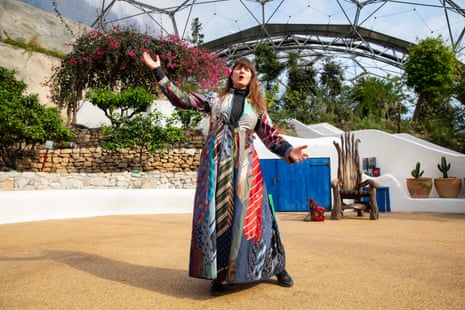
In the Mediterranean biome, Jenny Crowe is regaling a small group of visitors with Cornish folklores. The performer is wearing a gown made from an eclectic array of ties, some of them gifted by Smit.
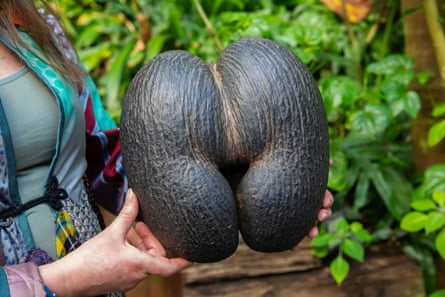
Crowe delights at the chance to showcase Eden’s “bum nut” – a rare, football-sized seed from a coco de mer plant. The double-lobed seed is the largest and heaviest seed type in the world.
“I love showing this to schoolchildren,” she says. “We get 50,000 schoolchildren a year through our doors and their faces light up when they see the bum nut!
“Sailors used to think these nuts grew on underwater trees, hence the name coco de mer, which means sea coconut. But it looks like a bum, so it’s known as the bum nut.”
-
Jenny Crowe telling tales in the Mediterranean biome
-
Crowe showcases a ‘bum nut’, a football-sized seed that belongs to the coco de mer plant
The plant, which is endemic to Seychelles, had been going extinct but has been saved by conservationists.
“We were given two bum nuts to grow at Eden,” Crowe says. “One successfully grew into a plant which you can see in the rainforest biome and this is the other one, which didn’t grow, so we kept the seed.
“I love sharing positive conservation stories like this because then people can leave Eden with a bit of hope in their hearts.”