3 months ago
125
3 months ago
125
In the first week of the final year of his life as a professional tennis player, Stanislas “Stan” Wawrinka found himself in the familiar position of staring down an opponent nearly half his age. Wawrinka, now 40, had tussled with the talented 23-year-old Flavio Cobolli for nearly three hours before offering himself a shot at a monumental victory.
Just a few tense errors deep in a tense final set tie-break saw those chances slip away. In theory, deciding that 2026 will be the final year of his career should provide Wawrinka with an opportunity to swing for the fences and completely empty his tank, playing without inhibitions. Life, however, is far more complicated than that. “Of course I would love to play more freely. And sometimes I tell myself: ‘Just play freely,’” sighs a frustrated Wawrinka. “But I care so much that it’s not that easy.”
That enduring passion and devotion Wawrinka has for his sport is his superpower. He has achieved things that most tennis players could never even dream of, winning three grand slam titles plus earning an Olympic gold medal in doubles and Davis Cup title alongside his legendary compatriot Roger Federer. Most players who have enjoyed even a fraction of Wawrinka’s success find it difficult to maintain similar motivation once their powers begin to wane.
This has never been a problem for him. Currently ranked No 156 in the world, he is the oldest player inside the top 1,000 and he has frequently dropped down to compete in ATP Challenger events due to his lowly ranking. He is also as motivated as he has ever been: “I always enjoyed this journey, and that was important for me to truly live that because being a professional tennis player was my dream when I was younger,” he says. “I made it happen. I achieved way more than I could dream. So, of course, for me, the most important thing is to always fight, always give the maximum, always push my own limit to not ever regret it at the end of your career. And also enjoying this life even when it’s difficult.”
Wawrinka will end his career as one of the most destructive shot-makers tennis has ever seen. At the height of his powers, he was capable of tearing the racket out of the hands of any opponent through his sheer pace and weight of shot. There will never be another single-handed backhand like his, a vision of elegance and brutal violence.
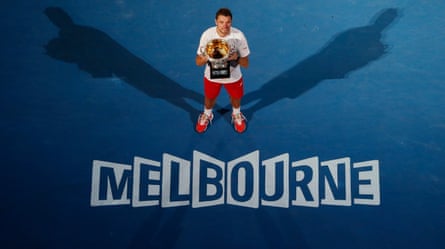
Still, his achievements remain undervalued. Until the age of 28, Wawrinka’s career trajectory seemed set. He had already been incredibly successful, spending many years inside the top 20, peaking at No 8. Despite his shot-making talents, though, his prospects of taking another step forward were remote. On the eve of the 2014 Australian Open, Wawrinka had a 0 wins, 12 losses record against Rafael Nadal, 1-13 against Federer and he had lost 14 consecutive matches against Novak Djokovic: “Especially staying for five, six years between 10 and 20, there’s a lot of doubt because you want more but you keep failing or keep losing to those top guys,” says Wawrinka. “You keep losing in those early rounds, fourth rounds. Of course, there was a lot of doubt.”
The shift began with an unforgettable night in the fourth round of the 2013 Australian Open when he fell 1-6, 7-5, 6-4, 6-7 (5), 12-10 to Djokovic in one of the highest quality matches of all time. Wawrinka suffered a brutal defeat, but he gained the belief that he belonged with the best players in the world. “This match was a turning point in my career, that’s for sure,” he says. “It was a tough loss. Again, you can doubt a lot, but this one gave me self confidence and self-belief that I was ready and that I could fight with the top players in the world and maybe beat them, that I was on the right track and was missing just a little bit to pass them. It gave me a lot of energy to keep doing what I was trying to achieve that’s been pushing myself to the limit every single day.”
Winning three grand slam titles is an incredible achievement alone, but Wawrinka did so in the most difficult manner possible; at the height of the Big Three era. Wawrinka defeated the ATP No 1 in each of his grand slam finals, finishing off Nadal in the 2014 Australian Open final and dismantling Djokovic in the 2015 French Open and 2016 US Open finals. Two of those title runs also included wins over the No 2 player, Federer in Paris and Djokovic in New York. “At the end, I really believe that I squeezed the lemon until the last drop,” he says. “And that, for me, is the most important, because that’s the only way I can leave this sport without any regrets. There’s always some small regrets: ‘In that match, oh, I should have done better,’ or whatever. But in general, I don’t have regrets, because I know that I did the most of it.”
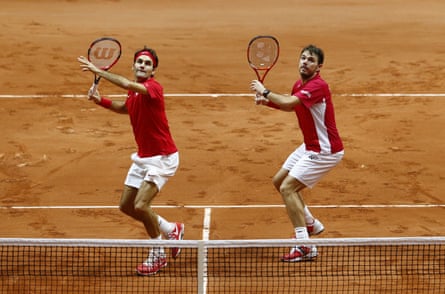
For so long, Wawrinka also seemed destined to remain in Federer’s shadow. He often looked defeated before he even took to the court against the elder Swiss, and away from the court many people were only interested in Wawrinka due to his proximity to such a legendary figure. “I’m always someone who’s going to take the positive of a situation, and I got only positive by arriving [after Federer],” says Wawrinka. “Roger was already at the top, I had the chance to share time with him, to share practice, to share a talk about tennis, to play Davis Cup with him so many years, to win gold medal with him, to face him. Even if he beat me most of the time, he put me [in a position] to see my weakness and how I should get better.”
Perhaps the most interesting example of their relationship came in the aftermath of their infamous semi-final clash at the ATP Finals in 2014. During Wawrinka’s crushing loss to Federer, which included a squandered match point, he and Mirka Federer, Roger’s wife, exchanged words, with Mirka calling Wawrinka a “cry baby”. A furious encounter between the two teams followed in the locker room that night. “There were big things around everything,” says Wawrinka. “I lost this match, I had match point, it was a big mess around the people around us.”
That resentment could have affected their relationship. Instead, less than a week later Wawrinka and Federer banded together to win the Davis Cup for the first time. “The next morning for me was a clear goal,” he says. “We have the Davis Cup final. We did it together. We’re gonna go for it together. It doesn’t matter what happened yesterday. At the end, it’s a tennis match, and you need to have a short memory, put it behind, and then be positive for the next one. One match [where] things happen around [us] – not necessarily between him and me – is not going to change anything between him and me.”
After an impressive week at the United Cup, with Wawrinka intensely competitive against some of the best players in the world, Switzerland finished as runner-up to Poland. The retirement tour will continue with a wildcard at the Australian Open, the site of Wawrinka’s true breakthrough and first grand slam triumph. This story will have no fairytale ending. A fourth grand slam title is not on the cards and there are likely more tight, painful defeats to come alongside many inspirational moments. The fact that Wawrinka still feels both pain and joy so passionately after so long is a triumph in itself.