3 months ago
93
3 months ago
93
I still remember, when I was a kid, the end of spring and early summer when markets in Jerusalem and across Palestine overflowed with freshly harvested freekeh. As you approached, the air carried a smoky, earthy aroma. Freekeh is an ancient grain, a staple across the Middle East and Turkey, made from green wheat roasted over open fires to burn off the husks, which gives it the characteristic nutty flavour. The name comes from the Arabic freek, meaning “to rub”, which describes how the grains are cleaned, dried, cracked and stored for the year.
Stuffed peppers with freekeh, lamb and spicy tomato sauce
Throughout the Middle East and Palestine, mahashi (stuffing vegetables) is a true labour of love, creating dishes that are designed to be shared. Though they take time to prepare, they disappear quickly once served. Here, romano peppers work beautifully, but small normal peppers are a great alternative. When they’re in season, tomatoes or small aubergines can be used instead. Once cooked, these peppers taste better next day; serve reheated or at room temperature with yoghurt and bread to soak up the juices. Any leftovers make a great lunch, too.
Prep 10 min
Soak 15 min
Cook 2 hr, plus cooling
Serves 4
100g cracked freekeh
8 large red romano peppers (about 1.2kg)
500g tomato passata
3 tbsp olive oil, plus extra for drizzling
3 tbsp pomegranate molasses
3 garlic cloves, peeled and crushed
¾ tsp dried mint
Salt and black pepper
1 small onion, peeled and finely chopped (100g)
250g minced lamb
10g flat-leaf parsley, finely chopped
½ tsp dried aleppo chilli flakes
1¼ tsp ground cumin
1 tsp ground coriander
¼ tsp ground cinnamon
¼ tsp ground allspice
Put the freekeh in a fine sieve and rinse under cold running water. Transfer the freekeh to a small saucepan, cover with plenty of fresh cold water, and leave to soak for 15 minutes.
Using a small knife, make a vertical cut along the length of each romano pepper, keeping the stem intact. Gently prise open the peppers, then scoop out and discard the pith and seeds.
In a medium bowl, whisk 300g of the passata, 350ml cold water, two tablespoons of olive oil, the pomegranate molasses, half the garlic, the dried mint, a teaspoon and a quarter of salt and a good grind of black pepper. Pour this into a large, deep, roughly 35cm x 25cm oven dish.
Bring the soaked freekeh to a boil over medium heat, skimming off any foam that floats to the surface, then turn down the heat and simmer for 15 minutes, until the freekeh is cooked but still retains some bite. Drain the freekeh, rinse it briefly under cold running water, then tip into a large bowl.
Add the remaining passata, onion, mince, remaining crushed garlic, the remaining tablespoon of olive oil, parsley, spices, a teaspoon and a quarter of salt and a good grind of black pepper, and give everything a good mix.
Heat the oven to 220C (200C fan)/425F/gas 7. Fill each pepper with about two heaped tablespoons of the freekeh mix, then arrange them slightly apart in the baking dish. Cover tightly with foil, then roast for 45 minutes. Turn up the oven to 240C (220C fan)/475F/gas 9, remove the foil and roast for another 25 minutes, until the peppers are soft and the sauce has thickened slightly.
Remove the dish from the oven, leave the peppers to cool for 20 minutes, drizzle with olive oil and serve with the chunky aubergine m’tabal (below) or a simple leafy salad, and lots of bread for mopping.
Crushed aubergine m’tabal with preserved lemon and yoghurt
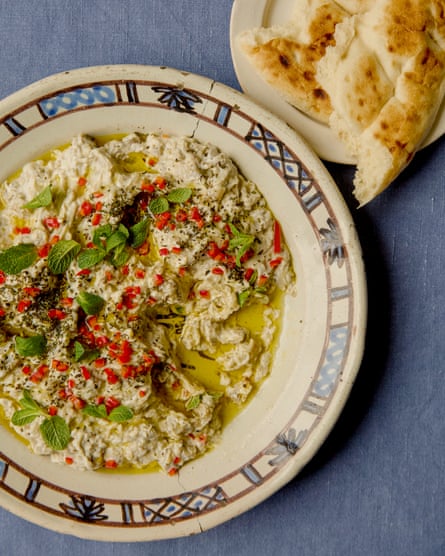
If I were to choose 10 essentials to take to a desert island to live off for ever, that list might include: aubergines, tahini, garlic, lemons, olive oil, pomegranate seeds, fresh mint, dried mint, parsley and salt. M’tabbal, a dish made from this top 10, is a real favourite. Start with the best-quality olive oil you can afford: as with hummus, the oil is used here as a finishing touch, rather than mixed in, keeping the dish light and silky.
Prep 10 min
Cook 55 min
Drain 1 hr+
Serves 4
4 large aubergines, pricked in a few places with the tip of a small sharp knife (1.5kg)
150g greek-style yoghurt
3 tbsp tahini paste
2 garlic cloves, peeled and crushed
1 tbsp finely chopped preserved lemon skin
3 tbsp lemon juice
Salt
To serve
1 red chilli, stalk, seeds and pith removed and discarded, flesh finely chopped
½ tsp dried mint
2 tbsp olive oil
About 10 mint leaves
Put the aubergines in a foil-lined baking tray and put under the hottest grill for 30-40 minutes, turning often, until they’re collapsing and very well charred all over. Once the grilled aubergines are cool enough to handle, cut them in half and scoop out the flesh into a colander set over a bowl (you should have about 400g flesh). Leave to drain for at least an hour (or overnight, in which case, cover and put in the fridge).
Very roughly chop the drained aubergine flesh and put it in a large bowl. Add the yoghurt, tahini, garlic, preserved lemon, lemon juice and a teaspoon and a half of salt, then mix to combine.
Spoon the m’tabal on to a serving plate with a lip, sprinkle over the chilli and dried mint, drizzle with the oil and finish with the fresh mint leaves.