3 months ago
123
3 months ago
123
Steve Hartman has been a CBS correspondent since 1996. In the US, he is known for his feelgood human interest stories. This month he has reported on the retirement of a well-loved New Jersey postman after 33 years on the job and a truck driver who has spent two decades building a balsa wood scale replica of New York City.
But since 1997, Hartman has also been reporting on school shootings, which have become a horrifyingly common feature of American life. (CNN reports that there were at least 78 in 2025, though there is no universal definition of a school shooting, which means that numbers vary depending on the source. Other reports suggest a much higher figure.)
Hartman would try to talk about the human angle, the hero’s story, but his attempts to find light in the darkness were beginning to feel repetitive. “I saw that America was moving on from each school shooting quicker and quicker every time,” he says, in the arresting short documentary All the Empty Rooms. Eight years ago, he decided to try a different approach.
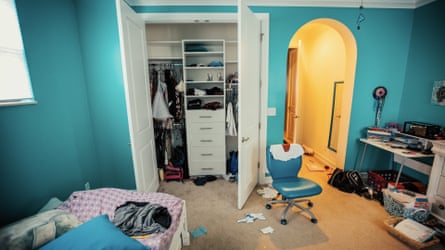
All the Empty Rooms, recently nominated for an Academy Award, offers up another way of looking. Over a painful, delicate and urgent 34 minutes, it follows Hartman and the photographer Lou Bopp as they visit and photograph the bedrooms of four children killed in school shootings. Dominic Blackwell was 14. Hallie Scruggs was nine. Jackie Cazares was nine. Gracie Muehlberger was 15. Its tiny details are likely to destroy you. A SpongeBob SquarePants pencil pot. Friendship bracelets. Children’s handwriting, scribbled on mirrors, on memory boards, on notes written for future selves, tucked away in trinket boxes. A laundry basket full of unwashed clothes.
Bopp is in his apartment in New York, and it is clear that he still finds the experience difficult to talk about. “In my early career, I went to Afghanistan, I took photographs of poachers in South America, erupting volcanoes,” he says. “There were many scary moments. But here I was, sitting in a hotel, the night before photographing a bedroom in Parkland, Florida, and I’ve never been so frightened.” Bopp had known Hartman for decades – Hartman once lived in Bopp’s basement – and when his friend asked him if he would take these photographs, he said yes straight away. “I just thought it was one of the most brilliant and poignant ideas I’ve ever heard,” he says. “My hope is that people feel something when they watch this. If only people could step in these rooms, I think that would change a lot.”
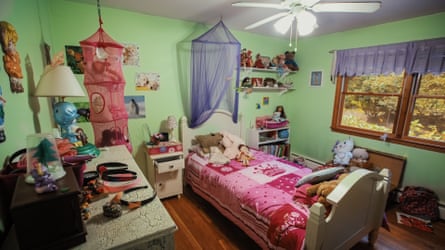
It is a sunny morning in Nashville and Jada Scruggs is calling from the family home. “After Hallie was killed, our world really just shut down, and we were bombarded by the press, wanting information and quotes from us,” she says. It is coming up to the third anniversary of her daughter’s death. They did not have the capacity to respond, she says, nor anything they wanted to say publicly. “We were just completely heartbroken.” A few months later, Hartman wrote to them and asked if they would take part in the photography project. They were the first family to agree.
Bopp’s photographs were printed in hardback books which were then given to the families. “We thought that could be a really good thing for us to have, down the road.” And they love to talk about Hallie, says Scruggs. “We wanted Hallie to be known, and it was a good way for us to be able to talk about her, and share her.” What would she like people to know about her daughter? “Hallie was full of life and lots of joy. She was happy and loved to laugh. She was sporty.”
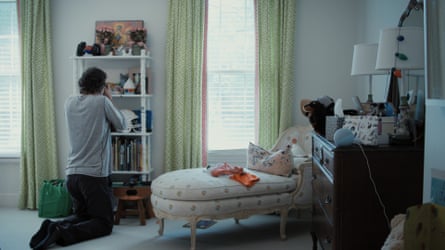
Her room is full of sports memorabilia, books, a miniature pool table, a karaoke microphone under her bed. Scruggs hopes that Hallie’s effervescence comes across in the film, which it does. “And just how much she was valued, as a family member. Her absence is the hole that we will never be able to fill. I hope the film captures that.”
The families’ participation is powerful. Everyone involved is driven by hope for what the film might be able to achieve. Scruggs says that she hopes for “actual, real change”. What does that look like? “A lot of this is going to be policy, and people are going to have to want policies to change. I would hope that the film would spur people on to want that change, and to act on it. Because no one wants this for people.”
“This issue is so stuck here,” says the film’s director Joshua Seftel, speaking from his home in Brooklyn, New York. “Nothing’s moving forward in the way that it should. People are numb. People who care about this are numb. There are more than 100 school shootings a year. We can’t even keep track of them all.” There was a mass shooting two days ago, he says, and few even know that it took place. “It used to be that this was not normal – now it’s normal and we’re numb.”
Seftel felt that if anyone could shake people out of this state of paralysis, it would be Hartman. “In our country, Steve Hartman is known by a lot of people, and he’s trusted, and he’s not political. I believed that he could be a very strong messenger.” The documentary makes a point of never using the word “gun”. “It was very intentional. Even that word is polarising, it’s sad to say,” Seftel admits. But is it possible for it to stand outside politics, in a climate as torrid and partisan as this? “In many ways, it’s not a political issue,” he replies. They wanted to avoid giving any viewer a reason to switch this film off. “Sending your kids to school and not having to worry whether they get shot is not a political issue. It’s something we all agree on. There’s no debate around that.” He hopes that these bedrooms can break through the numbness. “You need to feel the full weight of the issue before we find a solution, and we’re not feeling it any more.”
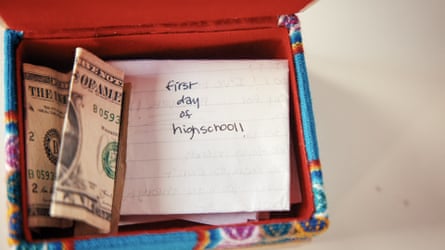
Has he found that there is a reluctance to watch it? “Definitely. I’ve heard that. People are afraid. They don’t want to feel sad. But what would you say to the parent who lost a child, who asked you to watch that film? They want you to know their child’s story and what happened to them.” He gets that people may find it tough. “But I think to myself, well, you can continue to look away, but in that setting, change is less likely to come.” Also, he points out, it is a gentle, quiet film. “This film is about the exquisiteness of life. It’s showing the little details of life that are so beautiful.” We are, he says, “getting to know these kids.”
Bopp says that he would like everyone in the US to stand in one of those bedrooms for 15 minutes. “And see what it’s like and how real it is,” he says. That, he thinks, is how change will come. “This isn’t just a headline. This is happening, and the next day the newspaper will print another headline, and this still goes on for the family. And years later, here we are in these bedrooms, pretty much untouched.”