3 months ago
154
3 months ago
154
Germany’s far-right Alternative für Deutschland (AfD) is different from its sister movements across the west.
In a country deeply conscious of its own history, the party, now riding high in the polls, has to decide whether it rejects or embraces Hitler as an ideological antecedent. Rather than answering definitively, the party is deliberately opaque. It flirts with the Nazi legacy without explicitly committing to it. Far from putting voters off, this strategic ambiguity cultivates a surprisingly powerful mix of outrage and plausible deniability.
The latest stunt is to announce that it will schedule its party conference in early July in Erfurt, the capital city of the central German state of Thuringia.
This date and location are of particular significance: it will be exactly 100 years since a notorious Nazi rally convened in Thuringia. On 3 and 4 July 1926, Adolf Hitler – then nowhere near power but already an infamous fanatic – gathered his party faithful in Weimar, which was then the state capital. This meeting was smaller than the better-known Nuremberg rallies of the 1930s. But for the Nazi party, Weimar was a milestone on its path to power.
The Weimar rally was where the Hitler Youth received its name, and where central Nazi rituals such as the Hitler salute were first presented to the public. Thuringia lifted sanctions on the Nazi party and its leader earlier than other German states after his botched coup attempt in Munich in 1923. Weimar became a safe haven for the movement and a testing ground for Nazi ideas.
A century later, the AfD claims to be ignorant of these events. Stefan Möller, a spokesperson for the party’s Thuringian chapter, said: “Those who draw dangerous links between the AfD conference in Erfurt and a Nazi party conference in Weimar 100 years ago are clearly only interested in the compulsive weaponisation of history.”
It is worth noting that there was no indignation in Möller’s statement, nor was it followed up by any other attempts to distance his party from comparison to Hitler’s. The AfD had evidently expected public outrage and reckoned being called out would do it no harm. It wasn’t wrong.
The outrage has certainly come. Headlines such as “AfD event draws massive criticism” have run in major German newspapers. Politicians have joined historians in a chorus of condemnation. Serap Güler, minister of state at the foreign office, spoke for many when she said that “this deliberately chosen anniversary shows yet again in whose image the AfD was made”. She added that it would be naive to believe party conferences had no symbolic meaning. “The AfD knows exactly what it’s doing,” Güler said. “I’m disgusted by how little decency that party has and how little respect it shows for our history. My goodness, how stupid do they think we all are?”
Güler’s anger is entirely understandable. The Weimar rally of 1926 is an event that any modern-day party ought to want to distance itself from. The AfD knows what it’s doing. It’s evoking rather than avoiding historical comparisons. Thuringia was a sanctuary for the early Nazi movement. Today, it is an AfD stronghold. At the 2024 state election, the AfD came out on top in Thuringia for the first time, although the mainstream parties’ “firewall” kept it out of the governing coalition. Recent polling gives the party 38% of the vote in the state.
Many believe it could finally achieve a breakthrough this year. There are five state elections scheduled in 2026, and in Saxony-Anhalt, which borders Thuringia, the party can even hope for an absolute majority. It’s just a few percentage points away from that at the moment. Such an outcome would not only put the party in government in one of the 16 German states for the first time but also allow it to rule alone, presiding over crucial devolved areas such as education and policing.
The Nazis made their first breakthrough in Thuringia. Weimar became the seat of the first state government to appoint a Nazi minister in 1930, three years before Hitler became chancellor of Germany. The AfD doesn’t explicitly embrace that legacy, but it doesn’t vehemently reject it either.
Coincidence or not, pointing out such flirtations with fascism has done little to halt the rise of the AfD. Björn Höcke, the leader of the party in Thuringia, has been fined twice for using the Nazi slogan “Everything for Germany” at campaign rallies. So far, neither the party’s supporters nor prospective voters appear concerned. The AfD is now neck and neck in the polls with the ruling CDU party, led by Chancellor Friedrich Merz, and a modified version of the slogan has been used by supporters of AfD leader Alice Weidel. Instead of “Alles für Deutschland”, she’s often greeted with “Alice für Deutschland”.
Neither public displays of indignation nor legal proceedings have stopped the AfD in its tracks. Its voters consist broadly of two types: a hardcore of ideological supporters who aren’t put off by Nazi comparisons, and the larger group that has more recently begun to vote for the AfD out of frustration with the social and economic status quo and the mainstream parties. Among that latter group are many working-class voters and people in the former East Germany.
Commenting on the party’s decision to hold its conference on the centenary of the Weimar rally, historian Jörg Ganzenmüller, director of the Hannah Arendt Institute for Totalitarianism Studies at the Dresden University of Technology, spoke of a “conscious symbolic act that works on several levels”. The deniability, he added, maintains a “facade of bourgeois respectability” while the implied radicalism keeps the AfD “open for other voters”. The AfD’s ambiguity works both ways.
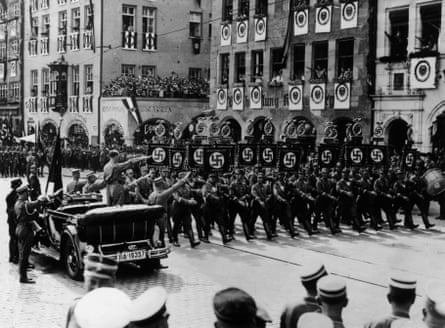
If there are lessons to be learned from 1926, it’s that unmasking the far right is unlikely to damage its chances of success. At his Weimar rally, Hitler, too, was keen to project an image of respectability, although that mask slipped. The Nazis were only in town for two days, but managed to leave a trail of destruction. There were mass brawls with police, wherein an officer was shot and very nearly killed. Ordinary citizens were also harassed by the visitors, especially those who were Jewish or left-leaning. Newspapers and politicians called this out, both locally and nationally. Shellshocked by the violence, one paper warned that this is “how the National Socialists behave if they are allowed even a little bit of leverage”.
Yet moral indignation couldn’t stop the Nazis. It won’t stop the AfD either. Radical parties are symptoms of social, economic and political problems, not causes. That’s why AfD support maps pretty neatly on to areas with deep, structural problems and political grievances, such as the former East Germany or deindustrialising parts of the Ruhr valley in the west.
Those who want to see the AfD diminished should expend less energy talking about the party and more on working out what has allowed it to grow and prosper. There is no evidence to suggest that repeated historical comparisons have any effect. The AfD is not the Nazi party, but it has no fear of wallowing in its infamy. If its opponents actually want to defeat it, they have to offer more than condemnation.