2 hours ago
7
2 hours ago
7
Fiction
Fiction
The Loneliness of Sonia and Sunny
Kiran Desai
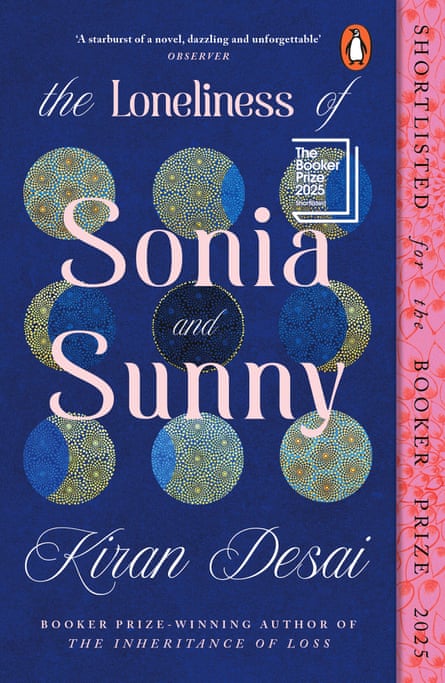
This Booker-shortlisted novel is about work as much as it is about the relationship between Sunny Bhatia and Sonia Shah, whose families are neighbours and whose attempts to make a match begin their on-off liaison. Where Sunny dreams of journalistic success, Sonia’s heart and mind lie in writing fiction. The dilemma facing an Indian writer, she ponders, is one of obeisance to the west’s appetites and projections.
Desai’s solution to the problem in this immensely entertaining and generative novel is to dart continually between modes of representation and register. The gothic novel appears with the early introduction of the monstrous Ilan de Toorjen Foss, a narcissistic artist who seduces Sonia, suppresses her literary endeavours and then abandons her. The predicaments and predilections of Sunny and Sonia’s Allahabad relatives create a low-key bourgeois comedy: stranded single aunts, genteel impoverishment, the wrangle over a cook famed for his kebabs.
Capacious and shape-shifting though the novel is, filled with subtexts and shadow narratives, it is still a challenge to hold the contradictions and demands of multiple identities. Desai pictures Sonia and her father listening to the Pakistani singer Iqbal Bano, and reflecting on what the music conjures in them: “To be a citizen of a troubled postcolonial nation gave a person gravitas. To be holding out against the crass new world gave a man gravitas. To be wounded yet fighting on against the barbarians gave one gravitas. To be exiled, abandoned by love and luck, gave them gravitas. What happened within a family, what happened between a couple, was no different from that which happened in a nation under dictatorship, running on fear.”
Whether or not a novel can accurately and productively capture this yearning for gravitas, or the continuum between the personal and the political, is one of the questions posed by The Loneliness of Sonia and Sunny. Another is the sheer exhaustion – mental, physical and artistic – caused by the constant need for self-invention and reinvention, whether individual, societal, national or global; and how the form of the novel, created in the European consciousness, can complexify itself to take account of an accelerated, fractured modernity. Desai’s answer to these questions is to make her story both dizzyingly vast and insistently miniature; to make us feel that there is as much at stake in the lives of Vini-Puri, a pair of servant girls not even accorded single-name recognition, as in the grand ambitions of the novel’s title characters. She pulls it off, not only in her manoeuvring of cast and incident, but in her ability to elicit apprehension, laughter, compassion and curiosity in the reader. Alex Clark
£11.04 (RRP £12.99) – purchase at the Guardian bookshop
Fiction
We Love You, Bunny
Mona Awad
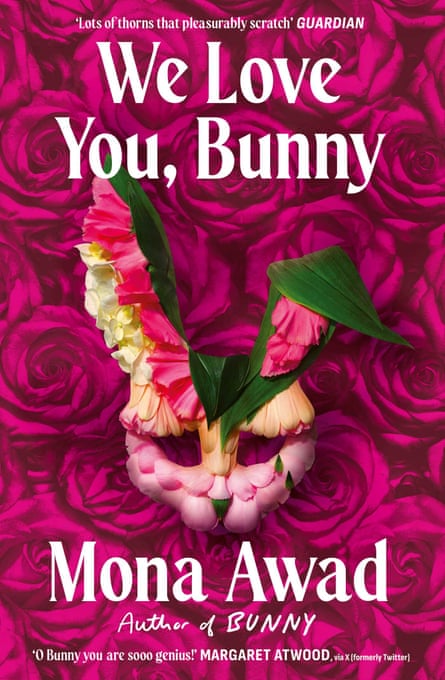
We Love You, Bunny, is the much-anticipated sequel to Mona Awad’s beloved campus horror/satire of 2019, Bunny. Both books are set at an Ivy League university in a crime-ridden New England town; from various well-seeded clues, we can identify this as Brown University. Here it is called Warren, because the Bunnyverse is unabashedly silly and self-referential. Rabbit jokes abound.
The first book followed Samantha, an alienated, cash-strapped creative writing student cold-shouldered by her workshop cohort, a cabal of four ultra-feminine rich girls who all call each other Bunny. The Bunnies wear fluffy dresses, eat mini food and – as Samantha learns when she’s finally inducted into their cult – express their creativity through demonic rites that involve exploding rabbits. Samantha has to transcend them to find her voice as an artist. The story of Bunny is the result.
We Love You, Bunny begins with Samantha bound and gagged in an attic. The Bunnies surround her, congratulating her venomously on the success of her book. Now they want to tell their story. Passing an axe like a talking stick, they introduce us to four versions of their Bunny-centric world. Then they pass the mic to a special guest.
This follow-up has the key strengths of the original, particularly its scabrous satire on upper-middle-class American femininity. However, it suffers from a certain sequelitis. It’s baggier than the original. Its metaphors for creativity feel less earned. The game of visiting each Bunny’s point of view also disappoints. This is redeemed, however, when we come to the last voice of the novel.
Toward the end, a writing professor passes judgment on the story we’re in: “A touch too camp. Zany. A sort of zany romantasy, isn’t it?” Yes, it is, but Awad is here to show us that romantasy can be serious literature, and nothing can really be too camp. And if We Love You, Bunny has weaknesses endemic to sequels, it also has their strengths. There’s the fun of meeting the old characters and seeing areas we wondered about before, but it also builds on the original, opening up new territory and making new jokes. And though it’s better to start with the first novel, We Love You, Bunny can be read alone. It’s a goofy, overblown flower of a book with lots of thorns that pleasurably scratch. Sandra Newman
£8.99 (RRP £9.99) – purchase at the Guardian bookshop
Fiction
Buckeye
Patrick Ryan
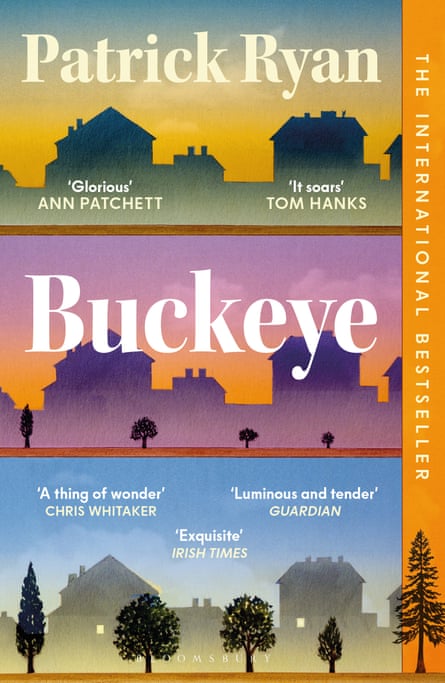
Opening in the first decades of the 20th century, this luminous and tender novel follows the interwoven lives of two married couples in the fictional town of Bonhomie, Ohio. One half of the first of these couples is Cal Jenkins, the sweet-tempered son of a traumatised first world war veteran, born in the spring of 1920 with (to use the parlance of the era) a mild deformity: “The day you were born and one of your legs came up short,” his father, Everett, tells him, “right then I thought, well, that’s it. If we get into another big one, he’ll never be in it.” The delights of prolepsis!
The US gets into another big one in quite short order, of course. Cal, just as his father predicted, is turned away from the recruitment office and ends up spending his days in drudgery at the local concrete factory instead. A chance meeting with Becky Hanover, a young woman with a dark bob and a loveably whimsical way about her, sees Cal married by the end of the first chapter.
On 8 May 1945, Cal is working a shift at the hardware store owned by Becky’s father when a gorgeous, confused redhead stumbles in. Together, they listen to President Truman announce allied victory in Europe over the wireless – and then she kisses him. The gorgeous, confused redhead is Margaret Salt. Her own equally gorgeous and strangely aloof husband is away on a cargo ship in the Pacific. From here, the novel takes off at full thrust, and, as one of Ryan’s characters summarises it: “people get laid, babies get made, everybody lies to their kids”.
It is no surprise that Ryan cut his teeth writing short fiction: Buckeye is elevated throughout by the precision with which he captures the tiny, haunting glories of everyday suburban life. And for all its quotidian charm, a deep melancholy prevents Buckeye from ever tipping into saccharine nostalgia. Ryan strips away the Bakelite glaze of the American dream to expose the raw flesh beneath. AK Blakemore
£9.89 (RRP £10.99) – purchase at the Guardian bookshop
Fiction
The Wax Child
Olga Ravn
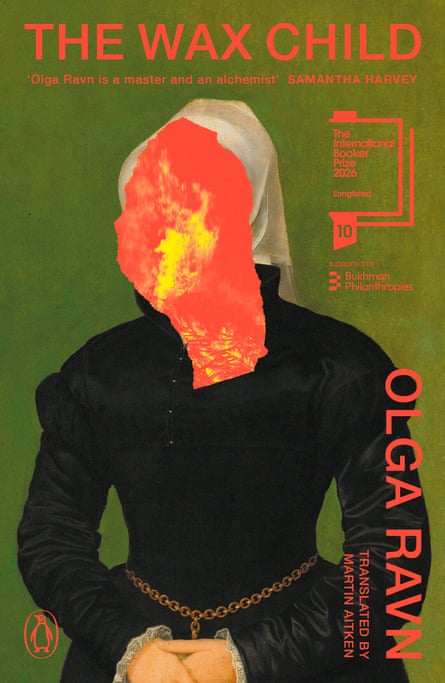
On 26 June 1621, in Copenhagen, a woman was beheaded – which was unusual, but only in the manner of her death. According to one historian, during the years 1617 to 1625, in Denmark a “witch” was burned every five days. The first time this happens in Danish author Olga Ravn’s fourth novel, the condemned woman is “tied to the ladder, and the ladder pushed into the bonfire”. Her daughter watches as she falls, her eye “so strangely orange from within. And then in the heat it explodes.”
The child is watched, in turn, by a wax doll who sees everything: everything in this scene, and everything everywhere, through all space and all the time since it was fashioned. On a basic level, the wax child is a useful narrative device. But it also complicates everything. The temptation, from the distance of the 21st century, is to assume charges against so-called witches to be baseless. But in this case, a well-known one in Denmark, the charges included the making of wax children – and Ravn begins with Christenze Krukow, a real Danish noblewoman who was accused of witchcraft three times during her lifetime, making this wax baby.
Ravn began as a poet, and even in English this lineage is clear. Her work asserts that knowledge inheres in objects, comprehension through smell and taste and blood and guts; through metaphor. “How do I know this?” demands the wax child, at one point. “It is like a gash in me to know it.”
At its best The Wax Child is richly evocative, beautiful, creepy and visceral. “It is the darkest of times, December. From the curvature of the earth, minutes run like droplets from the day.” At other times, there’s a bit too much research just out of sight; the novel can feel elliptical, even baffling. One misses the space, the clarity and freedom of Ravn’s International Booker-shortlisted novel The Employees. But maybe that’s the thing about weaving spells. About poetry, too: demand it makes neat sense, and you begin to have too much in common with the witch-hunters. Aida Edemariam
£8.49 (RRP £9.99) – purchase at the Guardian bookshop
Fiction
King Sorrow
Joe Hill
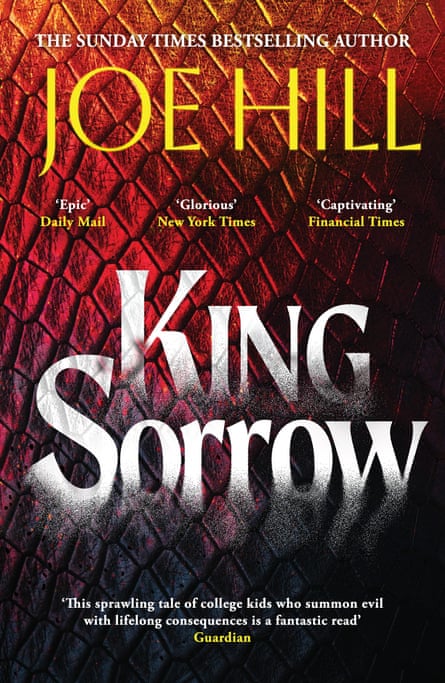
Six oddball but doughty kids fall into the path of a vast and terrible supernatural evil which has come into our world from the outer limits of darkness. They must spend their lifetimes battling it, facing horror after horror in the process.
This is the plot, roughly, of Stephen King’s novel It (his best; no arguments). It is also the plot, roughly, of King’s son Joe Hill’s new horror doorstopper, in which six friends summon the ancient, infinitely malicious dragon King Sorrow from the Long Dark to help them defeat some baddies. Needless to say, their supernatural ritual backfires.
Joseph Hillström King started his career making great efforts to avoid any connection with his famous father, publishing under the pen name he still uses today and avoiding meeting his agent in person (he bears a striking resemblance to his dad). But in this latest novel, he leans into it. There are lines that deliberately echo some of King’s most famous (“The man in black fled across the desert …”); a moment that brings to mind a King plot point (a riddling contest). In this whopper of a novel, Hill is delighting in his family connection, and we delight along with him. King Sorrow is huge, sprawling – and absolutely fantastic. Alison Flood
£11.69 (RRP £12.99) – purchase at the Guardian bookshop
Memoir
Memoir
Book of Lives
Margaret Atwood
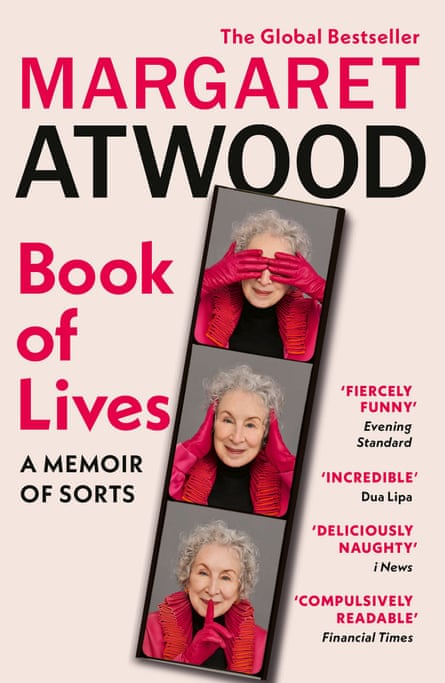
Book of Lives is less a memoir than an autobiography, not a slice of life but the whole works, 85 years. Where most such backward looks are cosily triumphalist or anxiously self-justifying, hers is sharp, funny and engaging, a book you can warm to even if you’re not fully au fait (and few people are) with her astonishing output, which in the “also by” contents list here fills two pages.
At the co-ed high school Atwood opted for, she soon graduated to the “brain class”. A small, “flat-chested weirdo”, with horn-rimmed glasses, a snaggle tooth, frizzy hair, astigmatism and anaemia, she put her energies into sewing and fancy dress. By 14 she was dating: older, artsy boyfriends “somehow just appeared, like mushrooms after rain”. Poetry pursued her, too: her adolescent efforts were “heavily sensational, sometimes macabre”. According to her school yearbook, her “not-so-secret ambition is to write THE Canadian novel”. But her first publications were poems that appeared under the name ME Atwood, “so I wouldn’t be tagged as a girl”.
From university in Toronto, she moved on to Harvard, a tweedily unglamorous scholarship girl. There she researched the Salem witch trials, which along with the patriarchal norms of Harvard graduate school fed into The Handmaid’s Tale many years later. She wasn’t an active feminist in her 20s, when the idea that “domestic tasks might be shared equally” hadn’t arrived. But the oppression of women increasingly troubled her. And by the time the TV version was made, in the era of Trumpism, it was more salient than ever.
At a party in 1969 she met Graeme Gibson, novelist, trickster, spendthrift, high-energy oddball. He was wearing blue denims, she a “white crocheted lace mini dress with wooden buttons down” (Atwood is scrupulous in recording her changing outfits and hairstyles), and at first she had no awareness of his “non-platonic interest” in her. There were complications: she’d married an American poet, less from love than to spare him being drafted to Vietnam, and Graeme had a child by a woman with whom he had an open marriage, Shirley. A cautious courtship followed; Graeme wooed Atwood with yearning letters. If she’d not met him she’d still have been a great novelist, he said, but she’d have had a lot less fun.
His decline, dementia and death bring a sombre tone to the book’s last pages. Ever the workaholic Ms Fixit, Atwood keeps going rather than miss out on the publicity whirl for The Testaments (her sequel to The Handmaid’s Tale): “Ask yourself, Dear Reader: The busy schedule or the empty chair? I chose the busy schedule. The empty chair would be there when I got home.” She has a pacemaker these days and eventually her body “will decide to go off on an adventure of its own”. But for now mind and body are still together and so, in friendly opposition, are the many selves she unveils here in a “blizzard” of memories and photos: nerdy brainiac, waifish poet, Medusa-eyed feminist, uncanny prophet and one of the great novelists of our time. Blake Morrison
£11.69 (RRP £12.99) – purchase at the Guardian bookshop
History
History
Indignity
Lea Ypi
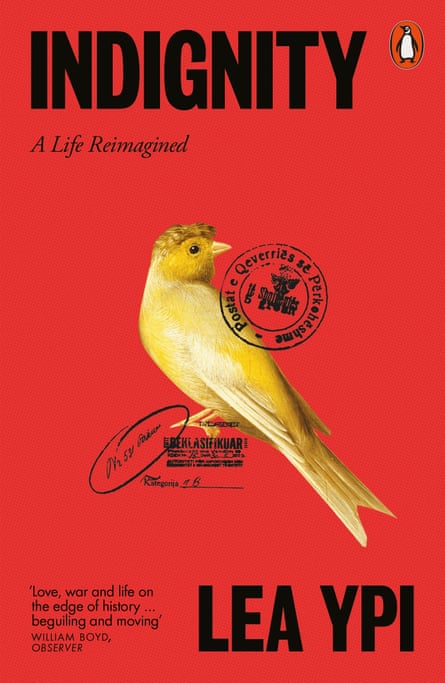
It starts with a photo. A black-and-white image of a couple relaxing on a pair of sun loungers in front of a luxury ski hotel: him, squinting against the sun; her, smiling at the camera, wrapped in a white fur coat. It is their honeymoon in Cortina, up in the Italian Alps.
The year is 1941, and the woman is Lea Ypi’s grandmother. Ypi saw the picture after it had been posted online by a stranger, gone viral across Albania, and attracted a stream of abuse. “Morally degenerate” was one comment. “Fascist collaborator” another.
And so, in Indignity, Ypi sets off to find out exactly who her grandmother was. It is, she writes, partly out of a sense of duty, to defend her family member from the trolls – a kind of 21st-century version of EP Thompson’s famous call for history to rescue the dead from “the enormous condescension of posterity”. But partly, Ypi admits, it is because she finds the photo unsettling. How to reconcile her beloved, compassionate grandmother with this glamorous young woman living it up in Mussolini’s Italy?
From here, two parallel stories unfold. The core of Indignity is a richly reimagined retelling of Ypi’s grandmother’s life. Born in Salonica (now Thessaloniki) in 1918, Leman Leskoviku came into a world that was already falling apart. Cosmopolitan empires were collapsing into nation states, unsure how to treat families like hers: Albanian-speaking, living in Greece, with a proud record of service to the Ottoman state. Leman’s childhood is shaped by the uncertainty of those years: the trauma of wars just ended, economic decline, and blunt, brutal social engineering. As Ypi describes, millions were forcibly moved across newly drawn borders. Leman’s nanny, one of Salonica’s many Muslim Turks, is barely able to hold back tears as she is packed off to central Anatolia.
Amid the ambiguity, and to escape an unwanted suitor, Leman sets her own life on a different path. At just 18, she decides to move to Albania alone. Ypi’s Ondaatje prize-winning memoir, Free, was haunted by stories of Albanians fleeing to neighbouring countries to escape the violence of the 1990s. This story hinges on a young woman’s extraordinary choice to move the other way. Sami Kent
£11.04 (RRP £12.99) – purchase at the Guardian bookshop
Politics
Politics
One Day, Everyone Will Have Always Been Against This
Omar El Akkad
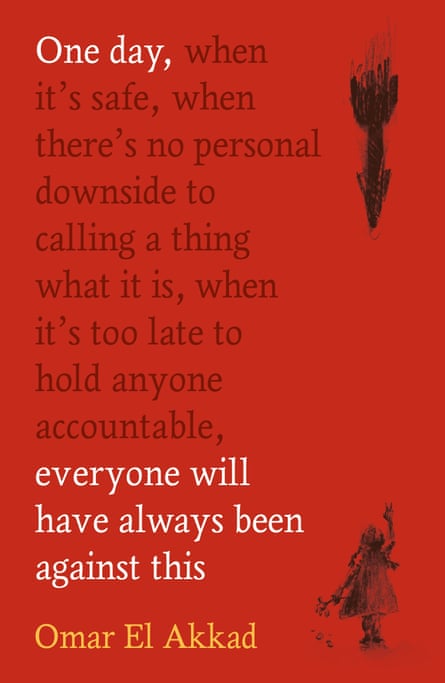
Palestine has many eloquent defenders, and El Akkad is one of them. Born in Egypt, raised in Qatar and Canada, and now a US citizen, he has reported from the Middle East, Afghanistan and Guantánamo. His new book is a response to events in Gaza after 7 October 2023. It is his voice, his bafflement, spilling out after decades of having to keep quiet for the sake of journalistic neutrality or artistic show-don’t-tell, of having to bite his tongue after readers responded to his journalism with racist doubt: “I don’t trust any story about terrorism written by a guy named Omar”.
He turns his back on these old strictures and tells the world what’s wrong as himself, not just reporting but processing all that he has seen and heard. “This is an account of a fracture,” he writes, “a breaking away from the notion that the polite, western liberal ever stood for anything at all.” It is a deft, broken-hearted, rhetorical savaging of comfortable people who say nothing (or pay lip service) but care only about preserving normality, convincing themselves that these things only happen “to certain places, to certain people”.
One Day is passionate, poetic and sickening. It is full of well-earned rage, frustration with those who need this morality to be spelled out. For me it was cathartic, almost spiritual, to have these ugly truths articulated. It stoked and tempered the fires of my own rage. It is an important book, a must-read, if only for the reminder that history always comes down to one simple question: “When it mattered, who sided with justice and who sided with power?” Dina Nayeri
£9.89 (RRP £10.99) – purchase at the Guardian bookshop
Biography
Biography
The Boundless Deep
Richard Holmes
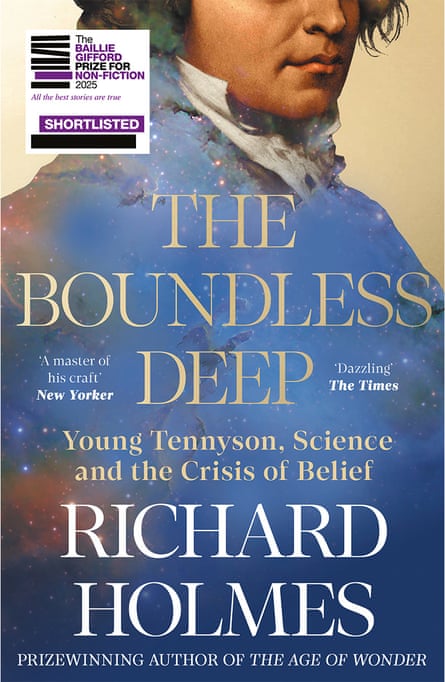
Alfred Tennyson was a divided soul. He even wrote a poem called The Two Voices in which dual versions of himself argued out the pros and cons of suicide. In this illuminating book, Richard Holmes has chosen to focus on the lesser known of the poet’s personae.
The Boundless Deep is not about the bestselling author of the nation’s favourite poem – The Charge of the Light Brigade – or the laureate lord, pacing along the clifftops of the Isle of Wight or posing for Julia Margaret Cameron’s famous photograph (known derisorily in his family as “the dirty monk”). Instead, Holmes gives us “young Tennyson”, the wildly talented youth whose story is far more rich and strange than that of the bearded celebrity.
The Tennysons, wrote Alfred, were a “black-blooded race”, meaning prone to moods and melancholy. His father, a reluctant clergyman, was angry and very often drunk. There was an incident, the details of which are obscure, that resulted in the family cook being burned to death in the rectory kitchen. One of Alfred’s brothers was confined to a lunatic asylum as a boy and stayed there for life. Another suffered from profound depression and followed his father into alcoholism. A third became addicted to opium. Alfred himself suffered from episodes of paralysing gloom and what he called “weird seizures”. His Maud is narrated by a madman: he must often have wondered whether he was or would become one himself.
Holmes is not an uncritical fan – he is tart about the pseudo-medieval flim-flam of Idylls of the King – but when he loves a poem, he writes about it with a wonderful capacity for noticing every pulse of metre, every flicker of nuance. This biography is a compelling story of an odd, brilliant, charismatic character, and a reappraisal of a man who had become so very established we could no longer see him. In giving us young Tennyson – gauche, beautiful, veiled in stinking tobacco smoke – Holmes has given the great poet back to us. Lucy Hughes-Hallett
£11.69 (RRP £12.99) – purchase at the Guardian bookshop
Biography
Crick
Matthew Cobb
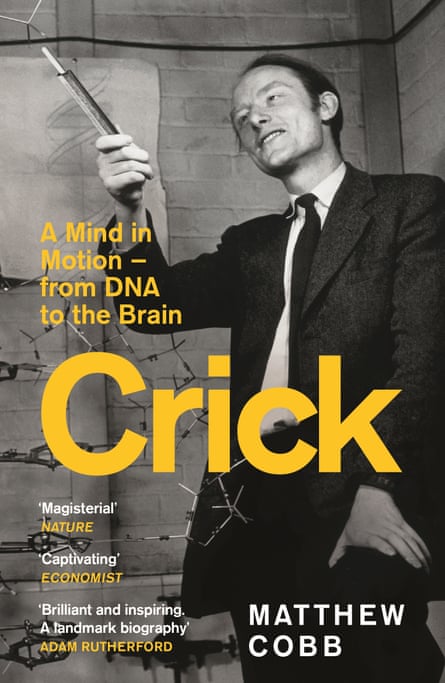
Most people could tell you that Francis Crick, together with James Watson, discovered the double helix structure of DNA, and shaped our understanding of how genes work. Fewer know that Crick also played a key role in modern neuroscience and inspired our continuing efforts to understand the biological basis of consciousness.
Crick once said the two questions that interested him most were “the borderline between the living and the non-living, and the workings of the brain”, questions that were usually discussed in religious or mystical terms but that he believed could be answered by science. In his new biography of the Nobel prize-winning scientist, Matthew Cobb, emeritus professor of zoology at the University of Manchester, does an admirable job of capturing the rare thinker who not only set himself such ambitious goals but made remarkable progress in achieving them, radically remaking two scientific disciplines in the process.
Far from being the stereotypical reclusive genius, labouring in isolation, Crick was loud-talking and charismatic, a philanderer, poetry lover and thrower of risque parties. Crick’s inspiration and breakthroughs came through intense encounters with others, and he was skilled at bringing researchers from different disciplines together to solve scientific puzzles.
In Cobb’s telling, Crick was bold and arrogant, with an uncanny ability to uncover connections and to identify new theoretical and experimental approaches, often challenging far more established experts. Lawrence Bragg, the head of the Cavendish lab, is said to have described him as “the sort of chap who was always doing someone else’s crossword”. This approach meant he often stepped on people’s toes and was occasionally wildly off mark.
Cobb sets himself an ambitious task in trying to do justice to both Crick’s prolific scientific career and his colourful personal life, and this biography is an impressive work of research and scholarship. It is intended to be accessible to the general reader, with the advice that those who are struggling with the science should “follow Crick’s advice to readers of his own books and skip the hard bits”. This general reader struggled often with the technical detail and vocabulary. Some difficulty may be inescapable simply because the science is complex. Nonetheless, it is a relief whenever Crick is quoted, describing his research in his own words, because he had a knack for translating hard science into lay terms. Sophie McBain
£12.74 (RRP £14.99) – purchase at the Guardian bookshop
Technology
Technology
If Anyone Builds it, Everyone Dies
Eliezer Yudkowsky and Nate Soares
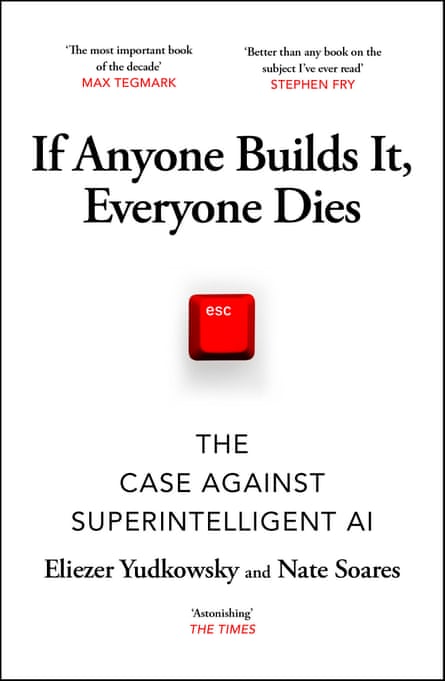
What if I told you I could stop you worrying about climate change, and all you had to do was read one book? Great, you’d say, until I mentioned that the reason you’d stop worrying was because the book says our species only has a few years before it’s wiped out by superintelligent AI anyway.
We don’t know what form this extinction will take exactly – perhaps an energy-hungry AI will let the millions of fusion power stations it has built run hot, boiling the oceans. Maybe it will want to reconfigure the atoms in our bodies into something more useful. There are many possibilities, almost all of them bad, say Eliezer Yudkowsky and Nate Soares in If Anyone Builds It, Everyone Dies, and who knows which will come true. But just as you can predict that an ice cube dropped into hot water will melt without knowing where any of its individual molecules will end up, you can be sure an AI that’s smarter than a human being will kill us all, somehow.
Yudkowsky and Soares present their case with such conviction that it’s easy to emerge from this book ready to cancel your pension contributions. The glimmer of hope they offer – and it’s low wattage – is that doom can be averted if the entire world agrees to shut down advanced AI development as soon as possible. Given the commercial and strategic incentives, and the current state of political leadership, this seems a little unlikely.
There are certainly moments in the book when the confidence with which an argument is presented outstrips its strength. And Yudkowsky and Soares exhibit more than a touch of confirmation bias. “History,” they write, “is full of … examples of catastrophic risk being minimised and ignored,” from leaded petrol to Chornobyl. But what about predictions of catastrophic risk being proved wrong? History is full of those, too, from Malthus’s population apocalypse to Y2K. Yudkowsky himself once claimed that nanotechnology would destroy humanity “no later than 2010”.
The problem is that you can be overconfident, inconsistent, a serial doom-monger, and still be right. It’s important to be aware of our own motivated reasoning when considering the arguments presented here; we have every incentive to disbelieve them. It still feels like everyone with an interest in the future has a duty to read what Yudkowsky and Soares have to say. David Shariatmadari
£11.69 (RRP £12.99) – purchase at the Guardian bookshop
Music
Music
Night People
Mark Ronson
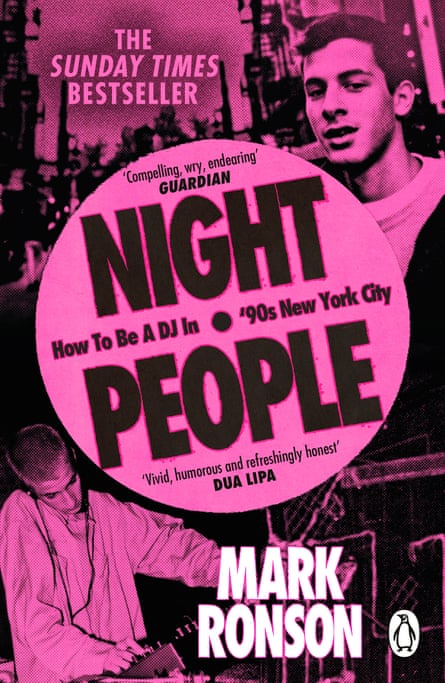
Night People is intended as Ronson’s memoir but is as much an attempt to immortalise the people and scenes he came up in as it is a reflection on a childhood shaped by the late-night parties hosted by his parents – first in London, where a distant memory of Robin Williams tucking him in to bed with “Nanu nanu” floats through, then later in Manhattan, when his mother marries Mick Jones from Foreigner.
By his own, self-aware account, Ronson has led a gilded life. Elite schools (Collegiate, Vassar, NYU); sleepovers with Sean Lennon and a cast of New York’s nepo who’s who; hanging out with Michael Jackson; the abundant creative freedom gifted by the safety net of generational wealth. It would be enough to make many readers roll their eyes before turning a single page. Their loss.
Ronson’s talent as a writer enables him to render this privilege, the background glamour, his awkward stumbles as well as successes, with a kind of wry, soft self-deprecation that is genuinely endearing. It helps, of course, that he is a massive nerd. Ronson would rather spend paragraphs enthusing about the thickness of slipmats required for a specific DJ setup than he would recalling the wild-eyed buzz generated at an afterparty close to dawn. On balance, this is a good thing. There is more than enough bad writing on hedonism in the world. I’ll take the earnest, qualitative review of turntable cartridges.
The one-man hit factory, the force who famously drove Amy Winehouse to create her best work, the mega producer – none of that is here, of course. At the centre of this book is a Ronson much closer to the teenage crate-digger whose mum bought him his first Technics turntables and who blagged his way to the booth. It shouldn’t be as compelling as it is, but for the accompanying soundtrack of deep cuts alone, Night People is well worth a spin. Nosheen Iqbal