3 hours ago
10
3 hours ago
10
Derek Gow and Derek Banbury should hate each other. Gow is an outspoken rewilder widely credited with bringing back the beaver in England. As he returns his Devon sheep farm to wild nature, he is also breeding storks, wildcats, red-backed shrikes, glowworms and even adders to return to the countryside. Over the hedge, Banbury, his neighbour, is proud to be an intensive farmer, producing milk and beef cattle behind tightly clipped hedges.
“It’s like he’s just gone mad,” says Banbury of Gow at the start of Derek vs Derek, an illuminating and unexpectedly funny new documentary that follows the pair over three years. “And the madness is now crossing the road on to my land.”
What begins as a portrait of neighbours at war, with no hope of bridging the chasm between modern chemical farmers and idealistic rewilders, or between the needs of food production and the worsening extinction crisis, is slowly and subtly upended, as the two Dereks learn to live alongside each other and hopeful seeds of common ground are sown.
Documentary-maker James Dawson started following Gow as he sold the last of his sheep, planning a film about the dramatic changes brought about by rewilding his farm. Then, when Dawson first visited Gow, he was put up at the Banburys, where wife Linda has turned former pigsties and old sheds into holiday cottages. As soon as Dawson met Derek Banbury over breakfast in the farmhouse kitchen, he knew he had to make a rather different film.
As well as a boundary, both Dereks share a certain charisma, bloody-mindedness, business acumen and, actually, a love of animals. Gow is an imposing, fast-talking, sweary Scot who criticises “showers of morons” in conservation for convening endless committees while species plummet towards extinction. He’s equally disdainful of farmers “spaffing” public money on Land Rovers and sticking sheep on overgrazed pastures and feeding them fish-meal from the Gambia, “raping what’s left of a disastrous environment to produce something that nobody wants”.
Meanwhile, Banbury, who has an impish grin and quick wit, is unrepentant about agribusiness. “I love farming,” he declares in the film. “Intensive farming, that’s supplying the world with food. The population’s getting bigger. It’s not getting smaller, and everyone is going to be happy if they’ve got full bellies. I’ve done it for 50 years and I won’t change. I won’t change.” Or will he?
I find both Dereks in the Banburys’ kitchen, where Linda is doling out tea and cake and Banbury’s four grownup children (three daughters and one son) and dogs are bustling around. They are preparing to welcome an audience of farmers, neighbours and friends to a special preview of Derek vs Derek, which is being shown on a temporary screen erected in the Banburys’ biggest, newest barn.
Banbury is laughing, but he is also raging: the production company was duty-bound to bring in a health and safety officer, and he’s been instructed to reduce the number of chairs in the barn. “It’s my farm! Nobody tells me what to do!” he says. “I’ve done what I wanted for 50 years.”
“It’s in case there’s a fire,” reasons his eldest daughter, Katie.
“Oh, for God’s sake! It’s a steel building and concrete walls. If there’s a fire, people will run out quickly.”
“My Derek doesn’t get cross often,” says Linda. “But he’s cross now.”
It takes all four Banbury children to calm Derek down. A few chairs are shuffled around to enable a swift evacuation. Meanwhile, Banbury admits he was “a little bit” reluctant to appear in a film where he assumed Gow would be the hero. “Then James [Dawson] started going outside and filming some of my animals. Then they came up with a little payment, and it started from there.”
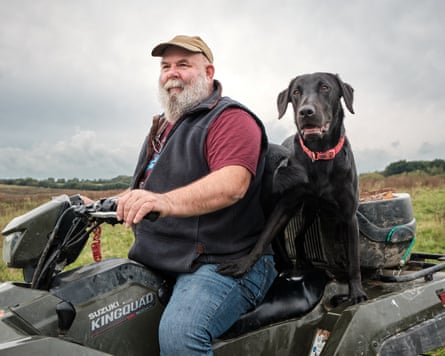
When Dawson’s cameras followed Banbury to the local cattle market, the farmer got some stick. The auctioneer called out “‘Oh Derek you’re needed, hair and makeup’s waiting for you,’ right in front of everyone, and everyone started laughing.” When Banbury told a spraying contractor that he and Gow would soon be on The One Show, the contractor replied: “What, as the Teletubbies?”
Banbury doesn’t mind because, in a way, he is the hero of the film. As well as documenting the transformation of Gow’s land from grim mudbath to natural paradise, the film follows Banbury’s journey from feeling a visceral dislike of wild boar, storks and beavers to acknowledging the losses brought about by intensive farming. Linda, his perceptive wife, who preaches tolerance and an acceptance of beavers, is a second breakout star.
The Banburys and Gow received a standing ovation at film festivals in Thessaloniki, Greece, and in Sheffield. Banbury, who has never before visited Mayfair in central London, thinks he might have to buy a new suit for the film’s UK premiere there. How does he feel he comes across? “I’ve got more confident as I’ve got older and I know what I’m talking about. I’m proud to be a farmer and I’ve tried to do the best I can. We’re tied a bit by the price of milk, but we just keep going, we keep struggling on and we love what we do.”
His father started out with just 14 cows, and in those days he could support his family with a small farm of less than 150 acres. Like most farmers, Banbury has had to expand – and intensify production – to survive. His farm has become a small village of barns housing 200 milking cows, with 600 in total. While sparrows still chirrup on the farm and swallows dip over the pond, Banbury has noticed the loss of nature as he fertilises, sprays and takes three or four cuts of silage each year. “I wish there was more insects and birds and bees but I don’t study that. I study my crops,” he says in the film.
Dawson documents the tensions when rewilding and intensive farming share the same corner of north-west Devon. Gow’s wild boar escape and rootle up Banbury’s pasture. Banbury has the boar shot. Banbury “hates” storks, and don’t talk to him about beavers, which are acclaimed by conservationists for creating new wetlands that become havens for wildlife: “I can’t see that they do any good at all. They just do vicious damage,” he thunders. When Gow writes a book about the history of wolves in Britain and hosts a conference considering their reintroduction, Banbury and other local farmers are apoplectic.
after newsletter promotion
And yet, Banbury is taken to see Gow’s meadows, which after unpromising beginnings, are today burgeoning with rare birds, wildflowers and butterflies, and admits “we’ve got to have areas like this for the wildlife”. Gow does not want to rewild the world, but suggests if every farmer set aside 10% of their least productive land for wildlife, it could reverse the extinction crisis. “I hate to say it but sometimes he’s right,” nods Banbury on film.
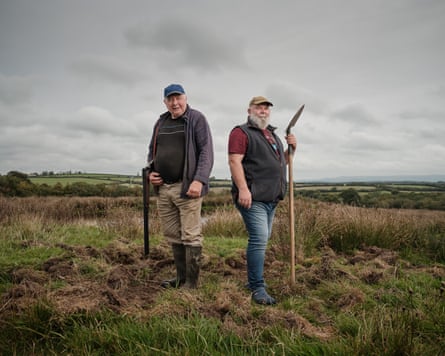
“The man’s a psychopath when it comes to hedgerows,” Gow initially says of Banbury, but as the film progresses, there is talk of Banbury allowing hedges to grow wild and create corridors for nature to move through his neat green fields. So will he? “It depends on the land. It depends if we’re paid for it,” he tells me. Banbury is due to re-fence his fields this autumn; Gow hopes he will make a bit more space for nature.
For all Gow’s bristle, Linda recognises him as a “big Scottish softie at heart”. Has Gow’s view of farmers softened as well? “I do have great sympathy for them, especially the older men,” he says. “Some of them are just bastards. They are hard, hard farmers but they know what has happened. They know of the loss of nature. These inflexible and difficult old men are the last generation who understand that.”
Today, Gow gives rewilding talks with illustrations from the Ladybird books of the 1950s and 60s that recall a lost British countryside – “pictures of the redshanks with chicks and hedgehogs and bats in these beautiful woodlands under a full moon at night. And you look and think: that’s attainable. It’s not alarming. It’s not scary. It’s actually something that’s quite alluring.”’
Gow’s latest big idea is that farmers could be paid to do what he does: breed rare wild animals in captivity and release them. They would then be invested in seeing local populations of “their” wild animals thrive. “They’re the guys that are sitting in the pubs at night, they’re talking to their neighbours. If there are issues, it’s much easier to resolve them amongst themselves,” he says. “As a farmer, you become part of the solution. You’d feel good. But most conservationists have to understand farming and farmers better and, despite all the rhetoric, I’m not sure they do.”
More than 300 farmers and neighbours turn up for the Banburys’ special screening, where they are served local cider, pasties and ice-cream. They laugh loudest at Banbury’s put-downs of rewilding. But, as Gow says afterwards, “when the film finished, no one was arguing” against the facts of nature loss. As well as a cinematic release, Derek vs Derek will be shown at special on-farm screenings across the country. Its makers hope it might forge new conversations and even new working relationships between farmers, conservationists and rewilders.
Has the two Dereks’ relationship been strengthened by the film? Gow took the Banburys to see flamingoes when they visited the film festival in Thessaloniki together. He also ensured Derek and Linda found a cab after the show in Sheffield. The first thing Gow asks when he pops into the Banburys’ kitchen the morning after the screening – after ribbing them about their St George’s flags flying from their farm buildings – is whether he can borrow their trailer. While he’s there, Linda serves him another of her generous cooked breakfasts.
Are Derek and Derek friends? I ask Banbury. “Yeah!” he beams. A big sincere smile. “You can’t be no other can you, when you’re neighbours? He’d do anything for me. And I’d do anything for him.”
Derek vs Derek is in UK cinemas from 2 October.