3 hours ago
10
3 hours ago
10
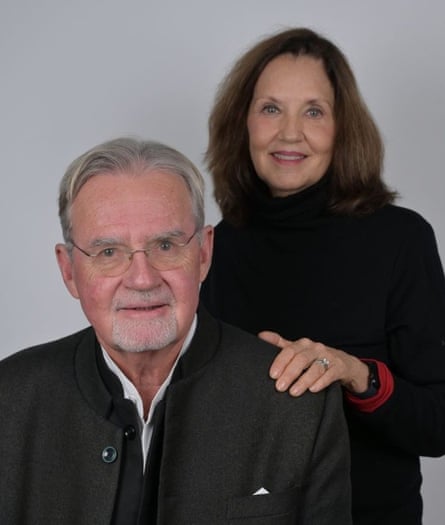
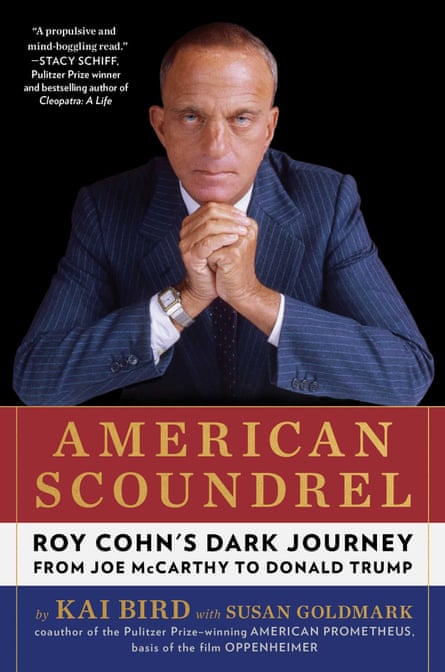
Kai Bird and Susan Goldmark have written a book Trumpworld doesn’t want you to read. Published on Tuesday, American Scoundrel is a propulsive, horrifying biography of Roy Cohn, the New York mob lawyer whose extraordinary life charted, as the book’s subtitle has it, a “Dark Journey from Joe McCarthy to Donald Trump”.
“I told my publicist to reach out to any of the Fox News hosts and reporters, to Joe Rogan, Steve Bannon,” Bird said. “We haven’t gotten a peep, other than Joe Rogan. He said he looked at the galleys, and he got back to my publicist and said, ‘I’m not interested.’ I’m kind of surprised. This is a serious biography of the president’s mentor, whom he publicly admires and says he still misses.”
From the mid-70s to the mid-80s, Cohn guided Trump through the cutthroat world of New York real estate. Everything brutal about Trump, in business and politics, he likely learned from Cohn. How to profit from ties to organized crime? Check. How to stay a step ahead of the law? Check. How to remorselessly lie and never admit wrong or defeat? Check.
Small wonder that in 2017, amid scandal over links to Russia that aides couldn’t master, Trump famously demanded: “Where’s my Roy Cohn?”
Trump does know about American Scoundrel, because Bird called him four times on his personal number.
“The interviews were eight, nine, 10 minutes,” Bird said. “He told some stories. They were of use to me. I asked, ‘Well, how did you first meet Roy Cohn?’ And I was expecting what he had said before in The Art of the Deal and in interviews, and instead he flipped the story all the way upside down. Instead of him going up to the older man, recognizing the powerful lawyer sitting at a nearby table at Le Club in Manhattan [in 1973], he said, ‘Oh, Roy Cohn recognized me. I was making a name for myself as a young developer in Manhattan.’”
Another lesson from Cohn: tell the story however the hell you want.
Describing his final Trump call, Bird said: “It’s so weird. You cold-call him, and he picks up. This time, instead of politely listening to my questions, he says, ‘Oh, I can’t do this. I don’t have time for this. You shouldn’t be using this number. I’m the president. I have Russia calling. I have China calling.’ And I say, ‘OK, I understand, Mr President, but I just have two questions.’
“And I ask, ‘Did you know that Roy Cohn in 1976 voted for Jimmy Carter?’ And he says, ‘Ah, that’s unbelievable. Why would he do that?’ And I said, ‘Well, Roy was kind of fed up and impatient with the old guard Republican party symbolized by Gerald Ford, and he thought Jimmy Carter was a fresh face.’ And Trump said, ‘Oh, I can understand that. That makes sense.’ You know his frustrations with the Republican party establishment. So that must have resonated with him.
“Then I said, ‘Well, Cohn quickly got disillusioned with Carter, particularly over the Panama canal treaty, and of course Trump jumped in and said, ‘Yeah, that was a terrible deal. What a terrible deal!’ He’s trying to get off the phone, and I say, ‘Well, I just want you to know this book is coming out in the autumn, and he says, ‘Oh, terrific, maybe I can promote it. Anything I promote goes to number one.’ And then there’s a pause, and he says, ‘Of course, it would have to be fair.’”
American Scoundrel is certainly fair. Bird won a Pulitzer prize for American Prometheus, a life of nuclear scientist J Robert Oppenheimer co-written with Martin J Sherwin and the basis for Christopher Nolan’s Oscar-winning biopic. Bird’s last subject was Carter. Cohn kept cropping up, so Bird and Goldmark (his wife, “director of research” and “muse”) got down to work. Then Trump was re-elected. Cohn was current again.
“At 27, Cohn was on the cover of Time magazine,” Bird said, pointing to a rise that saw Cohn graduate from Columbia Law School at 20, prosecute Julius and Ethel Rosenberg, executed for spying for Russia, then become GOP Senator Joe McCarthy’s aide in the Red Scare, the brutal 1950s witch-hunt of liberals and homosexuals in the federal government.
“Joe McCarthy is a much less complicated and driven kind of figure than Roy Cohn,” Bird said. “Joe McCarthy was a populist senator from Wisconsin who was simply looking to generate some headlines, and he kind of stumbled on the idea of communists and the government.”
Cohn was “the ideologue. He’s the svengali, the real brain, who tells Joe McCarthy how he can take advantage of this issue. He runs the hearings, actually conducts the interrogations of these witnesses and is driven out of ideological certainty that there is a danger to the nation from internal communism, and a desire as a Jewish American – this is, I think, important to his identity – to prove his own loyalty, to prove not all Jews are leftwing.”
Cohn’s rightwing credentials were impeccable: he was close to Rupert Murdoch, Ronald Reagan and other major reactionary figures.
As the horrors of McCarthyism now echo in Trump’s extra-legal war on “woke”, so do inquisitors’ unenforced errors. The Army-McCarthy hearings, which brought McCarthy down in 1954, were spawned by Cohn’s attempts to get another young inquisitor, G David Schine, out of overseas service. Senators insinuated Cohn and Shine were lovers. Cohn was certainly gay but never came out of the closet. He was also, Bird said, “quite definitely attracted to Donald Trump. When he met him, Trump was 27 years old. He was tall, blonde, blue-eyed. Wealthy, somewhat. So he was Roy’s type. I don’t think anything sexual went on between them but there was a dynamic, and a pattern to Roy’s friendships.”
Cohn could be generous. Bird considers the case of Gary Belis, who dated Cohn, 25 years his senior, but didn’t sleep with him and remained fond. But that story is told in a chapter titled “Predator”, which also contains the horrific story of Richard Kerr, a Northern Irish boy abused in care then trafficked around the world, including to Roy Cohn.
“He could be very charming with someone like Gary Belis and sort of decent,” Bird said. “He courted him, gave him favors as Roy would, but he backed off when Gary indicated he couldn’t go down that path. And yet Cohn was a sexual addict, and he had these ‘boy toys’” – teen hustlers paid for sex.
Cohn is an American villain. He features in Angels in America, Tony Kushner’s stage epic of the Aids crisis. In 2024, Jeremy Strong played him in The Apprentice, Ali Abbasi’s Trump biopic. A portion of his archive is owned by Michael Stipe of REM, author of the song Exhuming McCarthy.
He died in 1986, aged 59, from Aids. As he always denied his sexuality, so he denied his final illness, claiming liver cancer even as he received experimental Aids treatment thanks to Washington connections. Not long before he died, he was disbarred for unethical conduct, three indictments having failed to bring him down. (He still had 36 character witnesses, among them Trump, William F Buckley Jr and TV host Barbara Walters, once Cohn’s “beard”, or fake romantic interest.) In extremis, Trump is commonly said to have abandoned Cohn, causing him to say: “Donald pisses ice water.” Bird said: “That’s not entirely true.
“I quote the switchboard operator Chris Seymour at Cohn’s New York townhouse law firm. He said that when Trump recognized that Roy was dying of Aids, he began to keep his distance. He didn’t rely on him as much, as his lawyer. The calls were fewer. But that didn’t mean he cut him off. He did invite him down to his new estate in Mar-a-Lago for this fabulous dinner, March 86, so just five months before he dies. And it was a touching farewell dinner, with many toasts.”
Cohn’s memorial service was held in midtown Manhattan. A witness saw Trump weeping.
-
American Scoundrel is out now