3 months ago
123
3 months ago
123
Lydia Bennet – the kickable youngest Bennet daughter from Jane Austen’s famous family unit, with an endless penchant for drama – has been the subject of many retellings. Not to mention unofficial sequels to Pride and Prejudice (unofficial in the sense that Austen has been slightly too dead for slightly too long to write one herself). Elizabeth, obviously, was the subject of the original and it is generally felt that Jane got enough of a look in, too. (Though, in firstborn solidarity, I would like the record to show that if anyone wants to do a full-blown rewrite or sequel from Jane’s point of view, I and a kabillion other dutiful oldest daughters would welcome the chance to escape from our life of responsibility and the burdens of innate superiority in all things for 300 pages or so, thank you.) Kitty is popular as a subject of fan fiction – the lure of bringing her out of Lydia’s shadow is pretty irresistible – and stars in a few more substantial works, such as Carrie Kablean’s fun and perfectly titled What Kitty Did Next.
Now it is Mary’s turn. She has had a few already – including Coleen “The ThornBirds” McCullough’s The Independence of Miss Mary Bennet, and Perception by Terri Fleming, another neat titling. But the most popular by far has been Janice Hadlow’s 2020 bestseller The Other Bennet Sister, now adapted into a 10-part series for television by Sarah Quintrell with additional writing by Maddie Dai.
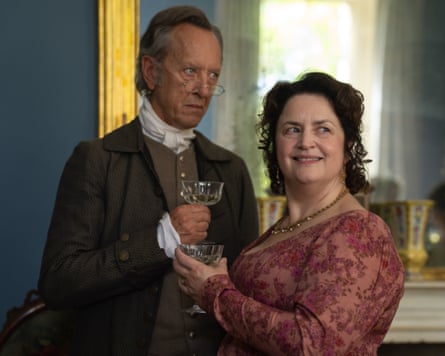
We open just as Mrs Bennet (Ruth Jones) is convulsing, along with half of Meryton, over the news that Netherfield Park has been let to a single man of good fortune and probably, therefore, in want of a wife. Jane (Maddie Close) smiles Janely, Elizabeth (Poppy Gilbert) rolls her eyes (I bet it was called “Lizzing” throughout Hertfordshire) and the young ’uns (Grace Hogg-Robinson as Lydia, Molly Wright as Kitty) prick up their ears at this potential revolution in social life. Mary? Well, Mary (Ella Bruccoleri) has questions. It doesn’t matter what they are, however, because no one listens to Mary. She has a ruddy complexion, you see, and this is apparently tantamount to being actual poison. She is arsenic and prussic acid in a muslin gown.
I understand that we are in a lighthearted half-an-hour-a-pop reimagining of a classic here, but the labouring of Mary’s unviability in the marriage market is wildly overdone, becoming quickly absurd and soon after that, tremendously boring. It takes up most of the first two episodes, especially after she gets spectacles. You would think she was walking around festooned with the body parts of children she has recently killed. It’s farcical. The Bennets never miss a chance to have a bash – from leaving her off the list of family accomplishments (“Jane’s beauty!” squeals Mrs Bennet as she appraises their chances with Mr Bingley. “Lizzie’s wit! Kitty’s good humour! Lydia’s spirit!” The end), to ignoring her attempts at conversation, to making her go last in the bath before the Netherfield ball. The girl never gets a break. I know she’s bookish and we are never people you warm to, but honestly. Your family is supposed to cut you some slack.
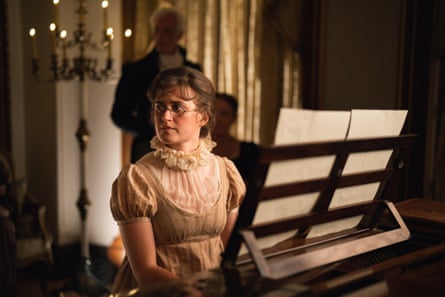
Not content with sending her to the ball after her dip in cold and visibly funky water, Mrs Bennet then kiboshes Mary’s chances with the lovely Mr Sparrow (Aaron Gill), who has taken quite a shine to her – precisely because of and not despite her correcting his talk of “less” oyster patties to “fewer”. This makes him a pearl beyond price, and I am hating this version of Mrs Bennet more than I have ever hated anyone who doesn’t actually exist before (and I am not helped by Jones’s performance, outsized even in this broad-brush production). Mr Sparrow is in trade, you see – he is an optician – and for Mary to stand up for a third dance with him would apparently ruin her other four sisters’ chances of a more worthy marriage. If I were Mary, this would present me with the opportunity for vengeance that I had been waiting for my whole life, but she is a better woman than I and agrees to keep her bum on the nearest chaise for the rest of the ball.
Matters improve for both Mary and the viewer when she is sent away to be a governess and is allowed to develop some character and interests. Until then, The Other Bennet Sister feels too slight a thing even for the pre-watershed Sunday evening slot it is designed for (insofar as time slots mean anything to us in these crazy digital streaming days). But the growing charm and heft – not to mention the lovely central performance from Bruccoleri – make it one worth sticking with. Sorry, Mary – one with which it is worth sticking.