2 months ago
103
2 months ago
103
For many of us, the idea of “the perfect” commute might sound laughable. If we travel to an office, it’s likely to involve either peak-time public transport or stressful traffic. You might not expect that either of those offers much scope for joy, but there are things we can do to make them more enjoyable, productive and healthier. It’s worth putting some thought into this, because commuting can increase stress, reduce capacity for exercise and encourage us to consume extra calories in on-the-go snacks.
The former lawyer turned time management coach Kelly Nolan suggests starting with a commute audit to assess its true impact. “Begin by blocking it out on a calendar. Creating a visual representation of how much commuting takes out of your day gives an accurate picture. It’s not just about how much free time you have left, it’s about seeing how commuting affects other activities in your life.”
The point is not to descend into a spiral of doom but to get creative about how to maximise your available time. One strategy is to build habit stacking into your commute to get other things done. Because going to work is something that you already do every day, piggybacking another activity to the routine makes it more likely that it will happen. That might mean building fitness into journeys by cycling, or walking part of the way, or running home. But it might also mean learning a language, meditating, doing admin or catching up with friends. The average UK commute is 27 minutes, rising to 38 minutes in London. That adds up to about five hours a week that people who commute every day have to themselves.
Nolan says commuting has the clear benefit of offering a structured, regular window to focus on an idea or project. She references Cal Newport’s bestseller Deep Work, in which he suggests we can use chunks of time to focus deeply on one topic. “So if you’re stuck on a bus, rather than scrolling, you could use the time to brainstorm a specific idea, either for work or a personal project,” says Nolan. “One reason ideas often come to us in the shower is because we’re so rarely quiet and still so ideas don’t have the opportunities to come to mind.”
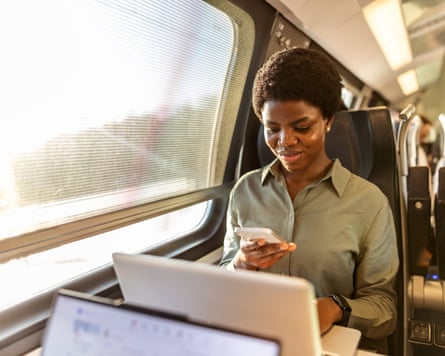
This does sound appealing. What if, instead of gritting my teeth as I enter Dante’s Seventh Circle (line) of hell, I could reframe it as two daily creative brainstorming sessions? In fact, I know this is possible. I have a friend who wrote a novel on his daily commute from Brighton to London and another who uses the time to work on her new business idea.
But how do we maintain positivity in the face of transport delays, or not getting a seat and standing trapped between a rucksack and someone’s sweaty armpit? The solution, says Gordon McCrorie, a Glasgow-based life coach, lies in the concept of acceptance. “A lot of life’s emotional friction comes when what we would like life to be is not matched by reality. If we can bridge that gap, we are going to remove a lot of unnecessary suffering. Ask yourself: ‘What is within my control? Have I tried to alter that? What is out of my control? What stories am I telling myself?’” Avoiding exaggerated language is one of his tips. Is the journey really a nightmare or is it just a bit frustrating? “Think data, not drama,” he says. “This train is running 15 minutes late. Is there anything I can do about that? No. OK. In which case, settle down and enjoy the extra free time. You were planning on listening to a podcast? Well, now it’s going to be a podcast and a half.”
For the journey home, it can be helpful to establish rituals that signal to your brain that you are leaving work behind. “I love listening to fun audiobooks,” says Nolan. “Anything that will take us out of work mode – a comedy podcast, listening to a playlist – will work. Or you could use the time to send an urgent email so you don’t need to do it later. A lot of people really struggle with the delineations between work and home.”

Which brings us to the dilemma facing many people who work from home or do hybrid working. Should we invent a faux commute to ease the transition? For McCrorie, when he is working from home, his day is bookended with dog walks. He suggests that even if you don’t have a canine friend, it’s a good idea to get outdoors or at least get moving. “If you don’t, that stagnant stiffness is going to linger as you go into your working day. Movement is a great way to reduce anxiety and stress. Even something as simple as stretching for a few minutes can regulate the nervous system.”
So conveniently rolling out of bed five minutes before the first Zoom meeting isn’t to be encouraged? “If you don’t create a buffer between waking up and work, what is your experience going to be like? If you did take the time, the impact that work has on you would be less by the end of the day, because percentage-wise less of your waking hours would be dominated by it,” McCrorie says.
Not that everyone who works at home needs a pretend commute. Nolan lives in Minnesota, where the climate can make going outdoors more of an expedition than a stroll. “Some people actually have really great boundaries between home and work,” she says. “It’s definitely easier if you have a separate office so you can open and close the door to signify the beginning and end of work. But I know someone who has a special pair of work slippers to get into and out of work mode. For them, that’s enough of a boundary.”