5 hours ago
16
5 hours ago
16
Despite the bright start to Andy Burnham’s premiership, and Reform UK’s sudden disarray, a shadow still hangs over British centre-left politics. Labour has a small poll lead, a cautious air of confidence and a leader who seems energised rather than overwhelmed by trying to solve the country’s problems. Meanwhile, Reform is having a terrible 2026: mired in deepening funding scandals, losing winnable byelections and, thanks to the drama and novelty of Burnham’s leadership coup and new government, no longer the freshest story around.
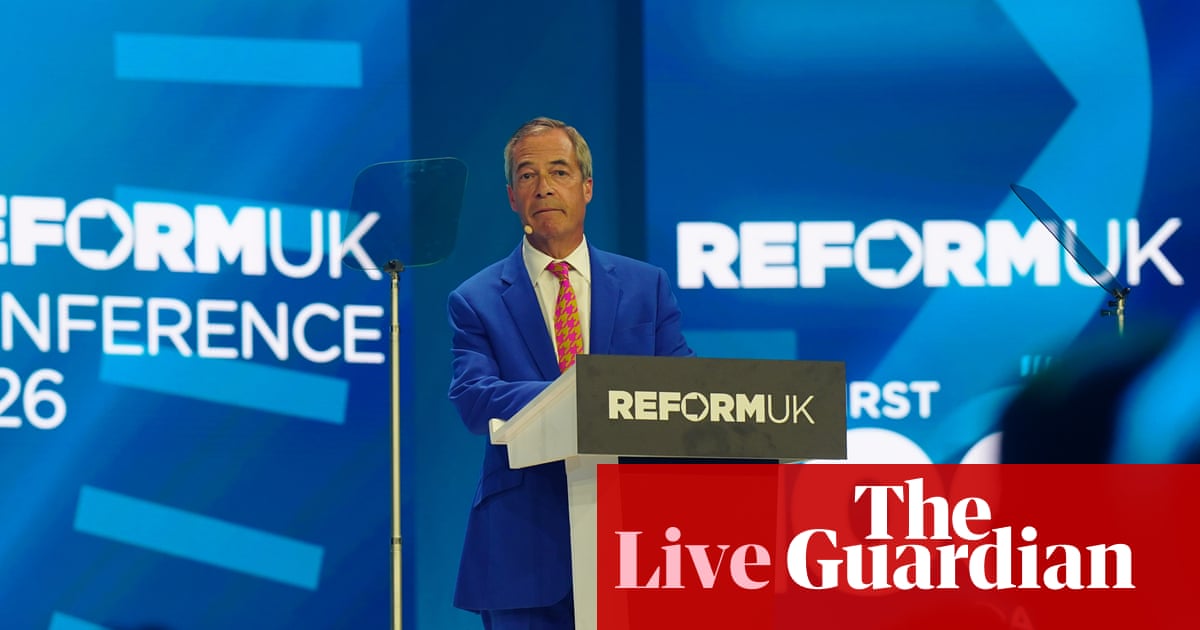
Yet Reform UK’s support has either held up or fallen only slightly in most polls since Burnham entered Downing Street. Even in the Makerfield byelection, where he beat it more decisively than expected, Reform’s vote share and total support actually rose. Nigel Farage may have spent the year uncharacteristically avoiding journalists, or in his prickly rather than jolly public mode, but the overwhelming majority of Reform supporters, almost a quarter of the electorate, remain faithful. “Power is within our grasp!” insisted Zia Yusuf, Reform’s home affairs spokesman, at its party conference in Birmingham on Friday, and they applauded with determined gusto.
Meanwhile, their preoccupations continue to shape politics and how the media processes it. Immigration, crime, the benefits system, “wokeness”, net zero policies: all are constantly presented as out of control and contributing to national decline. From our overcrowded prisons to our almost exhausted North Sea oil- and gasfields, what are widely considered to be the most politically realistic options for the government are generally what most Reform voters would like to happen. The likelihood that permanent crime crackdowns and further large-scale fossil-fuel drilling – which the government looks increasingly likely to approve – will be disastrous for a country with an ever more obvious climate crisis and unprecedentedly large prison population, by historical and European standards, does not disturb this deep-rooted rightwing consensus. The pressure on Burnham to go along with it as prime minister will be never-ending.
Yet the risks of governing under Reform’s shadow, while less discussed, are much larger. So far, Labour’s fragile poll recovery has mainly been built by taking support back from the Greens and Lib Dems, as the dip in their poll ratings since a Burnham premiership became likely has demonstrated. This change would almost certainly be undone if Burnham decided to follow a Reform-defined agenda. Keir Starmer’s abrupt announcement that he will leave parliament is the ultimate result of him making exactly that mistake in Downing Street – and has given the Greens’ leader, Zack Polanski, a chance to reverse the momentum shift from his party to Labour by standing as a byelection candidate.
Meanwhile, with Reform, Restore and the Tories all competing to be the most rightwing, and this country’s many reactionary media outlets doing the same, many right-leaning voters are even more convinced than usual that no Labour government is acceptable. So the appeasement of conservative Britain, designed by Morgan McSweeney and carried out by Starmer, not always with conviction, was never likely to win many converts for long. In a deeply divided country, the days of Labour premiers attracting and holding on to large numbers of rightwing voters, as Tony Blair, Harold Wilson and Clement Attlee once did, are gone, at least for now.
As a politician unusually keen by modern standards on cross-party collaboration and broad coalitions, Burnham could waste much of what may not be a long premiership trying to build bridges with the right. But there are some early signs he may pursue a more streetwise strategy. His debut contributions as prime minister in parliament this week mixed consensual catchphrases such as “problem-solving over point-scoring”, which made the Tory leader, Kemi Badenoch, sound rigidly confrontational in response, with sweeping attacks on areas where the right is vulnerable. Austerity, Brexit, privatisation and the centralisation of power in London have dwindling electoral support and even less credibility, however loudly the Tories and Reform defend some or all of them, because for decades these old-fashioned rightwing remedies have clearly failed to revive the country.
“Far from ‘taking back control’, the combination of those policies took control out of the hands of communities up and down Britain,” said Burnham, deftly turning a key promise of populism back against the rightwing populists. He knows that while Margaret Thatcher is still revered by Farage and Badenoch, the sometimes brutal economic changes that she and her Conservative successors drove through are not popular with all Tory and Reform voters. They may never switch to supporting Labour, but could support parts of Burnham’s programme, such as stronger public control over “the essentials of life” currently provided at excessive cost by toxic Thatcherite creations such as Thames Water.
after newsletter promotion
The approval, tacit or otherwise, of usually hostile voters on a specific issue can provide useful political cover for a government – especially an unpopular one, which Burnham’s is likely to be, however he performs, given the number of parties arrayed against him in our fragmented political landscape. He may well need that cover if his government is going to restructure the economy even half as ambitiously as he promises. The shareholders, financiers, lawyers and corporate executives who have done extremely well out of privatisation are not going to give up their gains and privileges without a fight.
A temporary coalition of leftwing and rightwing voters may be the only way to overcome them. The economy is not democratic – much to the disappointment of generations of radical leftists – but in a democracy, powerful interests can be curbed or even defeated if they are challenged by a premier acting with broad public consent, as Attlee and Franklin D Roosevelt once did against some of the 20th century’s most entrenched economic elites.
Yet if Burnham is to govern with anything like those legendary reformers’ effectiveness, then in other policy areas his government is going to have to stand up to Reform supporters. New research about them by King’s College London and UK in a Changing Europe shows that, despite this summer being the UK’s hottest ever, almost two-thirds “want to scrap the 2050 net zero target”. Meanwhile, a new Ipsos poll shows that immigration remains the number one public issue, particularly for Reform and Tory voters, despite the fact that immigration is rapidly falling.
Sooner or later, Burnham is going to have to use his celebrated communications skills to tell Britons some home truths, whether rightwing voters want to hear them or not. Otherwise, Reform’s shadow will chill his government for good.
-
Andy Beckett is a Guardian columnist