4 hours ago
6
4 hours ago
6
It’s a question that has taxed musical thinkers for centuries: just what is it about one composer’s music that makes it more distinctive than anyone else’s? Entire disciplines of academic thought, of music analysis and historical musicology, as well as the formation of classical music’s canon of “great” composers, have been given over to this single idea: can it be proved that Mozart, say, was measurably “better” than other composers?
Our instinctive feeling about the sensual magic of Mozart’s music is part of the equation, but accounting for precisely how his pieces can sustain a lifetime of listening, why their pleasures never seem to pall and are still capable of seeming to surprise us even when we know them inside out: that’s the million-dollar musicological question.
What generations of music analysts have tried and largely failed to do through imperfect means of variously subjective techniques, an 18-year-old US student has managed to prove through a combination of data and interpretative ingenuity.
A recent study by Philadelphia student Linus Chen-Plotkin demonstrates that Mozart’s melodies are more surprising in the way they unfold, moment-by-moment and note-by-note, than those of his contemporaries and successors, Haydn, Beethoven and Schubert.
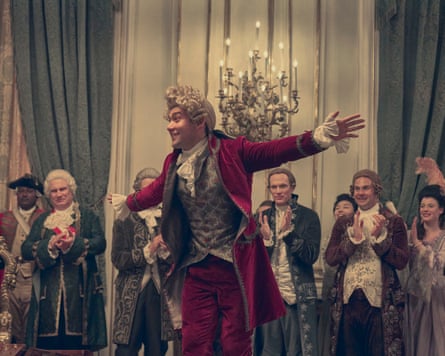
Chen-Plotkin put 600 movements of these four composers’ piano sonatas and string quartets through his bespoke software to analyse their tunes, based on Markov chains and other statistical and mathematical tools (he explains his work here). The data revealed that Mozart’s tunes have a shorter “memory” than other composers. That means the way they move is less predictable: that Mozart sets up patterns of expectation in his melodies and ideas that he confounds rather than confirms.
You can instinctively hear that at work in so many moments of his string quartets: the opening idea of the E flat major quartet, K428, which is already slipping out of the realms of the expected as early as its third note; or the opening of the Dissonance Quartet, K465, whose entire introduction is a chain of ever-more surprising moves of melody and harmony.

Chen-Plotkin is circumspect about the consequences of his work, recognising its limits as well as its possibilities. In fact, his statistical analyses shore up the conclusions that musicologists have often made about Mozart’s music: that it’s dizzyingly rich and strange in how it moves from note to note and phrase to phrase, but that Mozart was less interested in finding new or unpredictable structures across entire movements. In fact, if Chen-Plotkin were looking at unpredictability across whole pieces and not at the smaller scale of individual tunes and melodies, he would probably have come up with very different results: my hunch at least would be that Beethoven and Haydn would win those contests.
Mind you, Chen-Plotkin isn’t suggesting that maths replaces musicology. As well as being against the use of generative AI in art-making, his ambition is simply to show how statistical analysis can help reveal the underlying patterns behind human creativity. And his work has just begun: he enrols at university this autumn, and has already embarked on a computational analysis of the works and words of Chaucer.
Anyway: I’m back to put more Mozart through the random note generator of my fingers as I try – and fail, yet again – to play even one movement of his piano sonatas without making a mistake that not even Chen-Plotkin’s software or Markov’s chains could predict.
The Royal Philharmonic Orchestra is 80 this week, and, as you can see on their anniversary timeline, there’s a lot to celebrate. Which other orchestra can claim a legacy that encompasses some of the most exciting performances of Sibelius ever recorded in the 1950s and 60s? Listen to their founder Thomas Beecham’s performance of Tapiola to hear the edge of orchestral possibility, just as Sibelius pushes his music to new limits of wildness and experimentalism. Then, in the orchestra’s years with Rudolf Kempe in the 60s and early 70s, it transformed London’s musical life, and made pioneering recordings such as Janáček’s Glagolitic Mass.
But this is also the orchestra that Beecham insisted was men-only for as long as he conducted them (until his death in 1961), and which only had its first female musician over a decade later – clarinettist Prudence Whittaker.
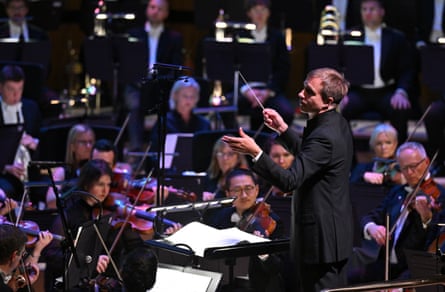
It’s also the same ensemble who would find new dimensions of orchestral kitsch with Hooked on Classics in the 1980s, who recorded the Champions League theme in the 90s, and played at King Charles’s coronation in the 2020s; and it’s the orchestra that played this summer with Mandle Cheung, who paid an undisclosed amount to conduct Mahler’s Resurrection Symphony.
The RPO have soundtracked the decades from the sublime to the ridiculous; and they’ve surfed financial crisis after crisis over the years. Under Vasily Petrenko’s music directorship since 2021, here’s hoping the sublime continues to win out.
This week, Tom has been listening to: Riccardo Minasi’s recording of Mozart’s last three symphonies with Ensemble Resonanz. I’ve been blown away by their ferocious imagination. The rhetorical volatility of these performances, their mix of styles, genres and ideas, isn’t an outlier in how this music should be performed – it’s in the fabric of how these symphonies are composed, and what they mean. Mozart really is unpredictable! Listen on Spotify | Apple Classical