2 months ago
81
2 months ago
81
“We’ve had quite a few people on the estate get jobs,” says Bryan Stokell, who found work as a full-time security guard thanks to Stockton-on-Tees’s JobsPlus project. The 47-year-old father has since become a “community champion”, encouraging his neighbours to enrol.
“It got to the point where even my little boy was coming home and saying, ‘my friend’s mam and dad are looking for work’,” he grins. “They [the project] have a lot of contacts, they can open doors into places.”
Stokell has had health problems, and was struggling to find a suitable role before his caseworker, Khialah Wilson, helped him with his CV and job applications.
This is one of 10 JobsPlus schemes. It covers the adjoining Primrose Hill and Newtown estates in Stockton, on Teesside, an area with a proud railway history but bearing the scars of deindustrialisation.
The pilots – running against the backdrop of UK unemployment at a four-year high – are in areas of predominantly social housing across England, from Penge in south London to Wirral in Merseyside, with backing from the Department for Work and Pensions (DWP).

They are modelled on a US scheme, which was first tried in 1998 and initially ran for five years. Long-term analysis showed it was possible to trace a positive impact on the earnings and employment of residents across generations. The research suggested children living in three JobsPlus areas, in Dayton, Ohio; Los Angeles, California; and St Paul, Minnesota, where the scheme was fully implemented went on to earn $2,706 more than their counterparts in similar areas.
Key aspects of the “hyperlocal” approach include saturating a small geographical area with employment support, providing direct financial assistance and incentives, and involving the local community. With social tenants more than three times as likely to be lone parents and twice as likely to be disabled as the wider population, help is provided as close to home as possible.
In Stockton, this means sessions being held in the Newtown community resource centre: a former school, busy with other local facilities, including a nursery and a youth group. The community champions gather weekly at Nancy’s diner here to chat through ideas over dinner.
Wilson stresses that caseworkers stay in touch with their clients, providing moral support even after they find a job. “A lot of my work support customers still come in to see me face to face, even though they’ve signed off on the programme … I’m like, ‘I’ll put the kettle on’.”
The community-based nature of the scheme reflects research showing that boosting the “social capital” in an area – the trusted local connections – is good for economic growth.
Pat McFadden, who has taken over from Liz Kendall as work and pensions secretary since JobsPlus was launched, has signalled a particular focus on youth unemployment and inactivity, including launching a review chaired by the Blair-era minister Alan Milburn.
JobsPlus takes a place-based approach, rather than being tailored to a specific age range; but with unemployment rising across the UK, hitting a four-year high of 5.1% according to the latest data, its proponents argue it is one tool that could help.
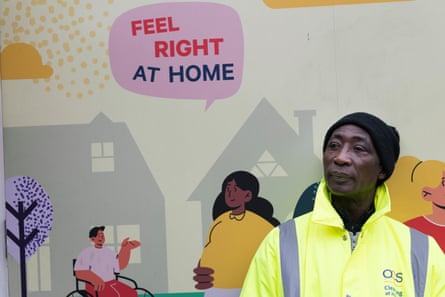
For 63-year-old Yaw Botwe, who was spending £15 a day on Ubers to get himself to work, the JobsPlus approach meant connecting him to an employer closer to home – Morrisons – and buying him a bike to get there. “It’s cleaning: it’s a nice job, we clean the floor, we pick the cardboard, the plastic. We are inside. This is the first time in my life I’ve got a job that my heart liked,” he says.
Megan Steel, 19, who had studied childcare at college but did not want to pursue it as a career and was struggling to find employment, got intensive help with her CV and applications.
“She’d come in twice a week, and we’d sit there for a full hour at least, sometimes a lot longer, and first we worked on your confidence, didn’t we? We built you up a bit,” her caseworker, Jade Green, tells Steel.
When an invitation for an interview at the local casino came in late one recent Friday, Green stepped in. “I met her outside Tesco and I gave a voucher and said, ‘get yourself kitted out’ because I want her to feel confident,” she says. Steel got the job. “It’s helped me a lot,” she says.
Young parents Leia Cuskern, 21, and Thomas Courtney, 18 – a care leaver – have also signed up. Cuskern has been signposted to the jobcentre, with her caseworker, Lyndsey Henry, scheduling an hour-long appointment for support with finding childcare for their 13-month-old daughter, Lily-Rose.
Part of the JobsPlus recipe is to bring together resources that are already available but may be hard to access – whether training, benefits advice or connections to local employers. “Everything is done within the community, so that they don’t have to venture out as much – sometimes it’s about building their confidence,” says Henry.

Courtney, the young dad, who lives with his partner on the estate, is keen to pursue a career in market management after completing a work placement with the local council under a separate employability scheme.
With the help of the JobsPlus caseworkers, he plans to study for a diploma with the National Association of British Market Authorities. “I’ll go through a lot of processes, a lot of tests, and then after I go through that I get a diploma in market management, and then hopefully after that I can get a market manager job,” he says.
“It’s running the whole markets,” he enthuses. “Taking rents, looking after the markets, making sure everyone feels OK while they’re on the market.”
Another happy customer, Jacquie Brown Fowler, describes herself as “the crazy lady who had eight children” – now aged from eight to 28.
Hitting a low patch after losing a previous job, she found regular phone calls with her caseworker helpful: she now has a job as a cleaner and lunchtime supervisor at her younger children’s school, and has completed a qualification in food hygiene. “I met lovely Khialah, who lit a lightbulb moment in my head,” she said.
One of the unusual aspects of the scheme is that after eight weeks’ paid employment participants receive a £400 bonus. Botwe says he will use it to buy presents for his grownup daughters.
As well as encouraging people to sign up, Suzanne Halliwell, the head of care and support at Thirteen Group, the housing association leading the pilot here in Stockton as well as being the landlord for many properties on the two estates, says the payment can help tide clients over the difficult transition between benefits and paid work. “Because of the way universal credit works, you’ve quite often got a period where it’s a bit of a hit and miss situation.”
The Learning and Work Institute (LWI) is overseeing the implementation of the 10 pilots and conducting a full evaluation. The latest data shows that since the launch in summer 2024 more than 1,000 people have signed up with one of the JobsPlus teams, with more than 270 finding work.
An interim assessment in September found that three-fifths of those who had found jobs through the scheme had hit the eight-week milestone, triggering the £400 bonus.
Alongside £2m of support from the DWP the pilots are being part-funded by a charity, the Youth Futures Foundation. But as it stands government funding will run out next March.
“This model is showing real promise to transform neighbourhoods and we look forward to watching it progress,” said Stephen Evans, the LWI’s chief executive.
For the moment, though, the caseworkers in Stockton and the nine other projects are awaiting news about whether they can continue the project beyond March. Wilson, whose infectious enthusiasm keeps her crew of community champions coming back, says: “Fingers crossed, because I absolutely love it.”