2 months ago
115
2 months ago
115
We are used to mapping the world by continents, dividing the globe into rigid geopolitical blocks. But to understand the complex reality behind each border, we are better off using a different, edible kind of cartography. For most of human existence, the Mediterranean has existed as an intercultural entity in its own right, where peoples and languages from different lands blur the lines that constitute modern frontiers. And nowhere is this shared regional identity more beautifully preserved than in Mediterranean kitchens.
Tracing the Italian Tyrrhenian coast, crossing the sea down to the shores of north Africa and then winding up to the Côte d’Azur, you will find a culinary pattern uniting diverse societies: an elemental batter of chickpea flour, water and olive oil. Baked in blazing wood ovens or deep‑fried in pans, it changes its name at every port, but its soul stays the same: a golden, sometimes crispy, sometimes soft proof that the peoples of the Mediterranean share a singular history that defies modern political boundaries.
I first noticed the contours of this grand alternative map in Tuscany. Arriving in Pisa on a foggy winter night after a long road trip, I slipped into the narrow medieval alleyways around the Borgo Stretto and, just past a quiet corner, the neon glow of Pizzeria Il Montino offered a sign of life. I quickly realised the crowd hadn’t gathered for pizza: nearly everyone was queueing for cecina, a golden chickpea pancake, steaming from the oven. The cook dusted my slice with a generous crack of black pepper and handed it over. It was love at first bite.
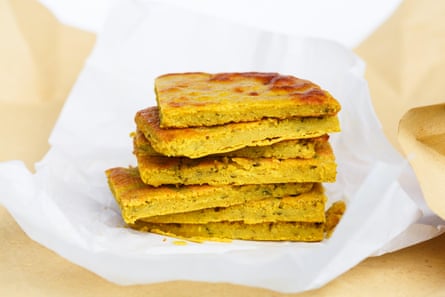
A few miles down the coast lies Livorno, and I remembered a friend who, a while back, had recommended the “5 e 5” (cinque e cinque) from a place called Gagarin. It’s essentially the same as cecina, but watch out: it’s forbidden to call it that in Livorno. The name comes from its historical price: five lire for the bread, and five for the chickpea pancake. Here it’s served as a sandwich filling, inside a round loaf. Apart from pepper, you might add aubergine marinated in vinegar, garlic and chilli flakes. Both Livorno and Pisa claim to have invented the dish, fuelling a fierce rivalry that spans sport, politics and food.
Also on the Tyrrhenian coast lies Liguria, the home of another sibling street food, farinata. According to legend, it was accidentally invented during the Battle of Meloria in 1284: Genoa defeated Pisa, and on the way back home, the Genoese ships ran into a sea storm. Barrels of oil and chickpea flour spilled and mixed with salt water. After letting this accidental mixture dry under the sun, the sailors ate it and discovered it was surprisingly delicious. A true blessing in disguise.
The recipe also found its way to Italy’s islands. In Sardinia, specifically around Sassari, it adopted the Genoese dialectal name fainè. While the classic oven-baked preparation remains the same, Sardinians love to upgrade it with dried sausage and onions. Over in Sicily, the story contains a plot twist. The base recipe is nearly identical, but in Palermo, they deep-fry the chickpea mixture to create golden panelle, which are then stuffed into soft sesame rolls to make pane e panelle. This crunchier, crispier version is best served with a squeeze of lemon, to cut through the heaviness of the frying oil.
From Sicily to north Africa is but a short step. In the Algerian city of Oran, karantika emerged under Spanish influence during the colonial period. The Algerian version differs from the Italian one: by adding eggs and milk to the batter and baking it at an intense heat, you get a texture that is incredibly creamy on the inside, and beautifully crusty on the outside. Naturally, the chickpea trail continues to northern Morocco, specifically Tangier. Here the dish goes by the name kalinti, and its preparation closely mirrors the Algerian method. Street vendors serve kalinti piping hot, traditionally finished with a generous sprinkle of salt and cumin.
after newsletter promotion
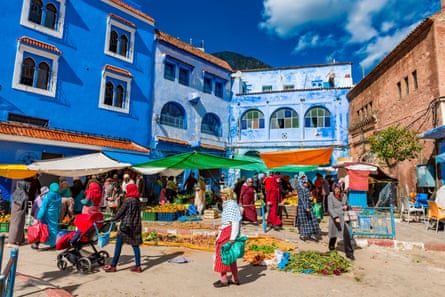
Curiously, after settling in Gibraltar – where it is known by the Spanish name calentita – this culinary pattern largely skips the Spanish coast, apart from Cádiz, where the magical batter is fried and called paniza gaditana. But if we keep following the trail to France, specifically to Marseille, we find panisse. An essential stop is Chez Magali, located in the northern neighbourhood of L’Estaque: it was here that Italian immigrants, arriving for industrial work, introduced their chickpea knowhow, which locals then reinterpreted. The Magali kiosk still serves up fried, thick and wonderfully crusty panisses, to be eaten rigorously by the sea.
We are now approaching the end of the chickpea trail, but there are a few crucial stops as we travel east toward the Côte d’Azur. In Toulon, the composition remains the same as its regional cousins, but it takes the name of cade and is traditionally baked in a wood-fired oven. Finally, arriving in Nice, the dish undergoes its ultimate transformation, becoming the peppery socca. Here it is poured much thinner, resulting in beautifully crusty edges and a roasted surface.
What clearer evidence could you ask for that the Mediterranean is its own distinct entity? One that transcends continental and national boundaries. It brings to mind the Mucem Museum in Marseille, which brilliantly argues that for most of human history, it was far easier to travel across the Mediterranean from port to port than it was to go inland from Mediterranean cities. The sea was once the highway, not the barrier.
Migration has been the historical norm across the Mediterranean, in all directions, before Europe decided to turn the sea into a heavily policed border. It is no wonder that panisse (and pizza) ended up being a huge part of Marseille’s cuisine, for example: migration from impoverished Italian coastal cities was so substantial that by the 1950s, 40% of the city’s population was Italian.
The chickpea trail is the edible proof of this ancient network. Whether it’s a peppery socca in Nice, a kalinti in Tangier, or a slice of cecina in a Pisan alley, you are tasting the exact same impulse. Long after modern frontiers were formed, this simple batter of chickpea and oil is a living reminder that these shores have a single, frontier soul: a little maritime, a little mercantile, and always delicious.
-
Federico De Blasi is an Italian food writer based in Barcelona