3 months ago
157
3 months ago
157
The US is no longer a democracy. One of the most credible global sources on the health of democratic nations now says this outright. The Varieties of Democracy (V-Dem) Institute at Gothenburg University reaches the alarming conclusion in its annual report, that the US is hurtling towards autocracy at a faster rate than Hungary and Turkey.
“Our data on the USA goes back to 1789. What we’re seeing now is the most severe magnitude of democratic backsliding ever in the country,” says Staffan Lindberg, founder of the institute.
Since 2012, Lindberg has led his small group of researchers in Sweden to become the world’s leading source for analysis of the health of global democracy. In their latest report, published on Tuesday, they conclude that the US, for the first time in more than half a century, has lost its long-term status as a liberal democracy. The country is now going through a rapid process of what the report’s authors call “autocratisation”.
“For Orbán in Hungary, it took about four years, for Vučić in Serbia, it took eight years, and for Erdoğan in Turkey and Modi in India, it took about 10 years to accomplish the suppression of democratic institutions that Trump has achieved in only one year,” Lindberg says.
US democracy is now back at the worst recorded level since 1965, when US civil rights laws first introduced de facto universal suffrage. All progress made since then has been erased, according to the report.
Worldwide, democracy has receded to its lowest levels since the mid-70s. “The world has never before seen as many countries autocratising at the same time,” Lindberg says.
A record 41% (3.4 billion) of the world’s population currently resides in countries where democracy is deteriorating, the report claims, adding that Washington is leading this global turn away from democracy.
The researchers use 48 different metrics to assess democratic health, such as the freedom of expression and the media, the quality of elections and the observance of the rule of law. The resulting “liberal democracy index” shows that the speed with which US democracy is being dismantled is unprecedented in modern history. The main factor is a “rapid and aggressive concentration of powers in the presidency”, Lindberg says. Congress has been marginalised, jeopardising the “checks and balances” (judicial and legislative constraints on the executive) so crucial to US democracy. At the same time, civil rights have been rapidly declining and freedom of expression is now at its lowest level since the 1940s.
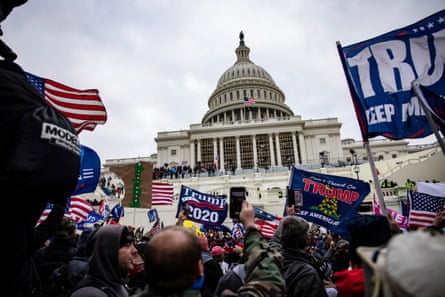
“We’ve seen a very fast concentration of power in the executive wing. The legislative branch has practically abdicated its powers to the president. It no longer functions as a check on executive power,” Lindberg says.
In Donald Trump’s first year as president, he signed 225 executive orders, whereas the Republican-controlled Congress passed only 49 new laws. “Most of Trump’s executive orders were significant. He shut down entire departments of the government, firing hundreds of thousands of employees. The bills passed by Congress were mostly insignificant modifications to existing laws. So, we no longer have a meaningful division between the legislative and executive branches,” Lindberg says.
Meanwhile, the supreme court has also mostly abdicated power, and even when it does strike down Trump’s executive orders, he circumvents it, Lindberg tells me. He points out that there are more than 600 ongoing judicial procedures against the Trump administration in the courts.
Another aspect of America’s rapidly deteriorating democracy, according to the report, is the removal of internal guardrails that protect the federal government from abuse of power. When I ask Lindberg how we should read the findings, his response is emphatic. “Trump has fired inspector generals and higher levels of civil servants across departments, and replaced them with loyalists. This is exactly what Orbán and Erdoğan did. They remove the constraints on power. It should be obvious by now that Trump is aiming for dictatorship.”
So how did a small research institute in Gothenburg become such a credible source on the decline of democracy in Washington? When Lindberg, a soft-spoken political scientist, founded the V-Dem Institute in 2012, global democracy was near its historic peak.
“Back then, we were all researching the process of democratisation, and we were frustrated that the metrics weren’t good enough, so we wanted to create a credible global index that was relevant for the whole community of democracy researchers,” he says.
Five years later, when the institute published its first dataset of global democracy, its experts realised that things were rapidly going in the wrong direction. “Now, all of us researching democratisation have become researchers on autocratisation,” Lindberg says.
At the time, their reports were criticised for “exaggerating” the risks to global democratic stability. “We were called alarmists. But now our warnings seem justified,” Lindberg says.
The core group of a dozen researchers in Gothenburg works with 4,200 researchers in 180 countries, using what they claim to be the largest global dataset on democracy, with more than 32m data points for 202 countries and territories, spanning from 1789 to 2025. “We have universal standards, but also people on the ground to tell us what is actually going on. The reports are 100% scientific, research-driven, and our data is free from bias and state influence, from general punditry and political considerations.”
V-Dem’s report, titled Unravelling the Democratic Era?, should be required reading for Europe, where seven EU member states – Hungary, Greece, Croatia, Slovenia, Slovakia, Italy and Romania – are “affected by autocratisation”, amid signs of governments using media censorship, curbs on freedom of expression and repression of civil society. Portugal and Bulgaria have joined the institute’s “watchlist”.
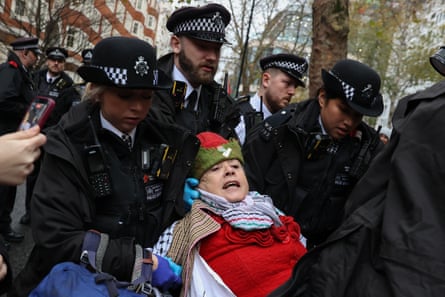
The report identifies the UK as a “new autocratiser”, driven by “a substantial decline” in freedom of expression and the media. “In the UK, it began before Keir Starmer, with the Elections Act 2022, and the government expanding its power over electoral commissions,” Lindberg says. “The Policing Act 2022 decreased civil rights and free speech. The Online Safety Act 2023 was used to penalise online speech and lawsuits silencing journalists. The Higher Education (Freedom of Speech) Act 2023 increased demands on universities to monitor protests and police free speech. What’s worrying is that once the democratic backsliding begins, it’s often hard to stop.”.
Denmark, Sweden, Norway, Switzerland, Estonia and Ireland top V-Dem’s global democracy index for 2025. The efforts of others, including Poland, are highlighted for attempting to “U-turn” away from autocracy. But only 18 countries across the world are democratising, a historic low.
A single bright spot in the assessment of the US is that free and open elections are still being held, and the electoral system “remains stable for now”. But executive orders since Trump came to power point to new risks for the electoral system.
Threats to bureaucrats and poll workers administering elections are already alarming, Lindberg says. “We’ve seen media reports that 40% of election/poll workers have quit since 2020. And Trump never accepted his defeat then. Why would he accept a defeat now? If we see a denial of the election results in 2026, then it’s a complete democratic breakdown.”
A potential source of cautious optimism may be that Trump’s authoritarian turn is increasingly unpopular. His approval rating is now below 40%. Large numbers of Trump voters are deeply disappointed with the new war in Iran, and with steadily rising living costs. Many of the liberal states that have been Trump targets, such as Minnesota and California, have successfully fought back against threats to civil rights and local communities.
“We’re also seeing more criticism from within the Maga movement,” Lindberg says.
It would be naive, as the report warns, to think that European countries are immune to democratic decline, whatever happens in Washington. “It’s a global trend,” says Lindberg, “so it’s not just America that is driving this. Research clearly shows that the far right, once they gain power, have a high probability of dismantling democratic institutions.”
In many countries across Europe, voters are now mobilising to elect their own versions of Trump, despite the administration’s open threats to the continent and its persistent support for extremist parties that undermine European stability. Establishment conservatives are following along, hoping against reason that things will somehow work out better this time than in previous eras of authoritarian rule. With stark numbers and crystal-clear language, the V-Dem report underscores the risks of this path.
-
Martin Gelin is a journalist and author. He writes for the Swedish newspaper Dagens Nyheter