3 months ago
94
3 months ago
94
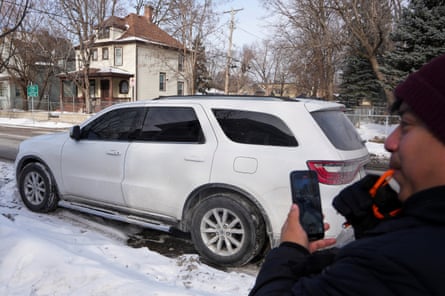
Cory never expected he’d spend hours each day driving around after immigration agents, videotaping their moves. The south Minneapolis resident is “not the type of person to do this”, he said.
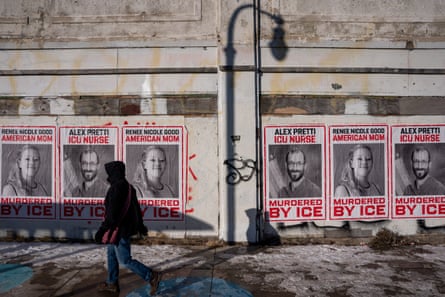
The dangers of what he’s doing, even after the killings of two observers, largely stay out of his mind when he’s watching Immigration and Customs Enforcement (ICE) agents – even when he’s gotten hit with pepper spray. In quieter moments, it occurs to him that agents likely know where he lives. Alex Pretti, the 37-year-old whom agents killed while he was filming them, “100% could have been me”, Cory said.
Still, he felt no choice but to step up. He had taken legal bystander training in November when other cities were experiencing ICE’s crackdowns. And in early January, as more and more stories surfaced about people being taken by federal agents from their families, at bus stops, from their jobs, it became clear to him that Minnesotans needed to do whatever they could.
“We learned growing up about a lot of horrible things people have done in history. And there’s a lot of asking yourself, ‘What would I have done if I was in that time period?’” Cory said. “And I found myself asking that a lot – like, what is our obligation to stop things, like these horrible racist attacks on people and frankly what feels like an ethnic cleansing project?”
In what is arguably the most widespread effort in the country to combat Donald Trump’s severe mass deportation tactics, tens of thousands of Minnesotans have played a role in defending their neighbors from ICE. They patrol in their cars and document agents, give rides to people who feel unsafe driving, stand outside schools at drop-offs and dismissals to protect children and their parents, deliver groceries and supplies to families who are staying inside for fear of detention, and crowdfunding legal aid or rent.
The resistance is built on a longstanding culture of civic engagement, workers unions and a sprawling infrastructure of community-led groups, particularly those who advocate for the rights of Latino and Somali residents. Neighborhoods that banded together after George Floyd’s death at the hands of police in 2020 have reignited their networks. And the federal government’s onslaught has meant an end to normal life here – drafting a large part of Minneapolis into action.
Cracks are starting to show in Trump’s brutal deportation scheme after widespread outrage over Pretti and Renee Nicole Good’s killings by federal agents in January. Gregory Bovino, the border patrol agent who was leading operations in Minneapolis, was removed from his post, replaced by Tom Homan, the president’s “border czar”, and some agents were pulled off duty. The justice department also announced a civil rights investigation into Pretti’s death.
Still, deportations and detentions continue in the suburbs and in rural areas. Homan and the Trump administration have continually blamed local officials for the chaos. On Friday, as protests grew outside the Whipple federal building, where many immigrants and protesters have been detained, the administration arrested journalists who documented a church protest.
But the anti-ICE resistance in Minnesota is broad. For every person documenting ICE visible in videos now spread around the world, there are hundreds more behind the scenes working to keep their immigrant neighbors safe. Some city council members and state lawmakers are doing rapid response themselves, following ICE to document or showing up at deportation scenes.
“All of that anti-democratic activity has been focused on Minnesota as their proving ground for what they can actually accomplish,” the US senator Tina Smith from Minnesota, a Democrat, told the Guardian. “That’s why it’s been so important that Minnesotans have stood up and said: ‘You can’t bully us. We’re not going to put up with this. You can’t scare us. We’re going to stand tall and stand strong.’”
Minneapolis, a progressive midwestern city besieged by the federal government, has long held a network of non-profits, faith communities and unions that make civil engagement a standard. In 2020, after George Floyd was killed by police during the Covid-19 pandemic, his death became a rallying cry locally, then spread nationally. With hundreds of thousands protesting in the streets, sometimes clashing with local law enforcement and the national guard, organizers in the area learned more how to come together effectively.
ICE’s surge into the city revived and expanded those networks.
“I think that we’re just battle-worn, that’s the phrase that I’ve been using a lot, it’s like we’ve been here before,” said Kirstie Kimball, a food writer and fundraiser who has organized mutual aid here. “We know some things that worked and some things that didn’t were tested, and we’re meeting the moment. The leaders who were involved then are involved now.”
Groups like the Immigrant Defense Network and the Minnesota Immigrant Rights Action Committee have been organizing since Trump returned to office, putting together trainings on how to document ICE and knowing your rights. Hotlines have been in place for months, gathering intel from residents and sharing to alert people when ICE is in an area. Other cities that faced federal surges shared their best practices, including the use of whistles and car horns to quickly spread the word when ICE was around.
More people got involved in December when Trump started calling Somali people “garbage” and first flooded agents into town, emptying out Somali and Latino businesses. And the number of helpers amplified considerably after the killing of Renee Good by federal agents in early January. Their work has remained largely nonviolent.
Will Stancil, a local attorney with a large internet presence who has been driving around to track ICE for weeks, said this moment feels markedly different than 2020 because it’s not the state’s or city’s own institutions failing them.
Joining a Signal chat of other people keeping eyes on the neighborhood, Stancil looks out for suspicious vehicles that carry hallmarks of those agents use – tinted windows, out-of-state license plates, men in masks in the front seats. “It feels like we’re being invaded,” he said. “The invaders want to destroy the city, but we want to protect the city. And I think that posture has made it much easier for us to keep the peace.”
After Pretti was killed, “I thought for sure we were going to completely lose control of the city at this point,” Minneapolis’s police chief, Brian O’Hara, told CBS News. He said it was a testament to the people of the city and the police that the city didn’t fall apart.
There’s also a sense that Trump could further escalate his campaign against Minnesota by invoking the Insurrection Act. The stakes are really high, Kimball said.
“It’s hard to be like, they will keep killing us, and we must remain peaceful,” she said. “But we also know that the conditions that we’re organizing under require us to be exceptionally careful about anything that could be perceived as violence, even if it’s self-defense. And that’s an unfortunate reality of the moment that we’re in right now, where we’re not just fighting for the soul of Minnesota, we’re fighting for the soul of the rest of the country.”
In the city, some are carrying supplies like gas masks in their cars, ready to fight back against ICE. A server at a cafe in Minneapolis overheard a table of Guardian journalists talking about protective gear and said she had a bunch of goggles in her car. She brought some in to share, with hot glue filling the holes that normally allow for ventilation.
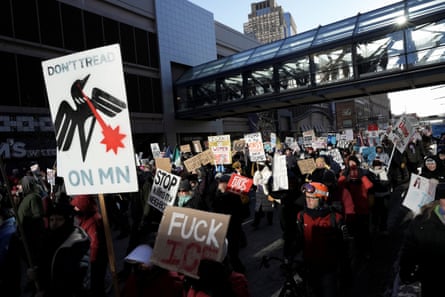
Local organizations including the Minnesota AFL-CIO union and the multi-faith coalition Isaiah have also pulled off an economic blackout and large rally in subzero temperatures on 23 January, attracting supporters across the country who joined in calling out of work and not spending money. A survey of nearly 2,000 likely voters by Blue Rose Research commissioned by groups involved in the rally found 23% of people surveyed had participated in the protest in some way, either through not shopping, working, going to school or closing their businesses.
After the 23 January action, Communities Organizing Latine Power and Action, a non-profit that’s worked for months to protect people from ICE, said: “Despite the fear, Minnesotans are united. More than 50,000 Minnesotans took action to say: ‘Our families are not safe with ICE here.’”
On 30 January, a second day of action saw businesses close or donate proceeds in Minnesota and beyond, and protests in places around the country, including in Minneapolis.
Christa Sarrack, president of Unite Here Local 17, said the city is home to progressive unions that have been working collectively since 2018, making this moment a natural time to work together. The local represents about 6,000 hospitality workers. Just at the airport, 16 union members have been detained by immigration agents, despite legal work permits and extensive vetting to be able to work inside the airport terminals, Sarrack said. About 200 of its members are receiving mutual aid and food donations from the union.
“This is probably the easiest organizing we’ve ever been able to do,” she said. “I think it is because people just want to reach out and they want to do something so that they can feel like they’re actually being a part of a solution to this.”
Minnesota consistently ranks among the highest levels of voter turnout. A concept known as “Minnesota nice”, which can be both a blessing and an insult, governs the social order. The Atlantic referred to the resistance here as “neighborism”, an apt term for people who routinely say their defense came down to keeping their neighbors safe. They bring up the social contract that comes with heavy snow: if your neighbor is stuck in a snowbank, you’re going to shovel them out, regardless of whether you like each other, because it’s the right thing to do.
“And now we’re in this moment of, we’re pushing everyone’s cars out at once, and we’ll keep doing it, and more people will keep joining in this fight,” said Dylan Alverson, the owner of Modern Times, who switched to a free or donation-based business he’s calling the “Post Modern Times” to deprive the government of any taxable income until the federal surge is over.
These are not neighbors in theory; at this point, most know someone who has been taken by ICE, either directly or in their school or work networks, or people who have been detained for protesting or observing, or businesses they frequent that can’t safely open their doors, or families that haven’t left their homes in weeks. The onslaught of 3,000 agents in a smaller city means everyone has felt it.
“We are still a state where you can run to your neighbors’ for a cup of sugar, and we carry jumper cables in our trunks, so on cold winter days we will help start each other’s cars,” said Sarah Moberg, CEO of Second Harvest Heartland, a large food bank based here. “And so if you think about the depth and the importance of those personal relationships, we’re not going to let each other go hungry.”
At Second Harvest Heartland, a couple dozen volunteers lined up along a makeshift assembly line on Tuesday morning to fill boxes with shelf-stable foods – rice, beans, proteins, spices and noodles – that will go out to thousands of homes across the metro area. Food shelves have reported lower than normal numbers, but not because people aren’t hungry. They’re not comfortable leaving their homes in case agents are following. Hunger is often a hidden problem, Moberg said. “It’s just gotten even more hidden because of the fear that ICE is imparting on the community.”
Mutual aid networks have gone into overdrive to feed the community, metro-wide. Restaurants and small businesses have become makeshift storage sites for donations. Churches have distributed thousands of pounds of food to their members.
Kimball, the food writer, worked with local business Moona Moono to move 3,000lbs of food in two and a half days – a carload every 15 minutes – until she was diagnosed with breast cancer and had to take herself out of direct action. She started sharing GoFundMe campaigns that had stalled out from locals seeking rent assistance before the first of the month. Her followers have raised tens of thousands of dollars . She searched for phrases in Spanish about rent and mortgage payments so often that her GoFundMe now defaults to that language.
“We really are talking about everyday people giving what they can,” she said. “In flashpoint moments, people reprioritize their own spending. And so we might see someone be like, ‘Hey, instead of going out to eat this week or getting a coffee, I’m going to spend whatever that dollar amount is for me on mutual aid.’”
At Whipple, the federal building where ICE has set up shop, Natalie Ehret sits in a minivan, a near-constant presence with her newly started group, Haven Watch, for the last few weeks, ready to give a coat, a phone and a friendly face to those released from detention, which includes protesters and immigrants.
She and her sons had gone to the building, and her son found two people outside in the cold without coats after being released. She had printed out know-your-rights cards to bring with them, but she’d thrown them all away – the rules seemed to be out the window. Now when someone is released, a volunteer with Haven Watch wearing a brightly colored vest will meet them at the gate, take them to a warm vehicle, talk to them about what they went through and give them what they need to get back home.
There’s often a language barrier, but women will collapse into her regardless. She has seen children released. Her husband, who also volunteers with the group, told her he helped a two- and a six-year-old who were with their mom in recent days. She estimates she’s helped dozens of people in the last two weeks.
“It’s nearly impossible to not walk away changed from those stories,” she said. “And I don’t think you should. I think you should be changed hearing a story like we hear.”
Among those who’ve been compelled to head outside to protest at Whipple over the past week, despite the icy winds and freezing temperatures often below 0F, was Lori Gesch, a proud “Granny against ICE”. She had written the phase, in marker, across the back of her mint-green puffer coat. “Because I am a granny,” she said. “And if they want to take me down – go for it. But I just wanted to show them I’m not afraid.”
A woman named Esther came from Florida because she was sick of sitting at home crying while watching what was happening in Minnesota. She used vacation time to come sit in the cold, joining protests at Whipple daily to lend her voice. Her area has seen immigration raids, but nothing like those in Minnesota.
“It is not even close to what this city is being used for,” she said. “This city is literally being slaughtered for political sport.”
The surge of agents in Twin Cities have now sprawled across the region. And even resident’s in these communities – more politically mixed than the progressive urban enclaves – are not staying silent.
Nicole Helget, who lives in Nicollet county, a rural region in southern Minnesota, spoke directly to agents parked outside a community in her area, asking them whom they had a warrant for and how she could help them find that person, essentially calling their bluff that there was no warrant or specific target.
In her area, Somali and Latino neighbors have been a part of the community fabric for generations, and the area’s workforce is dependent on them. Most of the leadership in responding to ICE has come from inside communities being targeted, she said. “They just can’t be out front because they’re vulnerable.”
“The bravest people are in the communities of color,” Helget said. “They’re doing organizing. They’re doing the leadership. They’re the ones working the hardest jobs. We love them. We need them. We want them here.”
Cory, the observer who felt no choice but to get involved, hopes that the engagement and attention don’t shift, that people locally and nationally don’t quickly move on. He doesn’t want more people to have to die for people to continue to care. He plans to keep documenting until he hears from people who feel unsafe now that they’re ready to leave their homes again.
“I don’t think we can take our foot off the gas until we know our neighbors are safe,” Cory said, and that will be dictated by those most affected by the deportation scheme. “When do my Latino and Somali neighbors feel free to live their lives again? When can [the largely Somali] Karmel Mall be full? When can all these restaurants that have to close open again because people can go back to living their normal life?”