3 months ago
177
3 months ago
177
When the snow comes, the car parks fill. Word spreads quickly, a good week, a belter of snow, and by mid-morning the access roads are tight with hatchbacks, hire skis and cautious optimism. In Scotland, the difference between a strong season and a poor one can be a weather front drifting 10 miles too far north. A thaw, a gust, a band of rain, and everything changes.
The project was partly inspired by the approach of the Milano Cortina Winter Olympics and the idea of what they might look like if staged in Scotland. It was not about shiny podiums, more an exercise in imagining how weather, people and place might shape a very different kind of Games.
-
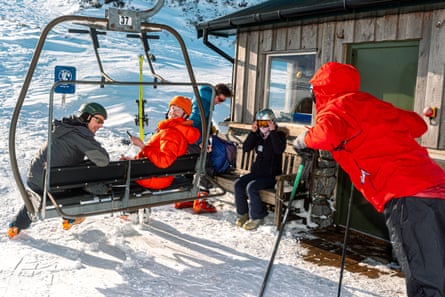
Cold air, small talk, a few quiet minutes before the ride, Glencoe.
Clear skies are rare, though over the seven days spent shooting in Scotland’s ski resorts, I had two clear, blue-sky days. Flat light is common. The cold on the mountains can be bracing, but it toughens you up. Sleeping in the camper van at the base was challenging. Blizzards one night. Conditions can turn within minutes, and good days are shortlived.
Skiing is only part of it now. Visitor numbers often swell beyond those clipping into bindings.
During the Covid lockdowns, some of the best snow in years lay untouched. Blue skies, empty slopes, and no one allowed to use them. Frustration hung in the air, a season that looked perfect but remained out of reach.
-
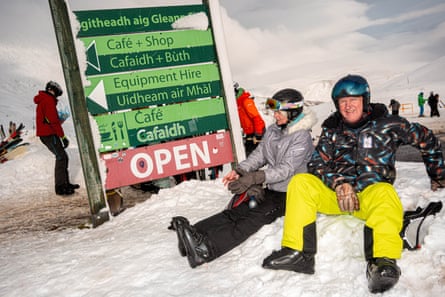
Lunch break at altitude in Glenshee. Gloves off, helmets on, cafe open – the Scottish Alps, briefly.
There is no glamour here, no polished Alpine certainty. There are tired legs and small private victories. The cafe becomes a checkpoint. The queue is its own discipline. Infrastructure strains under a good weekend. Car parks max out. Weather warnings flash. And still, when the snow falls they come back.
-
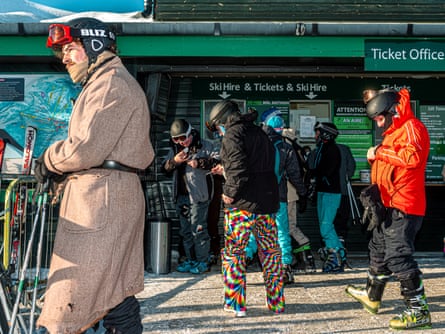
Under the green signage of tickets and hire, skiers assemble in mismatched armour, Glenshee.
The project came together in a practical way, just after the camper van passed its MOT and was pointed northwards towards the hills as the Games began. It is self-built for life on the road, for me and my dog Flash, an Irish setter x poodle co-lab, already huge at 10 months. This became our first project together. The van-build and learning to live in it came first; the pictures followed, shooting for seven days shaped by weather, movement and the slow rhythm of winter travel.
-
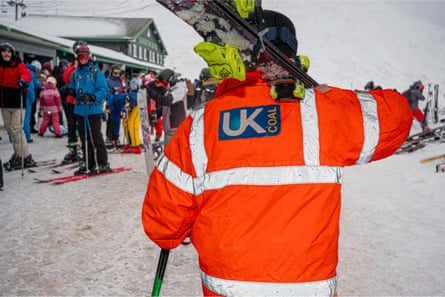
A hi-vis relic from a forgotten industry.
The Glenshee snowsports centre is Scotland’s largest ski area, spread across the wide high-level Cairnwell pass, between Deeside and Perthshire. Base altitude 650 metres (2,130ft). Top altitude 1,060 metres.
Gaelic – Gàidhlig – once flowed across much of Scotland, the everyday tongue of the Highlands and Islands before history pushed it to the margins. After Culloden the culture thinned, and the language with it, yet the words never vanished – they linger in placenames, in voices, in the grain of the land. Today only a small minority speak it fluently, but the language still breathes, carried in the hills, the weather, the memory of the country itself.
The modern signs are deliberate. The Scottish government’s Gaelic Language Act gave the language official recognition and “equal respect” with English, not because everyone speaks it, but because it belongs, reminding travellers they are moving through a land older than the motorway.
-
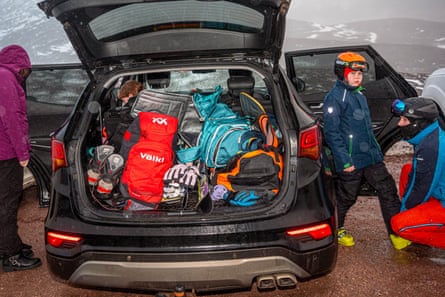
Car park choreography, doors flung, steam breath, the mountain waiting. Parents bent into the logistics of winter.
-
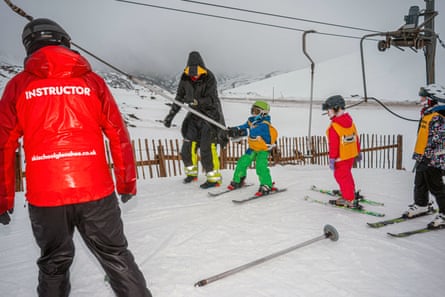
Glenshee, known for its broad, gentle slopes and long runs that attract a high number of beginners and families. On busy days the mountain fills with learners finding their balance.
Scotland is teaching patience one metre at a time. Four weathers in one day. They say if you can ski in Scotland, you can ski anywhere.
I served in the Argyll and Sutherland Highlanders. We learned to ski on a course called Exercise Snow Queen, run in Bavaria as part of winter training. We were issued skis, were taught the basics and sent on to the slopes. Because it was officially classed as an exercise, food and accommodation were covered, so we received our R&R allowance back. After leaving the army, I studied outdoor pursuits as part of a sports degree, training as a ski leader and in running and managing outdoor education centres. This can go anywhere.
-
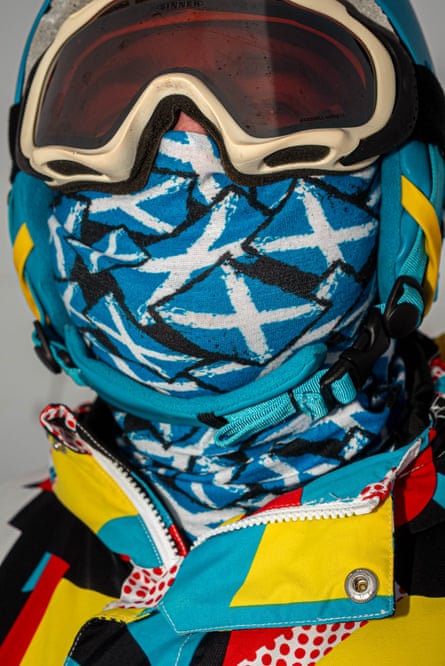
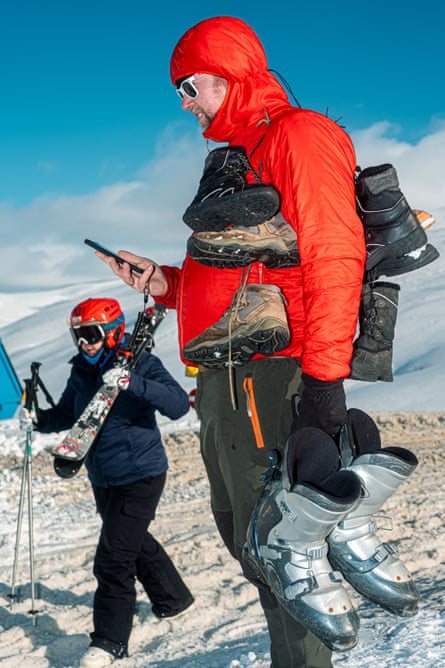
Warrior of the slope in Cairngorm. Saltire wrapped tight, worn like armour against the cold. Hiking boots slung like trophies. Winter filtered through 5G in Glenshee.
The Cairngorm mountain, above Aviemore, in the central Highlands, sits within Britain’s largest national park. It is known for its high, exposed plateau, sudden whiteouts, flat light and some of the coldest conditions in the UK.
-
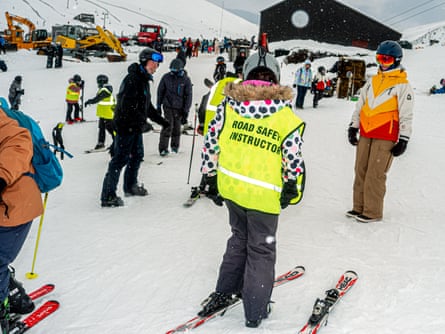
Hi-vis logic transplanted to snow in Glenshee.
The Cairngorm ski area sits in a sub-arctic environment where weather changes fast and visibility can disappear within minutes. Base altitude 635 metres. Top altitude 1,245 metres.
-
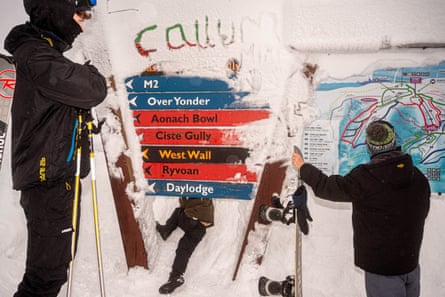
Scottish-style, half signage, half guesswork. The mountain offers options while a child disappears headfirst into drift.
-
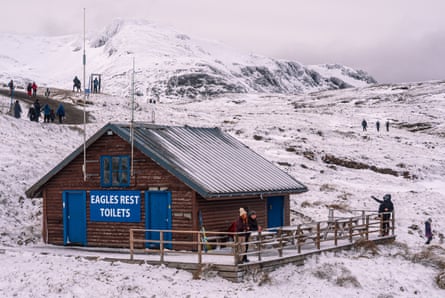
Glencoe in the west Highlands, set among steep volcanic terrain near Rannoch Moor.
Glencoe, in the west Highlands, set among steep volcanic terrain near Rannoch Moor, a glen of glacial origins that cuts though volcanic rocks. Known for narrow access, strong winds and raw, exposed slopes, it is often regarded as Scotland’s most elemental and weather-driven ski area. Shifting light and fast-moving. Base altitude 300 metres. Top altitude 1,108 metres.
Often seen as Scotland’s most striking ski setting, it is raw, exposed and elemental – though each of the country’s resorts holds its own quiet beauty in a different way. Spent many a night here in my camper. Magical.
-
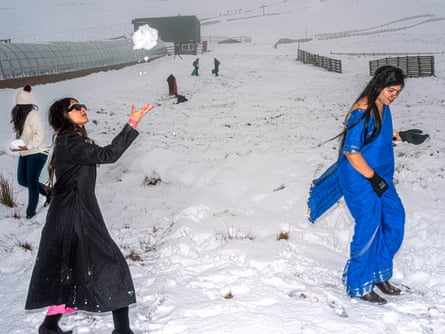
Tourists at the Nevis Range resort, near Fort William, Lochabe.
Nevis Range is on the slopes of Aonach Mòr, near Fort William, in the west Highlands, with Ben Nevis rising nearby. Influenced by Atlantic weather systems bringing cloud, wind and rapid changes in conditions. The gondola rises from forest to open mountain, giving access to high, often harsh terrain. Base altitude 100m. Top ski altitude 1,220 metres. Gondola top station 650 metres.
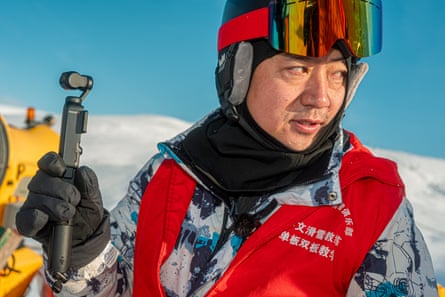
Snow tourism has grown steadily in recent years, with visitors from warmer countries such as India and China travelling north specifically to experience snow for the first time. Resorts now cater for organised coach trips, families arriving for photographs, sledging and short mountain visits rather than skiing itself. I spoke to a woman in a sari who told me she had come from Bengaluru. It was her first time seeing snow. She was not here to ski, but to experience winter itself. Cold, unfamiliar, quietly absorbing a landscape entirely new to her.
-
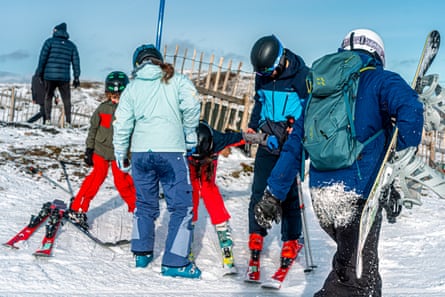
Adults reorganise the moment. Balance negotiated, learned by falling. Glenshee.
-
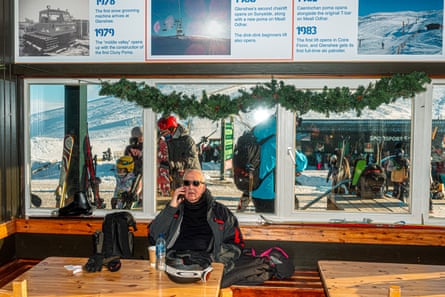
Between runs and reception a man phones the outside world from altitude in Glenshee.
-
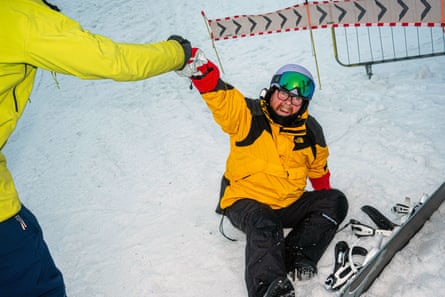
Gravity wins early, a small collapse, fist bump a brief contract between effort and encouragement.
-
Across languages and weather. A global winter arriving on a Scottish hill. Device in hand, documentation and direction combined in Glenshee.
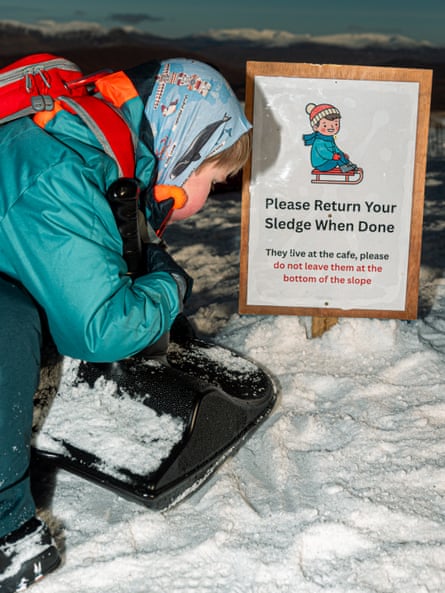
Two Olympic gold medals in the skeleton, and this is the grassroots version, laminated and leaning in snow. Olympic podiums built quietly, beginning with sledges that must be returned to the cafe. National success is measured in hundredths of a second; the development pathway begins at the top of the slope.
-
‘Please return your sledge’: infrastructure is reduced to a laminated request in Glencoe.
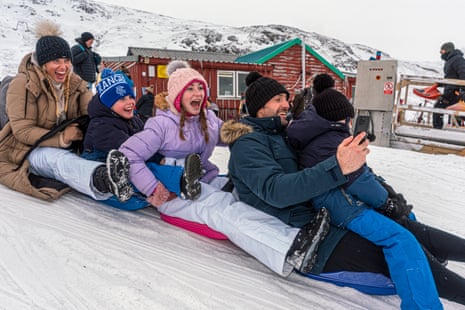
A hundred metres of machine-made snow and a magic carpet can carry as much expectation as a full mountain. Glencoe has a snow-making factory just for the sledging.
-
Almost the Winter Olympics. Five bodies, one trajectory, laughter cutting through cold air. Phones raised mid-descent, memory captured before momentum fades.
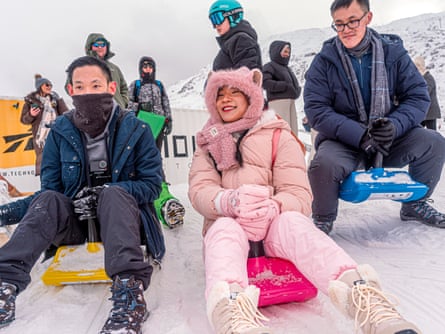
There is three times more sledging than skiing at Glencoe. Skiing is only part of it now. Visitor numbers often swell beyond those on skis. Glencoe resort recorded about 10,000 skiers in a season but more than 30,000 visitors coming simply to sledge. A hundred metres of machine-made snow and a magic carpet can carry as much expectation as a full mountain.
-
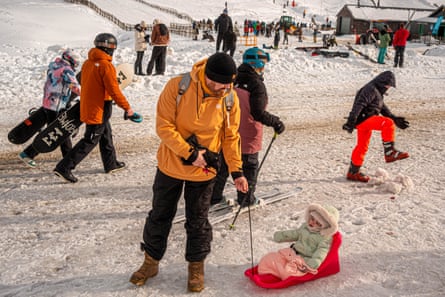
The national development programme begins in a red plastic sledge, Glenshee.
-
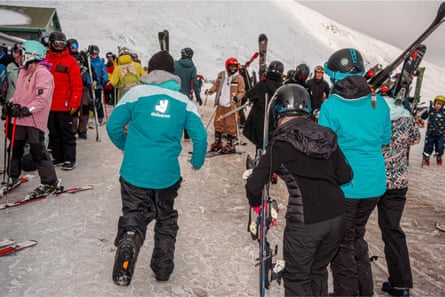
Gig economy meets altitude.
-
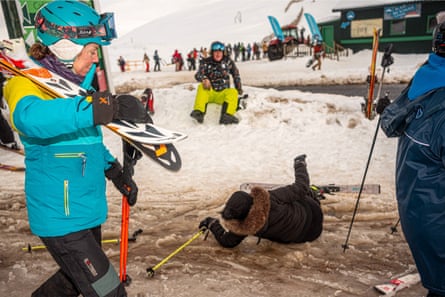
A fall in Glenshee.
Slush defeats confidence, a controlled slide becomes horizontal. Momentum negotiated at knee height. Recreation continues regardless.
-
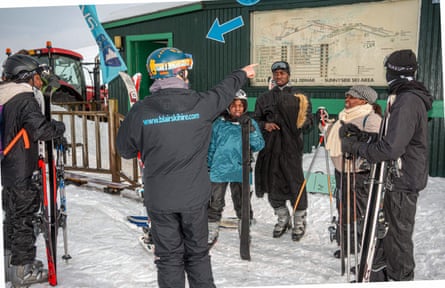
Route explained beneath a faded piste map.
-
Adults seated on plastic, waiting for gravity to begin the schedule in Glencoe.
-
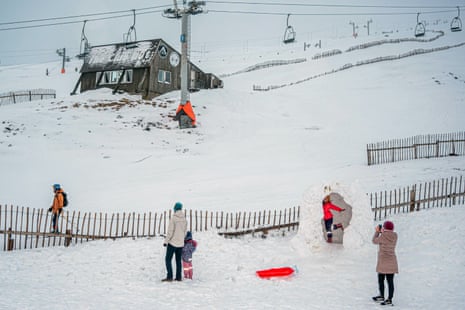
The Club Hut anchoring a slope patterned with cautious ambition.
-
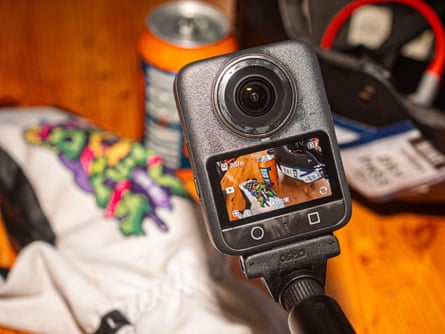
Irn-Bru, Scotland’s other national drink after whisky, consumed here as functional recovery.
Fluorescent orange, unofficial hangover protocol, widely trusted. Not medicinal, but treated as such across generations. Content captured at 1,108 metres “Made in Scotland from girders”, the slogan leaned into the country’s industrial mythology – strength, steel, survival, and a slightly absurd national joke that everyone understands.
-
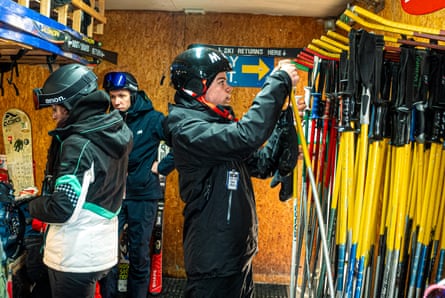
Poles at Glenshee snowsports centre.
The ritual is national: queue, fit, adjust, tighten, repeat. Generations pass through the same hut – first skis, first falls, first small victories.
-
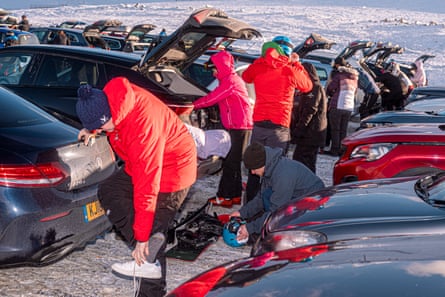
Boots off in a car park in Glenshee.
The day ends where it began, in a frozen car park. Temporary victories packed into the boot … boots loosened, engines start, heaters rise, winter left behind in tyre tracks and melting snow.