2 months ago
102
2 months ago
102
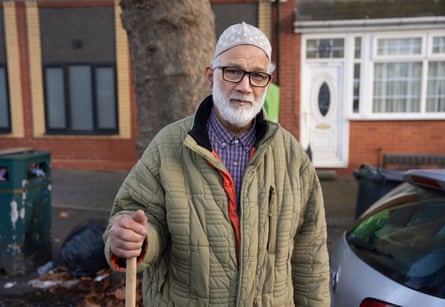
It’s an icy cold winter morning, and 80-year-old Mohammed Bashir is armed with a broom, tackling the large pile of rubbish that has accumulated outside his terraced house in Small Heath, Birmingham.
This has become an almost daily activity for Bashir since the city’s bin strike started 50 weeks ago and, like many in the city, he is starting to lose patience.
“Look at the condition we’re living in. I’ve lived here for 64 years, I came to this country at 16 – I’ve never seen it this bad. I’m sick,” he says. “I try my best. At the end of the day, I just want my area clean. That’s all I want.”
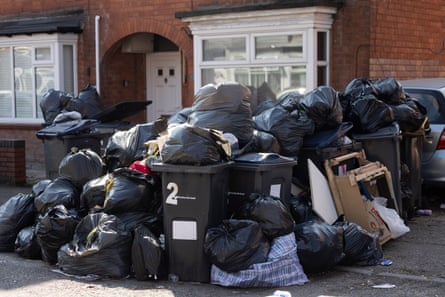
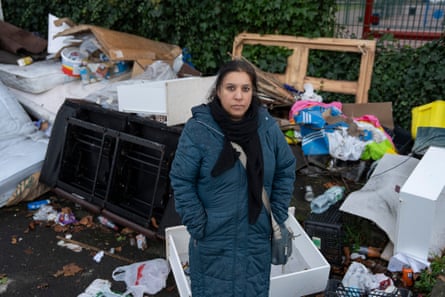
Piles of bin bags, broken glass and furniture have been dumped on the street outside his home and the mosque next door. Across the road, scorched pavement shows where a pile of rubbish was recently set on fire.
Bashir follows the council’s advice and tries to take much of his rubbish to the local tip, but residents have to book a slot online, and Bashir cannot read or write in English. “I want to do it but it’s hard for old people like myself. We need help. The city needs help. It’s gone on too long,” he says.
The bin strike in Birmingham hit headlines in March when the council declared a major incident due to 17,000 tonnes of rubbish that had built up on the streets and was attracting vermin.
Although the city council had used agency workers to cover the striking bin staff, people on the picket line were staging “go slow” protests that were preventing bin lorries from leaving the depot, causing the buildup of waste.
After the council secured a court injunction in May to stop this from happening, a degree of normality returned and national attention swiftly moved on – people outside the city thought the strike had long since finished.
But the people of Birmingham, which is home to more than one million, are still waiting for their normal bin collections to resume. With the workforce still striking, the council is relying on a smaller agency workforce which means collections are sporadic in some areas and there have been no recycling bin collections anywhere in the city since early January.
A December strike by the agency bin workers threatens to make things worse. Meanwhile, people have started to cram all their rubbish, including cardboard boxes, cans and bottles, into one general waste bin and they’re often overflowing by the time bin collection day comes round.
The effect has been felt most in the more deprived areas of the city where there is higher-density living such as houses in multiple occupation (HMOs) and large families squeezed into small homes – there are eight people, including Bashir’s children and grandchildren, living in his house. “How is one bin enough?” he says. “I can guarantee you that you can go into every house on this street and it is overcrowded with people. There are more than six people, seven people, eight people. One bin is not enough, is it?”
The result has been an increase in dumped bin bags and fly-tipping as people desperately try to get rid of their waste. Noor Ahmed, 57, said the bus stop outside her home has become a magnet for dumped rubbish, which she is forced to tackle while caring for her husband, who has cancer. “It’s a health and safety hazard, and there’s a very bad smell. I’ve had rats in my garden, even in my kitchen,” she says. “We have to go to the tip, but sometimes there are big queues. We started to organise groups to help older people who can’t take their own rubbish, we take it for them. We still pay our council tax and yet we do our bins like this. It’s exhausting.”

Robert Charlton, who runs his own pest control business in Birmingham, says it had been his busiest year since he first started working in the industry 11 years ago, and he has been gearing up for a hectic Christmas period. “It’s starting to pick up again because rodents are looking for food and shelter, so I’m getting more phone calls,” he says. “I’ve hardly had any days off, to be honest. At the peak, I was working from 8am to 8pm every day.”
He says most of his callouts were for mice and rats, as well as dead foxes who had been snooping around the piled-up bin bags, and he had to deal with some very distressed families. “Last month I was called to a house and we caught 23 rodents. It was crazy – the worst I have seen in my career,” he says. Have the rats actually been as big as cats, as has been much quoted in the press since the start of the strike? “I would say kittens, yeah, I do believe that,” he says.
One of the biggest impacts of the bin strike is the environmental toll. With recycling collections across the city paused for almost a year, more and more rubbish is heading into general waste, much of which ends up in an incinerator in the east of the city. Birmingham’s recycling rate has plummeted to 14%, substantially below the council’s target of 35% and the 44% average for England – of 90,667 tonnes of rubbish collected between July and September in Birmingham, just 12,471 tonnes was recycled.
“It is the biggest local authority in the country in population terms, so anything that happens in Birmingham affects 1.2 million people. And there is still no recycling collection,” says John Newson, from Birmingham Friends of the Earth. “Many people outside Birmingham, and even people inside Birmingham, can’t really believe that’s true and somehow think it’s over. But it is true, and that is a lot of stuff.”
He says there’s growing concern that people’s recycling habits could be permanently disrupted. “It’s not about blaming people – nobody in Birmingham asked for this to happen or has any real control over it,” says Newson. “There is a lot of confusion in people’s minds now, and the trust that was built up has gone – what do you want us to do with our rubbish, and what are you going to do with it? It has all gone backwards.”
Shafaq Hussain, a community leader and youth worker in Small Heath, says it would be particularly hard to reintroduce recycling in his area, where issues have persisted for some time. “It took a long time for us to do a lot of educating in the community about recycling, about the distinction between the two bins – but it has been almost a year now without that. So the environmental impact is very messy,” he says.
He has been leading community calls to end the strike, or to force central government to intervene and bring the striking workers and council back around the table, saying that the voice of residents had been lost over the course of the year. “People are just fed up – we’ve had maggots, we’ve had rats,” he says. “There are about 190 takeaways in a radius of about a half-mile here, which creates more bulk waste and we’re substantially overcrowded – there’s a lot of people in each household. We’re the ones left dealing with it but there’s no transparency – we have no idea what has gone on in those negotiations.”
On the picket line outside the bin lorry depot in Tyseley, the striking bin workers, have said they are more resolved than ever – having voted to continue their strike mandate to May 2026, when Labour will be vying to keep control of the council in local elections. They want to guarantee pay protection for the rest of the bin workers and the council to reverse its decision to scrap the waste and recycling collection officer role.
Scrapping the role would not only cut costs but the council also argues that the position is an equal-pay liability risk, with no equivalent paying role in the female-dominated workforce such as cleaning staff and school-meal supervisors. The council has lost millions of pounds in equal-pay claims in recent years – it is one of the main reasons it went “bankrupt”. However, the unions say they have consulted lawyers who say the role is not an equal-pay liability risk.
“We’re committed to see it through to the end,” says Matthew Reid, a bin lorry driver and Unite convener. “We can’t go through 11 months of what we’ve been through, and put the city through, to get no results at the end of it.” The striking workers are receiving £70 a day from the Unite strike fund, which is a significant pay cut, although Reid says this is what they would be paid under the council’s plan.
“There’s a feeling here of determination, people are willing to take that hit because they can’t accept an £8,000 [annual pay] loss,” he says. “But it has been a rollercoaster. We’ve never been on strike for this long before, and there’s financial strain – people not being able to afford mortgages and rent, family strain. We just have to stand with one other.”

Some of Basmin Khan’s videos, showing the huge piles of rubbish dumped on her street in Small Heath, have gone viral on social media – a mound of mattresses, broken furniture, cardboard boxes and plastic bottles sits at the end of her road, right next to a school playground.
The 47-year-old says the strike has “emboldened” fly-tippers, and vans have appeared in the middle of the night to drop off rubbish, with little consequence. Some of her neighbours say they have paid money to have their rubbish taken away, only to find it dumped on a street corner less than a mile away. “I don’t think the council know how to control it any more,” she says. “I can’t blame the council completely and I’m not going to, but we are stuck because we just want them to see what we’re experiencing and give us something to help tackle the problem.”
Her videos have attracted a toxic rhetoric directed at deprived areas with large BAME populations, she says. “Import the third world, and you get the third world” is one of many comments that frequently appear under her clips.
“We know that there is a problem, absolutely. But we also know we are under-resourced, there’s a huge lack of investment,” she says. “It gives us a really bad reputation to say we’re all like this – to suggest we all want to live in a dirty place. We don’t. That’s not how we want to live at all. It was never like this when I moved here.”
She has launched a petition to get the council to install more security cameras to clamp down on fly-tipping, and push to end the strike that has dragged on for so long. “Nobody should ever think this is normal,” she says. “We are the UK’s second city. It’s a disgrace. Everyone says we’re bankrupt or we’re poor. For goodness sake, the UK is in the G7. We should have enough money to be able to keep our streets clean.”