3 months ago
105
3 months ago
105
“What’s the earliest an uninjured goalkeeper has been substituted?” asks Sam Roberts.
Unless you’ve been at a digital retreat in the Kerguelen Islands for the past eight days, you’ll know the context of this question. With Spurs 3-0 down at Atlético Madrid last week, their goalkeeper Antonin Kinsky, who was at fault for two of the goals, was substituted after only 17 minutes.
It’s rare for a goalkeeper who isn’t injured – wounded pride doesn’t count – to be taken off in the first half of a game, never mind the first quarter. We had a similar question way back in 2006, when the answers included Jens Lehmann during Milan’s Scudetto-winning 1998-99 campaign.
There have been more examples in the last 20 years so it’s well worth giving this question a fresh coat of paint. Especially as, last time round, we missed a peculiar story from the Southern League in February 1984. With Cambridge City 4-0 down at home to Ashford after 25 minutes, and their teenage goalkeeper Nigel Ashman presumably having a suboptimal day at the office, Cambridge manager Bill Leivers decided to put the midfielder Trevor Williams in goal.
“I had to do something,” said Leivers. “I was worried they might get 20. I took the goalkeeper off for his own good as much as anything. He was definitely responsible for two of the goals but I would question the attitude of some of the players in front of him.”
Leivers’ decision was so nearly a heartless work of staggering genius: Cambridge fought back and eventually lost the game 4-3. Ashman left the club a few days later – “I shall probably be down on the golf course on Saturday” – but later managed the club’s reserve side between 2015 and 2017.
Swindon’s Wes Foderingham suffered a similar fate when his side were beaten 4-1 by Preston in September 2012. Unlike Kinsky, he wasn’t hooked straight after a goal. Swindon went 2-0 down inside 10 minutes, with Foderingham at fault for the opening goal. Then, in the 21st minute, their manager Paolo Di Canio replaced him with Leigh Bedwell.
Foderingham belted a water bottle and walked straight down the tunnel. After the game, Di Canio laid into him:
He was one of the worst players I have ever seen. He’s another player like the others, why can’t we change the goalkeeper? Because the goalkeeper has a different coloured shirt?
Out there he behaved as the worst professional, arrogant, ignorant athlete I have ever seen.
Foderingham apologised to Di Canio for his reaction and was soon back in the team. He and Ashman lasted a bit longer than Kinsky, who was taken off after 17 minutes. With the exception of rule-bending substitutions, more of which in a moment, that remains the earliest example in our inbox. (The 2006 article linked above said that Peru’s José Acasuzo was hooked after 13 minutes against Chile in a Mexico ‘86 playoff, but various sources suggest it was after 24 minutes.)
And so to goalkeepers who were substituted early doors – almost before the doors had opened – to circumvent the rules. Our own Will Unwin reminds us that, in the Checkatrade Trophy of 2016-17, Bradford hooked Colin Doyle after three minutes to get round a rule that required teams to field five “first-team players”. Bradford won 2-1 and their assistant manager Kenny Black joked that Doyle “had a poor 45 seconds”.
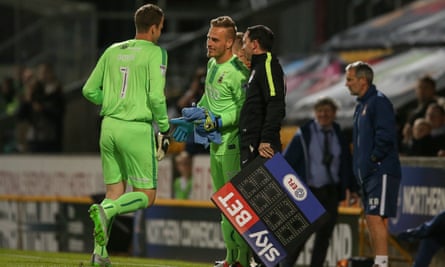
Three minutes? Try three seconds. “In 2014, Stabæk’s first choice goalkeeper, Mande Sayouba, was at the World Cup with Côte d’Ivoire,” writes Bjorn Barang. “Back-up goalkeeper Borger Thomas was sent off and suspended, so for their next match they brought Espen Isaksen (35 years old and now goalkeeper coach for the women’s national team), out of retirement on an amateur contract.
“The Norwegian Football Federation won’t allow amateurs to start, but they can be used as substitutes. Hence, against Start, midfielder Eirik Haugstad began in goal. The ball went out of play after three seconds, courtesy of Start, allowing Stabæk to put Isaksen on for Haugstad. They even had a goalkeeper shirt printed for Haugstad, with his name and regular squad number on!”
A nice try, but Stabæk still lost 2-1.
Here’s a list of some of the uninjured goalkeepers who have been substituted in the first half.
-
39 minutes James Nanor, Nigeria 3-0 Ghana, World Cup qualifier, 2001
Nanor’s replacement Ossei Boateng was sent off two minutes later, meaning Ghana played the rest of the game with an outfield player, the captain Emmanuel Osei Kuffour, in goal -
36 min Yohan Pelé, Lyon 8-1 Le Mans, Ligue 1, 2005-06
-
25 min Nigel Ashman, Cambridge City 3-4 Ashford, Southern League Southern Division, 1983-84
-
27 min Jens Lehmann, Cagliari 1-0 Milan, Serie A, 1998-99
-
24 min José Acasuzo, Chile 4-2 Peru, World Cup playoff, 1985-86
-
21 min Wes Foderingham, Preston 4-1 Swindon, League One, 2012-13
-
21 min Muamba Kazadi, Yugoslavia 9-0 Zaire, World Cup Group B, 1974
-
17 min Antonin Kinsky, Atlético Madrid 5-2 Tottenham Hotspur, Champions League last 16, 2025-26
-
3 min Colin Doyle, Bradford 2-1 Bury, EFL Trophy, 2016-17
-
3 seconds Eirik Haugstad, Stabæk 1-2 IK Start, Norwegian Tippeligaen, 2014
In the unlikely event that anyone can beat a goalkeeper being substituted after three seconds – or if you have any examples from women’s football – please drop us a line.
Weekday warriors
“By the end of March, Manchester United will have played 11 of their 31 Premier League fixtures on weekdays,” notes Tom Solan. “Which team has played the most league fixtures in a season on a weekday?”
An excellent and, for those of a certain age, evocative answer here from Michael Haughey. “When it comes to playing on weekdays – not Saturdays, Sundays and bank holidays – surely Tranmere Rovers must hold the record from when they played home games on Friday night or Monday night to avoid clashing with the two teams on the other side of the Mersey,” writes Michael. “Selecting the 1975-76 season as a random example, they played 20 home games on weekday nights plus seven away games.”
More snubbed hat-trick heroes
A couple of weeks ago we had a question about hat-trick heroes who were not awarded player of the match. You wrote in with some more cases.
“There is also the example of Ian Moores, who isn’t fondly remembered at Spurs in the 1970s (eight goals in 32 matches), and managed to hit the only hat-trick of his Tottenham career the day Colin Lee made his debut and scored four – yes the 9-0 demolition of Bristol Rovers,” says John Tumbridge. “He ended up being photographed with the ball from a match against Oldham, a game Spurs won 5-1 and in which Moores didn’t even play!”

Hsien Min highlights that Phil Foden scored a hat-trick when Manchester City tharashed Manchester United 6-3 in October 2022, but so did Erling Haaland and he was the player of the match. And, as Paul Fields points out, perhaps the most famous example came when Stan Mortensen scored a hat-trick when Blackpool beat Bolton 4-3 in the 1953 FA Cup final. There was no official player of the match award back then, but the game went down in folklore as the Matthews Final.
Knowledge archive
“When was the last season (if indeed there ever has been one) that all the clubs in the English top division finished the season with the same manager they had at the start?” wondered Tom Shaw in 2011.
The Knowledge turned to Twitter [those were the days – Knowledge Ed] in search of an answer for this one, and after sterling work from @ChristopherHarv and @STV_Andy, shadowy and intimidating stats robot @OptaJoe’s eyes started flashing, his cogs started whirring, and from within his metallic depths out chugged the answer – 1965-66. In each of the 45 seasons since, someone has lost their job in the top flight.
Perhaps imbued with pre-World Cup bonhomie Blackburn stuck with “Jolly Jack” Marshall despite barrelling headlong towards relegation, ending bottom with the lowest points tally in 19 years (though he was sacked midway through the following season – “This post at Ewood Park has been likened more than once to what the Americans call a ‘hot seat’,” reported the Guardian at the time). Dave Bowen, who was also moonlighting as the Wales manager, survived at Blackburn’s fellow relegates Northampton.
Fulham, despite a relegation-threatened season, stuck with Vic Buckingham; Ian McColl, appointed during the summer of 1965, survived at Sunderland who finished 19th; Nottingham Forest stayed up by three points and kept faith with the softly-softly approach of Johnny Carey (“Some of their tackling, while never vicious, lacked the finesse and complete inoffensiveness of a team managed by Mr Carey,” wrote the Guardian after a mid-season 1-1 draw at Manchester City. “Forest, like so many clubs, have had to adapt their style to meet modern requirements, although Mr Carey would never instruct his men to ‘mix it’.”) Above Blackburn nine teams ended the season separated by four points – perhaps this was a rare – and final? – example of clubs choosing the devils they knew.
The detente didn’t last, however. Arsenal started the 1966-67 season with a new man in charge, Billy Wright having resigned in June.
Can you help?
“What’s the furthest a team has gone in Europe while being relegated in the same season?” wonders Matt Reilly.
“On Saturday, Luton won 2-1 at Wycombe Wanders. The Hatters’ victory meant that, since their first visit in 1996, they have won nine and drawn seven at Adams Park. Can any other team boast a longer record of having never lost away at another club?” asks Neil Rose.
“Before last weekend, Barnet had 10 games remaining in League Two – eight of them against the teams in the top and bottom four places,” writes Graham Steed. “Does this constitute any kind of record for a team having as much influence on promotion and relegation while still having not much to play for? (We could still make the playoffs, but let’s face it, it’s not going to happen.)”
“Max Dowman’s goal for Arsenal, aged 16, felt meaningful but has a 16-year-old ever scored an actual trophy-clinching goal? And if not, who is the youngest player to score a trophy-clinching goal?” asks George Jones.
-
Mail us with your questions and answers